Data and earnings focus

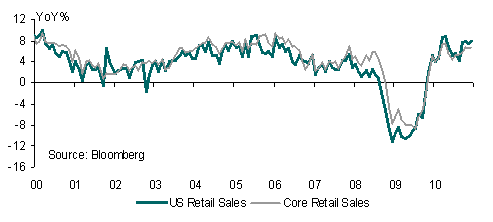
Friday’s round of US data were generally upbeat, highlighting that consumer spending is coming back to life. Inflation pressures however, remain benign at least on the core reading highlighting the Fed’s concern that inflation is running below the level consistent with its mandate. In other words it will be a long time, probably late into 2012 before policy rates increase.
While the Fed is no hurry to raise rates despite a few hawkish rumblings within the FOMC the European Central Bank (ECB) in contrast appears to have become more eager to pull the trigger for higher rates. ECB President Trichet’s hawkish press conference last week set the cat amongst the pigeons and marked a clear shift in ECB rhetoric towards a more hawkish stance.

A very big problem for the ECB is that the eurozone economy is not performing along the lines that its hawkish rhetoric would suggest, especially in the periphery. Growth momentum in the core in contrast, as likely reflected in the January ZEW investor confidence and IFO business confidence survey data this week in Germany, remains positive. Both surveys are likely to stabilize at healthy levels but how long can the likes of Germany drag along the eurozone periphery?

There will be relatively more attention on the meeting of Eurogroup/Ecofin officials, with focus on issues such as enlarging the size of the European Financial Stability Facility (EFSF) bailout fund and development of a “comprehensive plan” to contain the eurozone crisis. Don’t look for any conclusive agreements as this may have to wait until the European Union (EU) Council meeting on 4 February assuming (optimistically given ongoing German resistance) some agreement can even be reached.

Following the success (albeit at relatively high yields) of the eurozone debt auctions last week, sentiment for peripheral debt will face further tests this week in the form of debt sales in Spain, Belgium and Portugal.

The US Martin Luther King Jr. holiday will result in a quiet start to the week for markets but there will be plenty to chew on. This week’s key earnings reports include several banks scheduled to release Q4 earnings. Financials are a leading sector in the rally in equities at present and these earnings will be critical to determine whether the rally has legs.

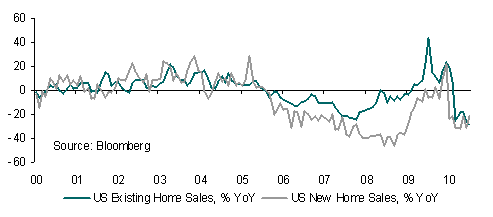
The US data slate includes January manufacturing surveys in the form of the Empire and Philly Fed, both of which are likely to post healthy gains whilst existing home sales are also likely to rise. This will not change the generally weak picture of the US housing market, with high inventories and elevated foreclosures characterizing conditions. As if to prove this, housing starts are set to drop in December. On the rates front, the Bank of Canada is likely to keep its policy rates on hold this week.
After coming under pressure last week much for the USD will depend on the eurozone’s travails to determine further direction. Concrete evidence of progress at the Ecofin may bolster the EUR further, with resistance seen around 1.3500 but don’t bank on it. The ability of eurozone officials to let down often lofty expectations should not be ignored. In any case following sharp gains last week progress over coming days for the EUR will be harder to achieve.
Temporary relief for US Dollar

Downbeat US economic news in the form of a widening US trade deficit, increase in jobless claims and bigger than expected increase in top line PPI inflation contrasted with upbeat earnings from Google. Google shares surged over 9% in after hours trading but US data tarnished the risk on mood of markets, leaving commodity prices and equities lower and the USD firmer. Higher US Treasury yields, especially in the longer end following a poor 30 year auction, helped the USD to push higher.

The USD’s trend is undoubtedly lower but profit taking may be the order of the day ahead of a speech by Fed Chairman Bernanke on monetary policy later today and the release of the highly anticipated US Treasury Report in which China may be named as a currency manipulator. A speech by the Minneapolis Fed’s Kocherlatoka (non voter) this morning sounded downbeat, even suggesting that “Fed asset purchases may have a muted effect”. Despite such comments the Fed appears likely to embark on QE2 at its 3 November meeting.

Today is also a key data for US data releases with September data on US retail sales, and CPI and October data on Michigan confidence and Empire manufacturing scheduled for release. Retail sales are likely to look reasonable, with headline sales expected to rise 0.5% and ex-autos sales expected up 0.4%. The gauges of both manufacturing and consumer confidence are also likely to show some recovery whilst inflation pressures will remain benign. Given the uncertainty about the magnitude of QE the Fed will undertake in November, the CPI data will have added importance.

The US trade will likely have resulted in an intensification of expectations that China will be labelled as a currency manipulator in the US Treasury report later today. The August trade deficit with China widened $28.04 billion, the largest on record. At the least it will give further ammunition to the US Congress who are spoiling for a fight ahead of mid-term congressional elections, whilst heightening tensions ahead of the November G20 meeting.

Indeed currency frictions continue to increase although “currency war” seems to be an extreme label for it. Nonetheless, Singapore’s move yesterday to widen the SGD band highlighted the pressure that many central banks in the region are coming under to combat local currency strength. Singapore’s move may be a monetary tightening but it is also a tacit recognition of the costs of intervening to weaken or at least limit the strength of currencies in the region. To have maintained the previous band would have required ongoing and aggressive FX intervention which has its own costs in terms of sterilization.

This problem will remain as long as the USD remains weak and this in turn will depend on US QE policy and bond yields. A lot of negativity is priced into the USD and market positioning has become quite extreme suggesting that it will not all be a downhill bet for the currency. Many currencies breached or came close to testing key psychological and technical levels yesterday, with EUR/USD breaching 1.4000, GBP/USD breaking 1.6000, USD/CAD breaking below parity and AUD/USD coming close to testing parity. Some reversal is likely today, but any relief for the USD is likely to prove temporary.

Quantitative easing and the USD

US earnings are coming in ahead of expectations, with Q2 income at the 42 S&P 500 companies reporting so far beating estimates by 11% whilst revenues are 3.3% ahead of forecasts, according to Bloomberg. The overall tone to equities looks positive helped by expectations of an agreement by BP to sell some of its assets and strong earnings reported by Apple after the close of US trade.

Market sentiment was also boosted by speculation that the Fed will embark on fresh monetary stimulus measures. Although there has been no indication that Fed Chairman Bernanke will announce such measures at his semi-annual testimony to the Senate today and to the House tomorrow, speculation of Fed action is rife and there is likely to be some questioning of Bernanke on the issue in the Q&A. If in any way quantitative easing is hinted at by Bernanke, it will act to undermine the USD.

US economic data is helping to compound expectations of further quantitative easing, with yet another weaker than forecast release in the form of a 5.0% drop in June housing starts as hinted at by the bigger than expected drop in homebuilders confidence on the previous day. Separately ABC consumer confidence declined more than expected in the week to July 18, its third consecutive weekly decline, supporting the evidence that consumer confidence is deteriorating once again.

In the absence of major data releases Bernanke’s testimony will be the main driver for markets but earnings from Coca-Cola and Morgan Stanley will also be of interest. Elsewhere the minutes of the Bank of England’s July MPC meeting will be under scrutiny. MPC member Sentance is expected to have voted for a rate hike at the meeting, but any sign that other members joined him, will give GBP a lift. Sentiment for European assets continues to improve, with Greece concluding a well received T-bill auction and Ireland auctioning EUR 1.5bn in 6 and 10-year bonds. Both were heavily oversubscribed although concerns over Hungary continue to linger.

There continue to be various leaks about the European bank stress tests. Banks are expected to detail three scenarios in the results including estimated Tier 1 capital ratios under a benchmark for 2011, an adverse scenario and finally, a “sovereign shock”, according to a document from the Committee of European banking Supervisors. Importantly and perhaps a factor that could hit the credibility of the tests, the sovereign shock scenario is said to not include a scenario of default on sovereign debt.

I continue to see downside risk for the EUR in the wake of the test results, with a “buy on rumour, sell on fact” reaction likely. EUR/USD is vulnerable to a short-term drop to technical support around 1.2763 but much depends on Bernanke’s speech today. Leaks, suggest that around 10-20 banks could fail the bank stress tests, with a total funding requirement in the region of EUR 70-90 billion. Confirmation will have to wait for the official release on Friday ahead of which most currencies are likely to remain range-bound.

For A Few Dollars More…

…or should I say a few EUR more.   This is what the Greek authorities must be wondering.  Once again Greek worries weighed on equities and risk appetite as a whole.  Although the saga is turning into one big yawn, markets have not had their fill with the bad news coming from this small eurozone economy.  Talks between Greek officials, International Monetary Fund (IMF), European Central Bank (ECB) and European Union (EU) began yesterday but are expected to go on for several days or weeks until a joint text is issued on May 15, just days ahead of a EUR 8.5 billion bond redemption by Greece. 

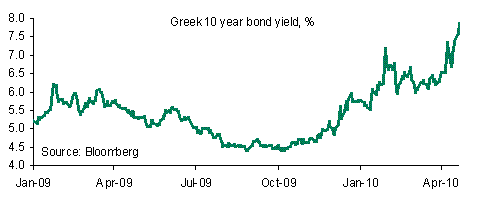
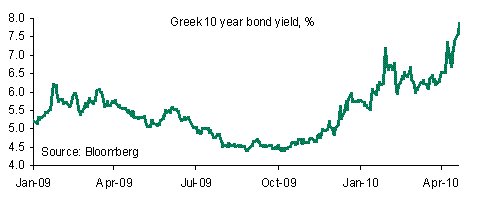
The talks have done nothing to prevent Greece’s bond yields moving higher, with the yield on 10-year bonds pushing well over 8% whilst the spread with Germany debt also blew out to over 500bps.  The main fear in the market is that Greece will ultimately end up restructuring its debt.  Moreover, contagion fears have dealt a blow to southern European sovereign CDS especially Portugal.  It wasn’t plain sailing for German bonds either, with yesterday’s auction of EUR 3 billion of 30-year Bunds failing to sell the full amount. 

Another casualty of ongoing Greece concerns is the EUR, with the currency under performing other majors and still on its path towards EUR/USD 1.3300 in the near term and onto 1.3150 after.   EUR also looks vulnerable on the crosses and EUR/GBP in particular is one to watch, with the 28 January low around 0.86029 likely to be targeted over the near term.  UK employment data gave some relief to GBP yesterday, with further direction coming from retail sales data today and the next televised leaders’ debate.  

At some point the market will become fatigued with consensus beating earnings and the positive impact on equities will become less marked.  This point is approaching but we’re not quite there yet.  Apple, Morgan Stanley and Boeing did not disappoint, with earnings easily beating forecasts.  Boeing’s earnings in particular helped industrials to be the best performing sector on the S&P 500 although the overall index closed marginally lower.

Earnings today include Amazon.com, American Express, Credit Suisse, Microsoft, Nokia, and PepsiCo.  It is becoming plainly obvious that market expectations for earnings are too pessimistic but as noted above the positive market impact of good earnings is likely to wane. 

On the data front, highlights include March existing home sales, jobless claims and Producer Price Index (PPI).   There will be less focus on PPI given that the Consumer Price Index (CPI) over the month has already been released whilst claims are likely to resume a path lower following the jump over the past couple of weeks.   Existing home sales are likely to post an impressive gain as indicated by firm pending home sales data.   

Overall, it appears that risk appetite is creeping back into the market psyche but the ongoing battle between positive earnings/data versus European/Greek woes suggests that there will be no clear direction for markets.  Improving risk appetite will ultimately win but current conditions will leave currencies trading within well worn ranges, with the exception of the underperforming EUR. In contrast the USD index is likely to remain supported, taking solace from positive data releases.

The Good, The Bad And The Ugly

GOOD: Positive earnings. The biggest earnings news of the day was from Goldman Sachs reporting that profits almost doubled in Q1. Apple also beat estimates and its shares surged. 82% of US earnings have beaten expectation so far. There is still a long way to go in the earnings season but the growth/earnings story is helping to maintain the positive bias to risk trades. There will be plenty of attention on earnings, including AT&T, eBay, Morgan Stanley, Starbucks, Boeing and Wells Fargo.

Data releases remain upbeat, with the April German ZEW investor confidence survey beating consensus, whilst central banks delivered hawkish messages across the board including the Reserve Bank of Australia policy meeting minutes, which pointed to another interest rate hike in May. However, the biggest impact came from the Bank of Canada which unsurprisingly left rates at 0.25%, but removed the conditional commitment to keep policy on hold until the end of Q2, leaving a rate hike on June 1 very likely.

The CAD jumped on the back of the outcome, with USD/CAD dropping below parity. I continue to like CAD alongside the AUD and NZD and believe they will be the star performers over the coming months despite lofty valuations.    Near term targets for CAD, AUD and NZD vs USD are 0.9953, 0.9407, and 0.7195, respectively. 

BAD: Talks between Greek officials and the IMF, ECB and EU on the conditions for a EUR 45 billion bailout loan will also be of interest although completion of talks could take weeks and in the meantime the situation is unlikely to improve, with Greece needing around EUR 10 billion to cover obligations by end May. Greek bond yields jumped to fresh record highs around 7.84% yesterday whilst the spread over German bunds also widened. Moreover, although Greece’s sale of EUR 1.95 billion in 13-week paper yesterday was heavily oversubscribed the, the yield was high at 3.65% which was far higher than the 1.67% yield at a similar sale in January.

In contrast to the likes of the CAD, AUD and NZD, the EUR is set to continue to suffer and as reflected in the widening in Greek bond spreads and high funding costs, Greek woes will keep plenty of pressure on the currency, with EUR/USD set to fall to support around 1.3300 in the short-term.

UGLY: UK regulator FSA will conduct a formal investigation of Goldman Sachs. The FSA will work closely with the US Securities and Exchange Commission SEC, which has accused the bank of Fraud though this has vehemently denied by Goldman Sachs. Although the negative market impact of the fraud case has been outweighed by good earnings and data the fallout is spreading. Some European politicians have even called for governments to stop working with the bank.