Shaking Off The Bad News

Markets managed to shake off the initial shock of the SEC’s fraud case against Goldman Sachs following news that the charge was not approved unanimously, but with a 3-2 vote. This was interpreted by some to imply that there was more of a political rather than economic bias behind the charge, with two Democrats voting for and two Republicans voting against and SEC Chairman Schapiro siding with the Democrats.

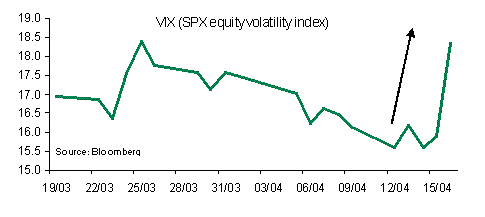
Stronger than forecast earnings from Citigroup and a bigger than expected 1.4% jump in US March leading indicators also helped to calm market nerves, with US equities closing higher and the VIX volatility index reversing some of its spike higher. Attention is still firmly fixed on earnings and with 121 S&P 500 companies due to release earnings this week including Apple, Goldman Sachs, Johnson & Johnson and Yahoo today.

Nonetheless, it is difficult to see sentiment improve too much against the background of ongoing worries about Greece as reflected in the renewed widening in Greek debt spreads yesterday. Moreover, the negative economic impact of the spread of volcanic ash from Iceland, and potential for more lawsuits related to CDOs from regulators as well as investors, against banks, will continue to act as a drag on market risk appetite.

Earnings have been positive so far into the season and as seen overnight, this is helping to counter market negatives, giving risk appetite some support. In turn, this will give risk currencies some relief but given the gyrations between positive and negative news it is difficult to see most currencies breaking out of recent ranges.

My overall bias is for positive earnings and data to overcome the negatives this week, leaving the likes of the AUD, NZD and CAD as well Asian currencies firmer. The EUR and GBP are likely to remain the weakest links, with both currencies set to retrace lower and EUR/USD finding plenty of sellers above 1.3500.
What To Watch This Week

Well so much for a “risk on” week. Market sentiment soured at the end of last week following The US Securities and Exchange Commission (SEC) civil action against Goldman Sachs, in which they accused the bank of fraud. The impact reverberated across markets and risk trades were pulled back as a consequence. Bulls shouldn’t be too downhearted though as the drop in risk trades followed several days of gains and part of the pullback could be attributed to profit taking.

Speculation of similar probes in Europe by financial regulators will cast a shadow over markets early this week. Nonetheless, direction will at least in part come from earnings. So far the run of earnings looks upbeat, with around 83% of the 48 S&P 500 companies reporting, beating analysts’ estimates. Overall profits are forecast to increase by around 30% from a year ago but are on track to easily beat this estimate. Bellwether names including IBM, Apple, Coca-Cola, Boeing, Microsoft, and AT&T report this week.

The meeting between Greek officials, ECB, IMF and EU has been delayed until Wednesday. There is little likelihood of Greece seeing any loan money soon as the need for parliamentary approval in some EU countries and upcoming regional elections in Germany on 9 May will put a spanner in the works. An issue of EUR 1.5bn of 3-month Greek debt tomorrow will act another test of market confidence but the recent widening in Greek debt spreads suggests a less positive reception than the previous sale.

There are also a few central bank meetings to contend with this week including Canada, Sweden, India, Philippines and Thailand. The only Bank likely to hike interest rates out of this bunch is the RBI in India with another hike expected, following closely on the heels of the March move. Canada and Sweden are unlikely to shift policy until at last after the end of Q2 whilst protests in Bangkok, Thailand, and the knock on impact on consumer confidence, have effectively sealed the case for no rate move there.

On the data front, attention will turn to US housing market activity. Markets will be able to gauge further clues to whether recovery in the housing market has stalled. An increase in both existing (Thu) and new home sales (Fri) in March is expected, which may allay some concerns although any improvement is likely to continue to fragile against the background of tight credit and high foreclosure levels.

In Europe, aside from the ongoing Greek sage, sentiment surveys will garner most attention, with the release of the German ZEW (Tue) and IFO (Fri) surveys as well as manufacturing and service sector purchasing managers indices (PMIs) across Europe. On the whole the surveys are likely to reveal some improvement as confidence.

Risk aversion will be slightly elevated at the beginning of this week but strong earnings and improving data will help to prevent too much damage. Consequently Risk currencies will start the week under pressure but any pullback will be limited. Given that speculative positioning in risk currencies such as the AUD, NZD and CAD is well above their three-month average according to the latest Commitment of Traders’ IMM data there will be some scope for profit taking. EUR speculative sentiment has seen some improvement but EUR/USD remains vulnerable to a further pull back to technical support around 1.3302 this week.

EUR under pressure

The EUR continues to struggle both due to the direct and indirect impact of Greece’s fiscal problems. The indirect impact was felt when the EUR dropped sharply following the release of the below consensus German ZEW survey, which dropped to 47.2 in January compared to consensus expectations of 50.0 and a reading of 50.4 in December. Investor sentiment as measured by the ZEW was dented by growing concerns about Greece outweighing any positive bias.

In terms of the direct impact on the EUR, concerns about the seriousness and/or ability of Greece to solve its problems are also weighing on the currency. The Ecofin meeting of European finance ministers this week inspired little confidence about the fate of the country. Officials noted that Greece would not receive help from its neighbours but said its problems are a concern for all of the eurozone. Officials urged Greece to take the necessary steps to reduce its burgeoning budget. In particular, officials called on Greece to detail “concrete” measures to achieve planned reforms.

The strength of the EUR was also discussed at the Ecofin meeting, with the EU’s Juncker stating that it should better represent European interests. The EUR is clearly overvalued and will act as yet another constraint to eurozone recovery so such concerns should be taken at face value but there is little that will likely be done about it. Intervention is certainly not much of a prospect at current levels. Greece’s problems may give some comfort on this front as it will likely keep the EUR under pressure but this benefit is small compared to the bigger cost that problems in Greece could have on the eurozone.

EUR/USD looks especially vulnerable below its 200-day moving average around 1.4298, the first time it has traded below the 200 day moving average since May 2009. Concerns about Greece will not go away quickly and will likely put further pressure on EUR/USD. EUR/USD 1.4250 will be an important level to watch and if a drop below this level is sustained on a closing basis a quick move towards 1.40 will beckon.

Going forward downside risks to the EUR may be limited by the general improvement in risk appetite as markets appear to be shaking off earnings disappointments, which in turn could put the USD under renewed pressure but for now the EUR will find it difficult to shake off the negativity surrounding the problems in Greece.

China tightens policy

Risk appetite has soured due to a combination of the rise in China’s reserve requirements, disappointing earnings including Alcoa and a profit warning by Chevron, setting the scene for a day in the red for Asian markets.  The turn in sentiment has hit commodities and commodity currencies particularly hard whilst the JPY has outperformed.  As would be expected against the background of higher risk aversion the US dollar made up some ground.

All eyes are on China and markets will now look to the implications for CNY policy.  Increasingly it seems that data and policy in China is driving global markets and aside from the hike in reserve requirements this was also evident in the fact that stronger trade data over the weekend helped to counter the impact of the soft US December payrolls report.  Further increases in the reserve ratio are likely over coming months followed by actual hikes in interest rates (likely the 1 year rate).  China’s move to tighten policy further over coming months will likely be accompanied by allowing greater appreciation of the CNY too.

The news worsened overnight as the ABC Consumer Confidence index dropped by 6 points to -47, the biggest one-week drop in the last 25 years.  US trade data also came in worse than expected, with the deficit widening to $36.4bn in November.  There is little on the data front today to keep markets occupied today, suggesting that direction will come from equity markets and with more earnings this week including Intel Corp and JPMorgan Chase & Co. there will be plenty to digest.  In the near term the tone of risk aversion is set to continue to dominate but any pull back in risk currencies is likely to prove short-lived.   

There will be more Fed speakers as well as the Fed’s Beige Book today to provide clues ahead of the January 26-27 FOMC meeting.   Aside from noting some improvements in the economy, weak labour market conditions as well as a lack of inflationary pressures will help support expectations that the Fed will hold off from raising interest rates this year.   Fed speakers include Fisher and Plosser both of whom give speeches on the US economy though neither are current voters on the FOMC.   Plosser’s comments so far have highlighted the need for a timely “exit strategy”.

Earnings in focus

The majority of US Q3 earnings have beaten market expectations resulting in a boost to risk appetite and further pressure on the US dollar. At the time of writing, 61 companies have reported earnings in the S&P 500 and an impressive 79% have beaten forecasts according to Thomson Reuters. This week there are plenty of earnings on tap and although a lot of positive news appears to be priced in the overall tone to risk appetite remains positive. This implies a weaker US dollar bias given the strong negative correlation between US equities and the USD index.

Aside from the plethora of earnings there are plenty of data releases on tap this week including housing data in the US in the form of building permits and starts as well as existing home sales. The data will likely maintain the message of housing market stabilisation and recovery in the US. There will also be plenty of Fed speakers this week and markets will once again scrutinize the speeches to determine the Fed’s exit strategy.

Highlights this week also include interest rate decisions in Canada and Sweden. Both the BoC and Riksbank to leave policy unchanged and expect a further improvement in the German IFO in October though at a more gradual pace than in recent months. There will be plenty of interest in the UK MPC minutes given conflicting comments from officials about extending quantitative easing. RBA minutes will be looked at for the opposite reason, to determine how quickly the Bank will raise interest rates again.

The USD index managed a slight rebound at the end of last week but is likely to remain under pressure unless earnings disappoint over coming days. US dollar Speculative sentiment became more bearish last week according to the CFTC IMM data, with dollar bloc currencies including the AUD, NZD and CAD benefiting the most in terms of an increase in speculative appetite. GBP short positions increased to a new record but the rally towards the end of last week may have seen some of these short positions being covered. Overall any recovery in the USD this week may just provide better levels to go short.