Losing Your Addiction

An interesting thing happened to me last week. On a business trip to Europe my blackberry broke and failed to work for the rest of the week. I felt like an addict coming off an addiction. The first couple of days were very tough; my usual instinct to constantly check for messages resulted in constant fidgeting and major withdrawal symptoms.

Once this had worn off I must admit I felt liberated. My addiction gone, it felt great to be weaned off my crackberry. The message here is that life goes on without access to mail. It’s an experience I would recommend to all users of such devices.

Back to reality and my view from Hong Kong this week is as follows. The risk-off tone as reflected in related to the turmoil in Libya and the increase in oil prices (as supply concerns intensify), may help to limit the pressure on the USD this week, but the overall tone is set to remain weak.

Much will depend on this week’s key US data releases and a testimony by Fed Chairman Bernanke to the US Senate, to determine whether the USD will find a more stable footing. Clearly the more hawkish tone of the European Central Bank (ECB) and Bank of England (BoE) in contrast to the lack of inclination by the Fed towards a tighter monetary policy stance could undermine the USD.

In this respect, it is doubtful that Bernanke will change his stance of the Fed failing to meet its dual mandate due to too low inflation. The main event is the February US jobs report at the tail end of the week. The consensus expectation of a 190k increase in payrolls will be finalised after gaining more clues from the US February ISM surveys and ADP jobs report earlier in the week. The week’s releases will likely reveal further improvements in US economic data, but given that this will do little to budge the Fed’s stance, the USD may be left somewhat underwhelmed.

The intensification in risk aversion over recent days has also been felt in the Eurozone periphery where bond market pressures have resumed. Nonetheless, the fallout on the EUR has been limited by hawkish ECB jawboning. Thursday’s ECB meeting will surely maintain this stance, and following the release of data on Tuesday likely to show a further increase in inflation in February, upside inflation risks are likely to be highlighted by ECB President Trichet in the press conference.

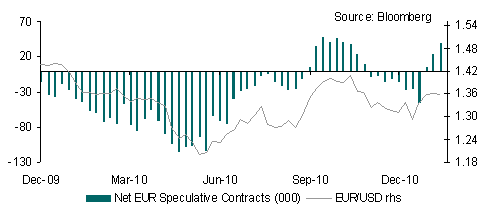
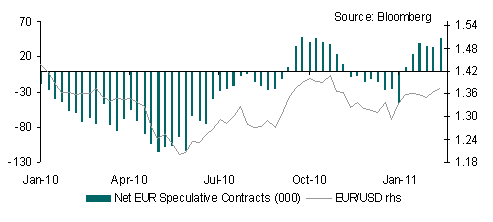
A likely pre-emptive strike from the ECB cannot be ruled out. Two rate hikes in H2 2011 are now likely even as the Bank maintains liquidity support for weaker peripherals. No change in policy but a hawkish press statement on Thursday will on the face of it play for a firmer EUR but i) the fact that the market has already discounted the possibility of early rate hikes and ii) the proximity of the US payrolls data on Friday and iii) uncertainty over the impact of the Irish election outcome in which the Fine Gael party won a clear victory, suggest that EUR risks are asymmetric. The net long positioning overhang also points to some downside risks to EUR.
There are plenty of other events and data on the calendar this week including Japan’s slate of month end releases, interest rate decisions by the Reserve Bank of Australia and Bank of Canada, UK PMI manufacturing survey data and Swedish Q4 GDP data.

The bottom line is that currencies will be driven by the conflicting influences of improving economic data on the one hand and elevated risk aversion on the other. The main beneficiaries of higher risk aversion will be the CHF and JPY though both have risen far whilst the USD will be restrained by a dovish Fed.

In contrast the EUR and GBP may yet extend gains but in both cases, markets have already shifted policy tightening expectations sharply over recent weeks and we suspect EUR/USD will be capped at resistance around 1.3860, whilst GBP/USD will similarly struggle to break its year high around 1.6279.
USD Pressured As Yields Dip

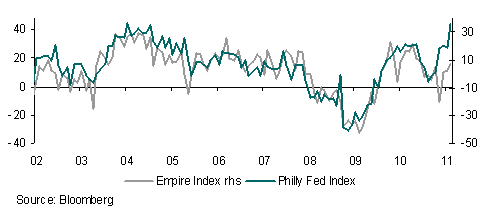
The USD came under pressure despite a higher than forecast reading for January US CPI and a strong jump in the February Philly Fed manufacturing survey. On the flip side, an increase in weekly jobless claims dented sentiment. The overnight rally in US Treasury yields was a factor likely weighing on the USD. The US calendar is light today leaving markets to focus on the G20 meeting and to ponder next week’s releases including durable goods orders, existing and new home sales.

The jump in the European Central Bank (ECB) marginal facility borrowing to EUR 15 billion, its highest since June 2009, provoked some jitters about potential problems in one or more eurozone banks. At a time when there are already plenty of nerves surrounding the fate of WestLB and news that Moody’s is reviewing another German bank for possible downgrade, this adds to an already nervous environment for the EUR.

Nonetheless, EUR/USD appears to be fighting off such concerns, with strong buying interest on dips around 1.3550. The G20 meeting under France’s presidency is unlikely to have any direct impact on the EUR or other currencies for that matter, with a G20 source stating that the usual statement about “excess volatility and disorderly movements in FX” will be omitted.

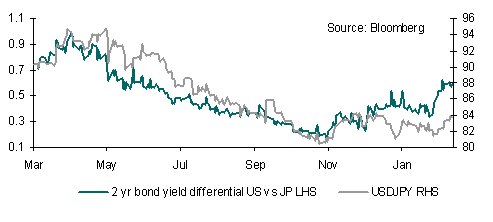
Although USD/JPY has been a highly sensitive currency pair to differentials between 2-year US and Japanese bonds (JGBs), this sensitivity has all but collapsed over recent weeks. USD/JPY failed to break the 84.00 level, coming close this week. There appears to be little scope to break the current range ahead of next week’s trade data and CPI.

Given the recent loss in momentum of Japan’s exports the data will be instructive on how damaging the strength of the JPY on the economy. In the near term, escalating tensions in the Middle East will likely keep the JPY supported, with support around USD/JPY 83.09 on the cards.

It seems that the jump in UK CPI this week (to 4.0%) provoked even more hawkish comments than usual from the Bank of England BoE’s Sentance, with the MPC member stating that the Quarterly Inflation Report understates the upside risks to inflation indicating that interest rates need to rise more quickly and by more than expected. Specifically on GBP he warned that the Bank should not be relaxed about its value.

Although these comments should not be particularly surprising from a known hawk, they may just help to underpin GBP ahead of the January retail sales report. Expectations for a rebound in sales following a weather related drop in the previous month will likely help prop up GBP, with GBP/USD resistance seen around 1.6279.

Global Themes

It’s definitely been a strange start to the year, with markets taking plenty of time to get their bearings. Some general themes have developed but none have provided clear direction. As a result, the path over coming weeks and months is likely to remain highly volatile and in this respect, currencies, equities and bonds will continue to see strong gyrations.

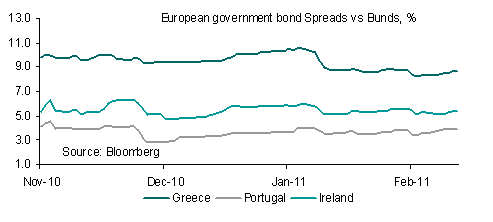
One theme that has been evident since the start of the year is an improvement in sentiment towards the eurozone periphery as hopes of an enlargement/extension of the European Union bailout fund (EFSF) have increased. This is a key reason why the EUR has strengthened this year although nervousness on this front appears to have returned over recent days (note the recent widening in peripheral bond spreads, drop in EUR and European Central Bank purchases of Portuguese debt). It seems that a lot of good news has already been discounted in relation to the eurozone periphery and now markets are in wait and see mode for the EU Council meeting on 24/25 March. There is a strong chance that eventually market expectations will prove overly optimistic and the EUR will drop but more on that later.

The second theme is global inflation concerns, driven by higher food and energy prices. Certainly this has had an impact on interest rate expectations and in some cases resulted in a hawkish shift in central bank language, notably in the eurozone and UK. Although European Central Bank (ECB) President Trichet has toned down his comments on tighter monetary policy compared to the more hawkish rhetoric following the last ECB council meeting, expectations for monetary tightening in the eurozone still look overly hawkish, with a policy rate hike currently being priced in for August/September this year, which looks way too early. The EUR has benefitted from the relative tightening in eurozone interest rate expectations compare to the US but will suffer if and when such expectations are wound down.

Elsewhere in many emerging markets the impact of higher food prices is finding its way even more quickly into higher inflation, forcing central banks to tighten policy. In Asia, the urgency for higher rates is even more significant given that real interest rates (taking into account inflation) are negative in many countries. China has accelerated the pace of its rate hikes over recent months and looks set to continue to tighten policy much further to combat inflation. In India, worries about inflation and the need for further monetary tightening have clearly weighed on equity markets, with more pain to come. Although not the sole cause by any means, in the Middle East and Africa higher food prices are feeding social tensions such as in Egypt.

Another clear theme that has developed is the improvement in US economic conditions. The run of US data over recent months has been encouraging, confirming that the economy is gaining momentum. Even the disappointing January non-farm payrolls report has not dashed hopes of recovery, with many other job market indicators pointing to strengthening job conditions such as the declining trend in weekly US jobless claims. Manufacturing, business and consumer confidence measures have strengthened whilst credit conditions are easing, albeit gradually. The US economy is set to outperform many other major economies this year, especially the eurozone, which will be beset with a diverging growth outlook between northern and southern Europe.

Although the US dollar has not yet benefitted from stronger US growth given the still dovish tone of the Fed and ongoing asset purchases in the form of quantitative easing, the rise in US bond yields relative to other countries, will likely propel the dollar higher over 2011 after a rocky start over Q1 2011. In contrast, the EUR at current levels looks too strong and as noted above, hopes of a resolution of eurozone peripheral problems look overdone. EUR/USD levels above 1.3500 provide attractive levels to short the currency. Other growth currencies that will likely continue to do well are commodity currencies such as AUD, NZD and CAD, whilst the outlook for Asian currencies remains positive even despite recent large scale capital outflows. The JPY however, will be one currency that suffers from an adverse yield differential with the US as US bond yields rise relative to Japan.

Econometer.org has been nominated in FXstreet.com’s Forex Best Awards 2011 in the “Best Fundamental Analysis” category. The survey is available at http://www.surveymonkey.com/s/fx_awards_2011

Beyond Expectations

Egypt worries continue to reverberate across markets, yet there appears to be growing resilience or at least some perspective being placed on problems there. Encouraging economic data, particularly in the US has helped to shield markets to some extent, with equity market rallying and US bond yields rising last week. The main impact of Egypt and worries about Middle East contagion continues to be felt on oil prices.

Even the mixed US January jobs report has failed to dent market sentiment; the smaller than expected 36k increase in payrolls was largely attributed to severe weather. A further surprising drop in the unemployment rate to 9.0% due mainly to a significant drop in the labor force was also well received by the market.

There will be less market moving releases on tap this week and the data are unlikely to dent recovery hopes. Michigan confidence is set to record an improvement in February whilst the December trade deficit is set to widen to around $41.0 billion. There are also plenty of Federal Reserve speakers this week including a testimony by Chairman Bernanke.

One central bank that has softened its hawkish rhetoric is the European Central Bank (ECB), with President Trichet dampening speculation of an early rate hike last week and alleviating some of the pressure on eurozone interest rate markets. Consequently the EUR fell as the interest rate differential with the USD became somewhat less attractive. The EUR was also undermined by the opposition from some member states to French and German ideas for greater fiscal policy coordination, an aim apparently not shared across euro members.

Data in Europe will be largely second tier. The EUR will look increasingly vulnerable to a further drop this week especially given the increase in net positioning over the past week to (1st February) according to the CFTC IMM data. The potential for position squaring looms large as positioning is now well above the three-month average. Stops are seen just below EUR/USD 1.3540.

In the UK the Bank of England policy meeting will take centre stage but there is unlikely to be any change in policy settings. Clues to policy thinking will be available in the monetary policy committee meeting minutes in two weeks times but it seems unlikely that any more members have joined the two voting for a hike at the last meeting.

Recent data have been a little more encouraging helping to wash off the disappointment of the surprise drop in Q4 GDP. The UK industrial production report is likely to be similarly firm on Thursday, with the annual pace accelerating. GBP/USD may however, struggle to make much headway against the background of a firmer USD and the weigh of long positioning, with GBP/USD 1.6279 seen as strong resistance.

There are plenty of releases in Australia this week to focus including the January employment data, consumer confidence, and a testimony by RBA governor Stevens in front of the House of Representatives on Friday. The data slate started off somewhat poorly this week, with December retail sales coming in softer than expected, up 0.2% MoM. AUD/USD is likely to be another currency that may struggle to sustain gains this week but much will depend on data over coming days. Resistance is seen around 1.0255.

On a final note, the weekend’s sporting events highlight how it’s not just economic data or moves in currencies that don’t always go as expected. After a solid run in the Ashes cricket England slumped to a 6-1 series loss to Australia in the one-day series, putting the Ashes win into distant memory. A similarly solid performance by Man United was dented with their unbeaten record broken by bottom of the table Wolves.

Econometer.org has been nominated in FXstreet.com’s Forex Best Awards 2011 in the “Best Fundamental Analysis” category. The survey is available at http://www.surveymonkey.com/s/fx_awards_2011

Your support in the survey is highly appreciated

Egypt Unrest Hits Risk Trades

Recent weeks have seen a real contrast in policy and growth across various economies. A case in point was the surprise drop in UK GDP in Q4 contrasting sharply with the solid (albeit less than forecast) rise in US Q4 2010 GDP. The resilience of the US consumer was particularly evident in the data. The European Central Bank’s (ECB) hawkish slant as reflected in comments from President Trichet compared to the dovish pitch of the Fed FOMC is another clear contrast for markets to ponder.

The ECB’s hawkish tone gave the EUR a lift but expectations of an early Eurozone rate hike looks premature. Although Eurozone inflation data (Monday) will reveal a further rise in CPI above the ECB’s target, to around 2.4% in January, this will not equate to a policy rate hike anytime soon. This message is likely to be echoed at this week’s ECB meeting where policy will be characterised as “appropriate”.

Whilst monetary tightening expectations look overdone in the Eurozone the same can be said for hopes of an expansion in the EU bailout fund (EFSF). Indeed, the fact that EU Commissioner Rehn appeared to pour cold water over an expansion in the size of the fund could hit the EUR and the currency may find itself struggling to extend gains over coming weeks especially if interest rate expectations return to reality too, with a move to EUR/USD 1.4000 looking far harder to achieve than it did only a few days ago.

It’s worth noting that a renewed widening in peripheral debt spreads will also send an ominous signal for the EUR. Against this background the EU Council meeting on February 4 will be in focus but any expectation of a unified policy resolution will be disappointed.

However, markets perhaps should not solely focus on peripheral Europe as the downgrading of Japan’s credit ratings last week highlights. Warnings about US credit ratings also demonstrate that the US authorities will need to get their act together to find a solution to reversing the unsustainable path of the US fiscal deficit, something that was not particularly apparent in last week’s State of the Union Address.

Last week ended with a risk off tone filtering through markets as unrest in Egypt provoked a sell-off in risk assets whilst worries about oil supplies saw oil prices spike. Gold surged on safe haven demand too. This week, markets will focus on events in the Middle East but there will be thinner trading conditions as Chinese New Year holidays result in a shortened trading week in various countries in Asia.

The main release of the week is the US January jobs report at the end of the week. Regional job market indicators and the trend in jobless claims point to a 160k gain in January although the unemployment rate will likely edge higher. Final clues to the payrolls outcome will be deemed from the ISM manufacturing confidence survey and ADP private sector jobs report this week. Whilst the January jobs report is unlikely to alter expectations for Fed policy (given the elevated unemployment rate) the USD may continue to benefit from rising risk aversion.