Currency Tensions Intensify Ahead of G7

Portugal, Greece and Spain remain firmly in the spotlight but it may not be long before the light broadens to include UK, US and many other countries facing similar difficulties on the fiscal front. Portuguese, Greek and Spanish equities were smashed in the wake of growing concerns and sentiment looks like it will get worse before it gets any better.

Events in each of these countries are not helping matters. In Portugal, parliament began to vote on a bill on financial transfers to the regions, which could damage the ability of the government to reduce the deficit whilst speculation that the Prime Minister is about to resign has intensified. In Greece tax collectors have started a 48-hour strike as social unrest worsens in the wake of the implementation of deficit cutting measures.

Although European officials pour cold water on the idea that the whole EMU Project could unravel bond markets are not taking any chances whilst the EUR looks destined to languish at ever weaker levels until there is a semblance of calm. Meanwhile. the European Central Bank (ECB) has clearly stated that does not want to get involved.

The G7 meeting in Canada will move rapidly into focus this weekend, with a joint press conference expected on Saturday. Sovereign debt concerns and restrictions and banks will likely be addressed whilst the not insignificant matter of China’s currency will also likely be discussed.

US pressure on China to strengthen the CNY has increased as has tensions between the two countries following US arms sales to Taiwan and a scheduled meeting between President Obama and the Dalai Lama.

There is growing speculation that the upcoming US Treasury report in April will label China as a currency manipulator which could result in tensions ratcheting up to a higher level. China holds the cards given the US reliance on Chinese money but with mid-term elections looming in the US and Obama’s promise to double US exports within five years, US pressure on China will intensify as will likely resistance from China.
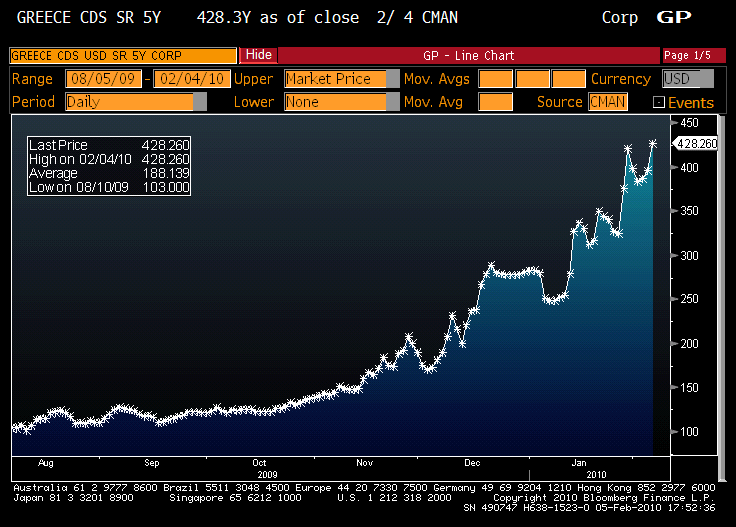
Not quite a Greek tragedy, but close

Not quite a Greek tragedy but getting there. Greece’s announcement of a three-year plan to reduce its burgeoning fiscal deficit has not convinced markets. Greece’s 5-year CDS widened out to around 333bps whilst 10-year sovereign spreads widened further. There has been some contagion in other European countries notably Spain, Portugal, Ireland, Italy, Poland etc.

The plan which aims to cut the budget deficit from 12.7% to 2.8% of GDP by the end of 2012 appears to be very optimistic if not unrealistic. One of the main problems is not related to the magnitude of deficit reduction but to the starting point of 12.7% of GDP which is more realistically around 14-15% of GDP.

The deficit is planned to be cut by 4% this year alone which seems tough given the likelihood that the economy will contract this year and thereby increase the cyclical portion of the deficit. However, the major concern is the ability of the Greek authorities to cut nominal wages and pensions and in areas where inefficiency and corruption are widespread, such hospital and defense spending.

Greece needs to convince the European Commission and if the negative reaction by markets is anything to go by it may need further revisions including more drastic spending cuts as well as concrete plans for structural reforms. Greece will also find it difficult to ignore the skeptical market reaction given that the country aims to raise around EUR 54 billion to fund its public debt.

Greek concerns and similar countries elsewhere in Europe will likely act as a major weight on the EUR in the days ahead. Interestingly GBP seems to be a beneficiary. The situation does not appear to have a happy ending in sight and more pain looks likely. Rumours/talk of a Eurozone break-up are likely to intensify, however unrealistic such an event may be. ECB President Trichet dampened speculation in his speech following the ECB meeting that Greece could exit the euro but also confirmed that there would be no special treatment for Greece.

What to watch this week

The 85k drop in US non-farm payrolls in December was obviously disappointing given hopes/expectations/rumours of a positive reading over the month.  There was a small silver lining however, as November payrolls were revised to show a positive reading of +4k, the first monthly gain in jobs since December 2007.  Overall, the US labour market is still gradually improving as the trend in jobless claims and other indicators show. 

The fact that the market took the drop in US payrolls in its stride highlights the fact that recovery is becoming more entrenched despite the occasional set back.  More significantly weaker US jobs disappointment has been countered by strong Chinese trade data, which showed both strong imports and exports growth in December.  Whilst the data, especially the strength in exports, will support calls for a stronger CNY, it also highlights China’s growing influence on world trade and the important role that the country is providing for global economic recovery.

Market resilience in the wake of the drop in US payrolls and positive reaction to Chinese trade data will maintain a “risk on” tone to markets this week.  In particular, the USD is set to start the week on the back foot and despite data last week showing that Eurozone unemployment reached an 11-year high of 10% and growing evidence that the Eurozone economy is falling behind the pace of recovery seen elsewhere, EUR/USD held above technical support (200 day moving average) around 1.4257, and is setting its sights on the 16 December 2009 high of 1.4591 helped by renewed Asian sovereign interest.  

The main event in the Eurozone is the ECB meeting on Thursday no surprises are expected, with the Bank set to keep policy unchanged whilst maintaining current liquidity settings.  The bigger concern for European markets is ongoing fiscal woes in the region, with press reports warning of a ratings downgrade for Portugal and still plenty of attention on Greece and its attempts at deficit reduction.  Fiscal concerns are not going to go away quickly and will clearly act as a restraint on market sentiment for European assets. 

In a holiday shortened week in the US as markets close early on Friday ahead of the 3-day MLK holiday, there are a number of data this week that will shed further light on the shape of US recovery. The main event is the December advance retail sales report on Thursday, which is expected to record a reasonable gain, helped by firm autos sales. 

Preceding this, tomorrow there is expected to be a renewed widening in the US trade deficit in November whilst on Wednesday the Fed’s Beige Book as well as various Fed speakers this week including Bullard, Lockhart, Fisher, Plosser, Evans and Lacker, will give important clues ahead of the January 27 Fed FOMC meeting.  Bullard sounded dovish in his comments in Shanghai, as he highlighted that US interest rates will remain low for some time. 

At the end of the week there will be a heavy slate of releases including December CPI, industrial production, capacity utilization, January Empire manufacturing and Michigan confidence. The outlook for these data is generally positive, with gains expected in both manufacturing and consumer confidence, whilst hard data in the form of industrial production is likely to record a healthy increase and CPI is set to reveal another benign reading.

FX Prospects for 2010

There can be no doubt that for the most part 2009 has been a year for risk trades, not withstanding the sell off into year end. The policy successes in preventing a systemic crisis and the massive flood of USD liquidity injected globally kept the USD under pressure for most of the year and the currency became a victim of this success. Risk appetite is likely to improve only gradually over coming months given the still significant obstacles to recovery in the months ahead.  This will coincide with the declining influence of risk on FX markets. 

2010 will not be as straightforward and whilst risk will dominate early in the year interest rate differentials will gain influence in driving currencies as the year progresses. The problem for the USD is that market expectations for the timing of the beginning of US interest rate hikes is likely to prove premature as the Fed is set to hold off until at least late 2010/early 2011 before raising interest rates. The liquidity tap will stay open for some time, and risk trades will still find further support at least in the early part of 2010, whilst the USD will come under renewed pressure.    

The ECB will be much quicker in closing its liquidity tap than the Fed and arguably an earlier reduction in credit easing and interest rate hikes compared to the Fed would favour a stronger EUR.  However, the EUR is already very overvalued and a relatively aggressive ECB policy is unwarranted. Consequently rather than benefiting from more favourable relative interest rate expectations, the EUR could be punished and the EUR is set to decline over much of 2010 following a brief rally in Q1 2010, with EUR/USD set to fall over the year. 

Japan is moving in the opposite direction to the ECB.  FX intervention is firmly on the table though the risk is limited unless USD/JPY drops back to around 85.00. Even at current levels the JPY is overvalued but for it to resume weakness it will need to regain the role of funding currency of choice, a title that the USD has assumed. Efforts by the BoJ to combat deflation will likely help result in fuelling some depreciation of the JPY and it is likely to be the worst performing major currency over 2010, with a move back up to around USD/JPY in prospect.

The issue of global rebalancing will need to involve currencies but the currency adjustments necessary will not be forthcoming in 2010.  USD weakness early in the year will be mostly exhibited against freely floating major currencies which will bear the brunt of USD weakness.  However, the bulk of adjustment is needed in Asian currencies and there is little sign that central banks in the region will allow a rapid appreciation.  China holds the key and a gradual appreciation in the CNY over 2010 suggests little incentive to allow other Asian currencies to appreciate strongly. 

So in many ways 2010 will be one of two halves for currency markets and this has the potential to reignite some volatility in FX markets.  High beta risk trades including the AUD, NZD, NOK and many emerging currencies will see further upside in H1 as the USD falls further.  Gains in risk currencies will look even more impressive when played against the JPY and/or CHF than vs. USD given that they will succumb to growing pressure in the months ahead as their usage as funding currencies increases.

Ongoing rate hikes in Australia and Norway and the likely beginning of the process to raise rates in New Zealand early next year will mean that these currencies will also have the additional support of yield to drive them higher unlike the JPY.  There is a limit to most things however, and eventually the USD will recover some of its lost ground against risk currencies, as it undergoes a cyclical recovery over H2 2010.

Dollar on top as central banks deliberate

There has been a veritable feast of central bank activity and decisions with most attention having been on the Fed’s decision.  In the event the FOMC meeting delivered no surprises in its decision and statement.  Basically the Fed acknowledged the recent improvement in economic activity but continued to see inflation as subdued and maintained that policy rates will remain low for an “extended period”.  The Fed also noted that most liquidity facilities were on track to expire on 1 February suggesting that they remain on track to withdraw liquidity.  

There was similarly no surprise in the Riksbank’s decision in Sweden to leave interest rates unchanged, with the Bank reiterating that it would maintain this stance through the autumn of 2010.  The SEK has been stung by outflows due to annual payments of premiums to mutual funds by the Pension Authority but the impact of this has now largely ended leaving the currency in better position.  Norway’s Norges Bank unexpectedly raised interest rates, for a second time, increasing its deposit rate by 25bps to 1.75%, with the surprise evident in the rally in NOK following the decision.   The other central bank to surprise but in the opposite direction was the Czech central bank which cut interest rates by 25bps.  

In contrast to the Norges Bank’s hawkish surprise the RBA has helped to toned down expectations for further rate hikes in Australia, with Deputy Governor Battellino suggesting that monetary policy was back in a “normal range” in contrast to the perception that policy was still very accommodative.   Weaker than expected Q3 GDP (0.2% QoQ versus forecasts of a 0.4% QoQ rise) data fed into the dovish tone of interest rate markets fuelling a further scaling back of rate hike expectations, casting doubt on a move at the February 2010 RBA meeting and pushing the AUD lower in the process.  Against this background AUD continues to look vulnerable in the short term, especially under the weight of year end profit taking and the resurgent USD.  

There was also some surprise in the amount of lending by the ECB, with the Bank lending EUR 96.9 bn in third and final tender of 1-year cash despite the cost of the loan being indexed to the refi rate over the term of the loan rather than being fixed at 1%.  There was also a sharp decline in the number of banks bidding compared to earlier 1-year auctions but at a much higher average bid.  This implies that some banks in Europe remain highly dependent on ECB funding despite the improvement in market conditions.   The EUR continues to struggle and its precipitous drop has shown little sign of reversing, with the currency set for a soft end to the year.  A break below technical support around 1.4407 opens the door to a fall to around 1.4290.   

The USD is set to retain its firmer tone in the near term though we would caution at reading its recent rally as marking a broader shift in sentiment.  The move in large part can be attributed to position adjustment into year end and is being particularly felt by those currencies that have gained the most in recent months.  Hence, the softer tone to Asian currencies and commodity currencies which appear to be bearing the brunt of the rebound in the USD.   Going into next year USD pressure is set to resume but for now the USD is set to remain on top, with the USD index on track to break above 78.000.