FX Winners and Losers

There has been a sense of mean reversion in FX markets so far this year as some of last year’s winners have become losers. Namely NZD, CHF, JPY and AUD have all lost ground whilst EUR and GBP have gained ground. The odd one out is the SEK which has strengthened over 2010 and in 2011 versus USD. I expect this pattern to change and the likely winners over the next 3- months are NZD, AUD and CAD, with CHF and JPY the likely losers.

EUR held up reasonably well in the wake of slightly disappointing growth data, with eurozone GDP rising less than expected in Q4, and a smaller than expected gain in the February German ZEW investor confidence survey (economic sentiment component). My sense is that the net long EUR speculative position has already been pared back somewhat over recent days reducing the potential selling pressure on the currency in the near term.

Given that EUR/USD is one of the only major currency pairs being influenced by interest rate differentials, its direction will hinge more on policy expectations but in the near the announcement by the German Finance Minister this morning of a restructuring plan for WestLB may give the currency some support.

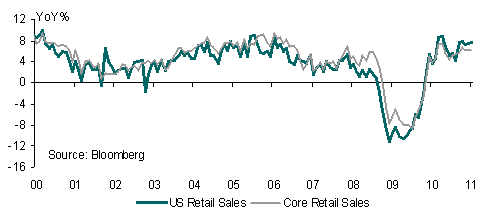
Perhaps one explanation for the stability of EUR/USD around the 1.3500 level is that US data was also disappointing yesterday. January retail sales rose less than forecast whilst revisions to back months suggest less momentum in Q4 consumer spending than previously envisaged. As with the eurozone data weather likely played a role in contributing to the outcome.
The net impact on currencies is that they are largely stuck within tight ranges. Further direction will come from the release of the Fed FOMC minutes for the January 26th meeting. The minutes may undermine the USD if a likely dovish slant continues to be expressed but given that the FOMC decision at that meeting to hold policy setting unchanged had no dissenters this should not come as a surprise.

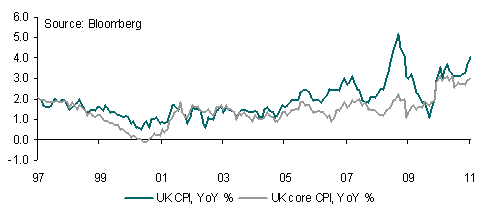
Whilst the battle between the USD and EUR ended in a stalemate GBP outperformed in the wake of the increase in UK January CPI inflation and in particular the letter from the BoE governor to the Chancellor keeping open the door to a rate hike. The Quarterly Inflation Report (QIR) today will be particularly important to determine whether the bounce in GBP is justified.
I remain hesitant to build on long GBP positions given the net long speculative overhang in the currency. The risks following yesterday’s jump in GBP are asymmetric, with a hawkish QIR likely to have less impact on the currency than the negative impact from a more dovish than expected report.

Econometer.org has been nominated in FXstreet.com’s Forex Best Awards 2011 in the “Best Fundamental Analysis” category. The survey is available at http://www.surveymonkey.com/s/fx_awards_2011
Euro Sentiment Jumps, USD Sentiment Dives

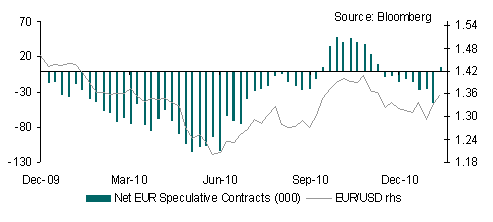
The bounce in the EUR against a broad range of currencies as well as a shift in speculative positioning highlights a sharp improvement in eurozone sentiment. Indeed, the CFTC IMM data reveals that net speculative positioning has turned positive for the first time since mid-November. A rise in the German IFO business confidence survey last week, reasonable success in peripheral bond auctions (albeit at unsustainable yields), hawkish ECB comments and talk of more German support for eurozone peripheral countries, have helped.

A big driver for EUR at present appears to be interest rate differentials. In the wake of recent commentary from Eurozone Central Bank (ECB) President Trichet following the last ECB meeting there has been a sharp move in interest rate differentials between the US and eurozone. This week’s European data releases are unlikely to reverse this move, with firm readings from the flash eurozone country purchasing managers indices (PMI) today and January eurozone economic sentiment gauges expected.

Two big events will dictate US market activity alongside more Q4 earnings reports. President Obama’s State of The Union address is likely to pay particular attention on the US budget outlook. Although the recent fiscal agreement to extend the Bush era tax cuts is positive for the path of the economy this year the lack of a medium to long term solution to an expanding budget deficit could come back to haunt the USD and US bonds.

The Fed FOMC meeting on Wednesday will likely keep markets treading water over the early part of the week. The Fed will maintain its commitment to its $600 billion asset purchase program. Although there is plenty of debate about the effectiveness of QE2 the program is set to be fully implemented by the end of Q2 2011. The FOMC statement will likely note some improvement in the economy whilst retaining a cautious tone. Markets will also be able to gauge the effects of the rotation of FOMC members, with new member Plosser possibly another dissenter.

These events will likely overshadow US data releases including Q4 real GDP, Jan consumer confidence, new home sales, and durable goods orders. GDP is likely to have accelerated in Q4, confidence is set to have improved, but at a low level, housing market activity will remain burdened by high inventories and durable goods orders will be boosted by transport orders. Overall, the encouraging tone of US data will likely continue but markets will also keep one eye on earnings. Unfortunately for the USD, firm US data are being overshadowed by rising inflation concerns elsewhere.

Against the background of intensifying inflation tensions several rate decisions this week will be of interest including the RBNZ in New Zealand, Norges Bank in Norway and the Bank of Japan. All three are likely to keep policy rates on hold. There will also be plenty of attention on the Bank of England (BoE) MPC minutes to determine their reaction to rising inflation pressures, with a slightly more hawkish voting pattern likely as MPC member Posen could have dropped his call for more quantitative easing (QE). There will also be more clues to RBA policy, with the release of Q4 inflation data tomorrow.

Both the EUR and GBP have benefitted from a widening in interest rate futures differentials. In contrast USD sentiment has clearly deteriorated over recent weeks as highlighted in the shift in IMM positioning, with net short positions increasing sharply. It is difficult to see this trend reversing over the short-term, especially as the Fed will likely maintain its dovish stance at its FOMC meeting this week. This suggests that the USD will remain on the back foot.

The Week Ahead

As last week progressed there was a clear deterioration in sentiment as growth worries crept back into the market psyche. It all started well enough, with a positive reaction to China’s de-pegging of the CNY but the euphoria faded as it became evident that there was still plenty of two-way risk on the CNY. A change in Prime Minister in Australia, which fuelled hopes of a resolution to a controversial mining tax, and an austere budget in the UK, were also key events. However, sentiment took a hit as the Fed sounded more cautious on the US economy in its FOMC statement.

The US Congress finalised a major regulatory reform bill towards the end of the week and markets, especially financial stocks, reacted positively as the bill appeared to give some concessions to banks and was not as severe as feared. However, equity market momentum has clearly faded against the background of renewed growth concerns including sprouting evidence of a double-dip in the US housing market as well as fresh worries about the European banking sector. As if to demonstrate this US Q1 GDP was duly revised lower once again, to a 2.7% annualised rate of growth.

The US Independence Day holiday and World Cup football tournament will likely keep liquidity thin in the run up to month and half year end. However, there is still plenty to digest this week including the all important employment report and consumer confidence data in the US. In Europe economic sentiment gauges, purchasing managers indices and the flash CPI estimate will be in focus. Elsewhere, Japan’s Tankan survey and usual slate of month end Japanese releases, Switzerland’s KoF leading indicator and Australian retail sales will be of interest.

On balance, economic data this week is unlikely to relieve growth concerns, with Eurozone, US and UK consumer and manufacturing confidence indicators likely to post broad based declines due to a host of factors. The data will further indicate a slowing in growth momentum following Q2 2010, with forward looking surveys turning lower, albeit gradually. Whilst a double-dip scenario still seems unlikely there can be no doubt that austerity measures and the waning of fiscal stimulus measures are beginning to weigh on growth prospects even if there is still plenty of optimism for emerging market and particularly Asian growth prospects.

This suggests that Q3 could turn into a period of heightened uncertainty in which equity markets and risk assets will struggle to gain traction. In addition to growth worries, some tensions in money markets remain in place whilst banking sector concerns seem to be coming back to the fore, especially in Europe and these factors will prevent a sustained improvement in risk appetite from taking place over the coming quarter. Some more clarity may come from the results of European stress tests but much will depend on just how stressful the tests are.

In the near term, the main focus of attention will be on the US June jobs report released at the end of the week. Non-farm payrolls are set to record a decline over the month due to a reversal in census hiring, with a consensus expectation of a 110k fall. Private sector hiring is likely to record a positive reading, however, suggesting some improvement in the underlying trend in jobs growth, albeit a very gradual one. Downside risks to consensus suggest plenty of scope for disappointment.

Interestingly, weaker US data of late, has managed to restrain the USD, suggesting that cyclical factors and not just risk aversion are beginning to play into FX movements. Notably the USD was on the back foot against a number of currencies as last week progressed. Even the beleaguered EUR managed to end the week well off its weekly low and close to where it closed the previous week whilst risk currencies such as the AUD and NZD as well as GBP also posted firm performances.

Perhaps some reversal of the optimism towards US recovery prospects give USD bulls some cause for concern, but pressure is likely to prove temporary, especially given that the US economy is still on course to outperform many other major economies. Over the short-term, especially ahead of the US jobs report markets are set to remain cautious with range trading likely to dominate in the week ahead, suggesting that EUR/USD is unlikely to breach the key level of 1.2500. GBP performance has been robust but even this currency is likely to make much headway above GBP/USD 1.5000, where there are likely to be plenty of sellers.