Positive Data Run Continues

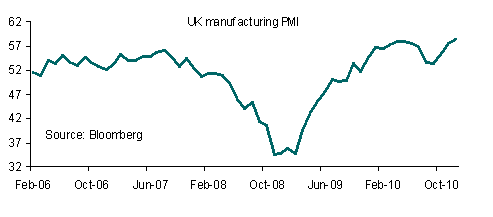
The batch of data releases in Tuesday’s trading session was generally positive. Leading the way was a stronger than expected increase in the UK manufacturing purchasing managers index (PMI) for December at 58.3 which coming in at a 16-year high. The data gave a boost to GBP though GBP/USD is unlikely to gain much of a foothold above 1.5600.

In the US, factory orders surprisingly jumped 0.7% in November and whilst the data is second tier it does maintain the run of generally upbeat US data. Meanwhile eurozone inflation came in higher than forecast at 2.2% YoY, above the European Central Bank (ECB) target level for the first time in two years. The outcome is unlikely to trigger a response from the ECB especially given that core inflation remains well behaved. After hitting a post CPI release high of 1.3433 EUR/USD is likely to drift lower in the short term.
Separately the Fed FOMC minutes of the December 14 meeting revealed little to surprise. Of note, FOMC members highlighted that the improvement in economic conditions was insufficient to warrant any change to the asset purchase program. The bottom line for the Fed is that the dual mandate of maximum employment and price stability is still not in reach and therefore they will keep the pedal to the floor in terms of policy stimulus. Although a further round of quantitative easing seems unlikely the Fed is likely to stick it out in terms of the $600 billion in planned asset purchases whilst an actual rate hike is unlikely until well into 2012.

Commodity prices dropped sharply overnight with soft commodities and energy prices in particular leading the declines. Commodity currencies fell as a result, with the AUD also impacted by growing worries about the impact of the Queensland floods. Initial estimates suggest that total damage from the flooding could reach AUD 6 billion and as Queensland represents around 19% of Australian GDP, the impact on growth could be significant. Growth could drop by a sharp -0.8% YoY in Q1 GDP. This is based on the assumptions that 40% of all exports will experience a 30% reduction

Today’s data slate in the US will be crucial to provide the final clues to Friday’s December payrolls report. The ADP jobs report, ISM non-manufacturing survey and Challenger job cuts data are all scheduled for release. The run of positive US data will help the USD to trade on a firm footing over the short term but clearer direction will await the outcome of the December jobs report whilst the beginning of the Q4 earnings season next week will also be influential. The exception to USD strength will continue to be Asian currencies where more upside is likely, but I prefer to play this via short EUR/Asian FX than the USD.

FX sensitivity to yield

It’s all about yield. The back up in US bond yields in reaction to the US tax compromise from the Obama administration has been particularly sharp. US 10 year bond yields jumped around 35bps this week prior to a small correction in yields overnight whilst 2s were up 21bps. US bond yields are now back where they were in June, a fact that makes a mockery out of the Fed’s attempts to drive bond yields lower via quantitative easing (QE). Yields elsewhere increased too but by a smaller degree whilst equity market sentiment has been dampened by the rise in global yields although US stocks still ended higher overnight.

There is plenty of commentary discussing the impact on currencies of the move in bond yields so it’s worth looking in more detail how sensitive FX markets have been to yield. The most sensitive currencies i.e. those with the highest 3-month correlations with relative bond yield differentials (2 year) are the AUD/USD, EUR/USD, and of course USD/JPY. However, there is less sensitivity to gyrations in 10 year yields with no currency pair registering a statistically significant correlation with 10-year bond yield differentials over the past 3-months.

Assuming that US bond yields continue to push higher into 2011, with much lager increases in both nominal and yields expected, this means that AUD, EUR and JPY will face the most pressure relative to the USD. Moreover, the stimulus measures agreed by the US administration will likely lead to many analysts penciling in higher growth forecasts over 2011 whilst reducing the prospects of QE3 from taking place, all of which is USD positive. I still retain a degree of caution in Q1 2011, especially with regard to a potential bounce in EUR, especially if the ECB becomes more aggressive in its bond buying, but even so, any EUR rally is likely to prove termporary.

The impact of higher US yields on the AUD may be more limited however, despite the high correlation with relative bond yields, as Australian bond yields are also likely to rise somewhat given the resilience of its economy. This was clearly demonstrated by Australian November employment data released overnight revealing yet another consensus beating outcome of +54.6k, with all the gains coming from full time employment. Against the background of a generally firm USD, the best way to play AUD resilience is via the NZD, with the currency pair likely break through resistance around 1.3220 (21 October high).

Speculators bail out of USDs

Risk appetite held up reasonably well last week, with markets failing to be derailed by concerns over Ireland’s banking sector and growing opposition to austerity measures across Europe. The main loser remained the USD, with the USD index hitting a low marginally above 78.00 and speculative positioning as reflected in the CFTC IMM data revealing a further sharp drop in sentiment to its lowest since Dec 2007.

This week is an important one for central bank meetings, with four major central banks deliberating on monetary policy including Bank of Japan (BoJ), Reserve Bank of Australia (RBA), European Central Bank (ECB) and Bank of England (BoE). The major event of the week however, is Friday’s release of the September US employment report. The RBA is set to hike its cash rate by 25bps, the BoJ may announced more easing measures whilst in contrast both the ECB and BoE are unlikely to alter their policy settings.

Whilst the BoJ is widely expected to leave its policy rate unchanged at 0.1%, it may announce further measures against the background of persistent JPY strength, a worsening economic outlook as reflected in last week’s Tankan survey and decline in exports. Japanese press indicate that the BoJ may increase lending of fixed rate 3 to 6 month loans to financial institutions as well as buy more short-term government debt.

The measures alongside risks of further JPY intervention may prevent USD/JPY slipping further but as reflected in the increase in speculative net long JPY positions last week, the market is increasingly testing the resolve of the Japanese authorities. Strong support is seen around USD/JPY 82.80, with the authorities unlikely to allow a break below this technical level in the short-term.

Although we will only see details of the voting in two weeks in the release of the UK BoE Monetary Policy Commitee (MPC) minutes it is likely that there was a three-way split within the MPC as reflected in recent comments, with MPC member Posen appearing to favour more quantitative easing whilst the MPC’s Sentance is set to retain his preference for higher rates. As has been the case over recent months the majority of the MPC are likely to have opted for the status quo.

GBP was a laggard over September as markets continued to fret over potential QE from the BoE. This uncertainty is unlikely to fade quickly suggesting limited gains against the USD and potentially more downside against the EUR. GBP speculative sentiment has improved but notably positioning remains short. EUR/GBP will likely target resistance around 0.8810.

In contrast to GBP the EUR has taken full advantage of USD weakness and looks set to extend its gains. Although there is a risk that speculative positioning will soon become overly stretched it is worth noting that positioning is well below its past highs according to the IMM data. EUR may have received some support from Chinese Premier Wen’s pledge to support Greece, and a stable EUR. Whilst there continues to be risks to the EUR from ongoing peripheral debt concerns such comments likely to be repeated at the EU-Asia summit today and tomorrow, will keep the EUR underpinned for a test of 1.3840.

What goes down must go up

What goes down must go up! A day that began with a stronger than forecast increase in China’s purchasing managers index (PMI) and firm Australian Q2 GDP continued with a surprise jump in the August ISM manufacturing index. The ISM rose to 56.3 from 55.5 in July an outcome that contradicted most of the regional US manufacturing surveys. It was not all positive in terms of data, yesterday however, with a weaker UK manufacturing PMI and unexpected drop in the August US ADP employment report casting a shadow over markets.

Nonetheless, for a change the market decided to act on the good news, with risk assets surging. Despite the improvement in risk appetite it still feels as though the market is grasping for direction. The jump in equities is unlikely to prove durable in an environment characterized by various uncertainties about growth and policy, especially the US.

The next hurdle for markets is the US payrolls data tomorrow. Although the ADP jobs report revealed a surprise 10k decline the employment component of the ISM manufacturing survey strengthened to 60.4, suggesting an improvement in August manufacturing payrolls. Ahead of the payrolls release the US data slate today largely consists of second tier releases including July pending home sales, August chain store sales, weekly jobless claims, and factory orders. It is worth paying particular interest to jobless claims given that the four week moving average has been edging higher, suggesting renewed job market deterioration. The consensus is for a 475k increase in claims, which will still leave the 4-week average at an elevated level.

Given that one of the biggest debates raging through markets at present is whether the Fed will embark on further quantitative easing comments by Fed officials overnight were closely scrutinized for further clues. In the event, Fed Governor Kohn highlighted that the Fed’s reinvestment of the proceeds from mortgage-backed securities will not automatically lead to further QE, suggesting some hesitancy on his part. Meanwhile, Dallas Fed President Fisher noted his reluctance to expand the Fed’s balance sheet until fiscal and regulatory uncertainties are cleared up.

Both sets of comments highlight the difficulty in gaining a consensus within the FOMC for a further increase in QE, suggesting that the hurdle for further balance sheet expansion will be set quite high. Moreover, such comments put the onus on Congress to move quickly in clearing up fiscal policy uncertainties.

As markets flip from risk on to risk off almost on a daily basis the question for today is how sustainable the rally in risk trades will prove to be against the background of so much policy and growth uncertainty. Unfortunately today’s data will provide few clues and markets will turn their attention to tomorrow’s US non-farm payrolls report for further direction. To an extent this suggests that it may be a case of treading water until then. Nonetheless, I still maintain that risk trades remain a sell on rallies over coming weeks

AUD and NZD outperformance

Just as the euro looked as though it was showing some signs of rebounding following the battering it received in the wake of the downgrade of Greece’s credit ratings, S&P placed Spain on credit watch negative from neutral, which helped drag EUR/USD all the way down again. Expect more to come as sovereign risk concerns / fiscal deficit remain in focus. EUR/USD was helped by the usual sovereign demand, preventing a test of technical support around 1.4625 but another push lower is likely over the short term.

Despite a tough budget from Ireland yesterday, it alongside the likes of Latvia, Ireland, Hungary and Portugal will remain on the ratings agencies’ hit lists. Eurozone periphery bond spreads have widened sharply against bunds but even larger countries in Europe such as Italy have seen an increase in funding costs. Added to these concerns are the lingering uncertainties about Dubai as reflected in the continued rise in CDS.

In contrast, growth worries are receding quickly in Australia where another robust jobs report was released. Employment rose 31.2k in November, with an upward revision to the previous month, to 27.2k from 24.5k initially. The details looked good too, with much of the jobs increase coming from full time hires (30.8k). The jobless rate fell to 5.7% compared to 5.8% in October. Taken together with the hawkish slant to the RBNZ statement, the data will help keep the AUD and NZD resilient to any sell off in risk trades.

The decision by the RBNZ to leave interest rates unchanged at 2.5% came as no surprise. However, Governor Bollard did shift away from the earlier pledge not to hike interest rates until H2 10 and stated that a hike could come around the middle of 2010. The RBNZ also upgraded its growth forecasts. A rate hike could come even earlier in my view, a factor likely to keep the NZD well supported.

Markets will digest more interest rate decisions today, in the UK and Switzerland. No change is likely from both the BoE and SNB but the issue of QE will remain at the forefront, especially given the split decision by the BoE MPC at the last meeting. As for the SNB the usual concerns about CHF strength are likely to be expressed but the tone of the SNB’s comments are likely to remain dovish, expressing little urgency to begin implementing an exit strategy.

The US data slate is light but does include weekly jobless claims and October trade data. There will be more interest than usual on the claims data given the surprise in last week’s payrolls report. Claims have been on an improving trend declining at a more rapid pace than previous recessions and markets will eye the numbers to determine whether they point to further improvement in payrolls or whether they suggest the November data was merely an aberration.