Quantitative easing and the USD

US earnings are coming in ahead of expectations, with Q2 income at the 42 S&P 500 companies reporting so far beating estimates by 11% whilst revenues are 3.3% ahead of forecasts, according to Bloomberg. The overall tone to equities looks positive helped by expectations of an agreement by BP to sell some of its assets and strong earnings reported by Apple after the close of US trade.

Market sentiment was also boosted by speculation that the Fed will embark on fresh monetary stimulus measures. Although there has been no indication that Fed Chairman Bernanke will announce such measures at his semi-annual testimony to the Senate today and to the House tomorrow, speculation of Fed action is rife and there is likely to be some questioning of Bernanke on the issue in the Q&A. If in any way quantitative easing is hinted at by Bernanke, it will act to undermine the USD.
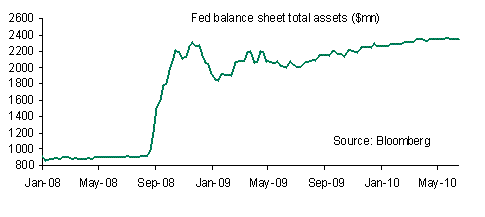
US economic data is helping to compound expectations of further quantitative easing, with yet another weaker than forecast release in the form of a 5.0% drop in June housing starts as hinted at by the bigger than expected drop in homebuilders confidence on the previous day. Separately ABC consumer confidence declined more than expected in the week to July 18, its third consecutive weekly decline, supporting the evidence that consumer confidence is deteriorating once again.

In the absence of major data releases Bernanke’s testimony will be the main driver for markets but earnings from Coca-Cola and Morgan Stanley will also be of interest. Elsewhere the minutes of the Bank of England’s July MPC meeting will be under scrutiny. MPC member Sentance is expected to have voted for a rate hike at the meeting, but any sign that other members joined him, will give GBP a lift. Sentiment for European assets continues to improve, with Greece concluding a well received T-bill auction and Ireland auctioning EUR 1.5bn in 6 and 10-year bonds. Both were heavily oversubscribed although concerns over Hungary continue to linger.

There continue to be various leaks about the European bank stress tests. Banks are expected to detail three scenarios in the results including estimated Tier 1 capital ratios under a benchmark for 2011, an adverse scenario and finally, a “sovereign shock”, according to a document from the Committee of European banking Supervisors. Importantly and perhaps a factor that could hit the credibility of the tests, the sovereign shock scenario is said to not include a scenario of default on sovereign debt.

I continue to see downside risk for the EUR in the wake of the test results, with a “buy on rumour, sell on fact” reaction likely. EUR/USD is vulnerable to a short-term drop to technical support around 1.2763 but much depends on Bernanke’s speech today. Leaks, suggest that around 10-20 banks could fail the bank stress tests, with a total funding requirement in the region of EUR 70-90 billion. Confirmation will have to wait for the official release on Friday ahead of which most currencies are likely to remain range-bound.

Stressing About European Stress Tests

Equities and risk appetite were bolstered by the relative success of the Spanish bond auction on Thursday. The results of the auction in which Spain sold EUR 3 billion in 10 year notes helped to stem some of the pressure on eurozone bond spreads, which despite the generalized improvement in market sentiment over recent days, had been continuing to widen.

Another key indicator that has been suggested that all is not well moving in the opposite direction to the improvement in many risk indicators is the Baltic Dry Index which has dropped by around a third since 26th May 2010.

Perhaps more significant in terms of providing sustainable support for markets was the news that the European Union agreed to publish the results of bank stress tests, slated for the second half of July. This could turn out to be a key stepping stone towards increasing the transparency of the eurozone banking sector.

However, doubts will remain until there is some clarity on the terms of the tests such as whether they include details of sovereign debt exposure. Also, if the stress tests reveal shortcomings in the banks in question it is unclear if government funding will be provided for them. Although the publishing of stress test results is a step in the right direction until these and other questions are answered it is difficult to see markets getting too excited.

It’s not all plain sailing for equity markets despite the relatively positive news in Europe as disappointing US data in the form of a surprise jump in weekly jobless claims and a bigger than expected drop in the June Philly Fed survey weighed in on the side of those expecting both a slow and jobless recovery in the US.

The CHF has been a key mover following the Swiss National Bank policy decision. The decision to leave interest rates unchanged was no surprise, but the change in rhetoric towards a less aggressive stance towards CHF strength opens up the floodgates for CHF buyers. will look to test its all time low around 1.3720.

Another central bank that has shown concern about a strengthening currency is the Bank of Japan but unlike the SNB Japan’s central bank has not intervened for several years. The BoJ in the minutes of its May meeting noted that it will “watch if Europe’s crisis strengthens JPY”, indicating some concern about JPY strength.

This sentiment that was echoed by the Japanese government in the release of Economic Growth Strategy aimed at avoiding an excessive rise in the JPY via fiscal and monetary steps to beat deflation. The JPY barely reacted to both the minutes and the growth strategy, with market players likely sceptical until concrete measures are actually implemented.

It still look like an environment of sell on rallies for the EUR and other risk currencies, with their gains likely to run out of steam over coming days. The next key technical level for EUR/USD is around 1.2454, a level that will prove a tough nut to crack.

What To Watch This Week

A “crisis over” mode is being adopted across markets as worries about Greece wane and economic data provides support to recovery hopes, whilst importantly allaying fears of a “double-dip”. Equities, bonds and currencies are reacting accordingly; equities are close to year highs, bond yields have risen and spreads have narrowed, whilst the USD and JPY are weaker, and conversely risk currencies are stronger. Even EUR/USD pushed higher on its way to 1.3800 as a number of stops were cleared and shorts were squeezed.

The coming weeks will be important to determine whether there is any staying power in the upward move in risk assets. A lot of the February data in the US will likely be obscured by bad weather however, including industrial production figures this week, leaving markets with little to go on. In Europe, the key release is the March German ZEW investor confidence survey, and better news in Greece, will likely prevent a sharper decline in confidence.

After both the Swish National Bank (SNB) and Reserve Bank of New Zealand (RBNZ) unsurprisingly left policy unchanged last week this week sees the turn of the US Federal Reserve and Bank of Japan (BoJ). Neither central bank is likely to shift policy but the Fed statement will be looked upon for guidance on the timing of rate hikes. The comment in the FOMC statement that the Fed Funds rate is expected to remain low for an “extended period” is set to be retained, even if some FOMC members are itching to remove it soon.

The BoJ meeting will be particularly interesting. I have just returned from a week long trip in Japan and on the ground there is plenty of speculation that the BoJ will take extra action to combat deflation and weaken the JPY. Additionally comments by Japan’s Prime Minister and Deputy PM have highlighted the potential for action to weaken the JPY although the usual market hesitation to sell JPY into fiscal year end and repatriation talk may mean a weaker JPY path is not straightforward.

Greece will not move too far from the spotlight, with EU officials likely to give the official stamp of approval on Greece’s deficit cutting measures and plenty of discussion at the Eurogroup Finance Minister’s meeting and Ecofin meeting early in the week. Moreover, weekend press reports suggest that a bailout up to EUR 25 billion is close to being agreed. Other topics of conversation will include the possible formation of a European Monetary Fund, though this looks like it will be a non-starter given the many objections to it.

Overall, risk appetite is set to continue its upward trajectory, likely keeping the USD on the back foot. Some deterioration in USD sentiment was reflected in the fact that net long aggregate USD speculation positioning has turned negative again according to the latest CFTC Commitment of Traders (IMM) report. Much in terms of FX direction will depend on what the FOMC says rather than does tomorrow.

EUR/USD may take a crack at resistance around 1.3840 on improving Greek news but it is difficult to see much upside from current levels. The one to watch will be the JPY, especially if the BoJ embarks on aggressive actions at this week’s meeting, leaving USD/JPY plenty of scope to test resistance around 92.16.

Renewed caution

Risk appetite is struggling to make any headway, with equities losing ground overnight. The positive impact on markets and adjustment to growth expectations following the US jobs report has given way to renewed concerns. Caution increased as Fed Chairman Bernanke introduced a dose of reality to markets talking about “formidable headwinds” to growth. As a result, bonds gained some lost ground and markets pared back expectations of interest rate hikes, leaving the USD vulnerable.

Eurozone risk factors continue to dampen market enthusiasm too, with ECB President Trichet warning of further bank writedowns and S&P downgrading the outlook for Greece and Portugal. The release of German factory orders data revealing a sharp 2.1% fall in October fed into concerns and played against strengthening recovery hopes in the region. EUR/USD failed to close below 1.4820 suggesting some alleviation of downside pressure. FX markets are likely eye stocks for further direction, with various EUR negative specific factors set to limit the upside.

The delayed release of additional stimulus measures in Japan will be the main focus of attention in Japanese markets assuming that an agreement is reached within the coalition. In the meantime markets will digest news that the current account surplus narrowed in October but was still up 51.4% from a year earlier. Additionally loan growth continued to slow, for the 11th straight month in November, adding further evidence that the injections of liquidity into banks are not finding their way into the economy.

GBP has come under growing pressure over recent days and bulls will be disappointed by the BRC retail sales data. The 1.8% YoY rise in like-for-like sales according will come as another disappointment for GBP. The gain was the slowest since August and below forecasts and as noted by the BRC looks even weaker when considering that the year ago figure was very weak. The sales data may fuel concerns about the recovery in consumer spending, especially going into the all important Christmas season. Attention will turn to the release of November Halifax house price data and October industrial production data later today and the pre-budget report tomorrow. GBP/USD looks likely to track EUR/USD for now and looks supported above 1.6390.

Although the USD has slipped as markets pare back expectations of rate hikes, the currency appears to be in a win-win situation and will likely see limited downside as risk aversion creeps back. Lingering concerns about Dubai as well as short covering towards year as well as other factors pushing risk aversion higher will likely see the USD retaining some support into the end of the week ahead of the US retail sales and Michigan confidence data

Post US Jobs Data FX Outlook

The massive upside surprise to US payrolls could prove to be a significant indicator for the USDs fortunes in the months ahead.  To summarize, payrolls dropped by 11k, much less than expected. Net revisions totaled +148k, the workweek rose and the unemployment rate fell to 10%, also better than forecast and likely a surprise to the US administration who hinted at a rise in the unemployment rate.

Equity and bond market reaction was as would be expected; equities rallied and bonds sold off.  Gold prices dropped sharply too.  However, and this is what was most interesting, the dollar strengthened. Why is this odd? Well, over the past 9 months any news that would have been perceived as positive for risk appetite was associated with dollar weakness.  This reaction clearly did not take place following the jobs data. 

It’s worth noting that going into the payrolls data markets were very short USDs as reflected in the CFTC Commitment of Traders IMM data which revealed the biggest aggregate net short USD position since 25 March 2008. The bounce in the USD could have reflected a strong degree of short covering especially against the JPY where net long JPY positions had jumped to close to its all time high.  Going into year end expect to see more position adjustment, perhaps indicating a return of the JPY funded carry trade is back on the cards.

The dollar’s reaction to the payrolls data was reminiscent of its pre-crisis relationship of buying dollars in anticipation of a more aggressive path for US interest rates and indeed markets brought forward expectations of higher rates following the data.  It is probably too early to believe that the dollar’s movements are once again a function of interest rate differentials but it is a taste of things to come. In any case, markets will be able to garner further clues from a speech by Fed Chairman Bernanke today.

The post payrolls dollar reaction could have also reflected the fact that EUR/USD failed to break above the 1.5145 high over the week resulting in a capitulation of stale long positions, especially as the move towards reducing liquidity provision by the ECB also failed to push the EUR higher. If the S&P 500 stays above 1100 EUR/USD could retrace higher for the most part a broad 1.48-1.51 range is likely to dominate over the week.  Nonetheless, a break below 1.4820 could provoke an accelerated stop loss fuelled drop in EUR/USD.  ECB President Trichet speaks today and may reiterate that the ECB’s measures to begin scaling back its liquidity provision should not be taken as a step towards monetary tightening.

USD/JPY proved interesting last week pushing higher in the wake of strong rhetoric by the Japanese authorities threatening intervention to prevent JPY strength. The BoJ’s attempt to provide more liquidity to banks also helped on the margin to weaker the JPY but the impact of the move is likely to prove limited. Nonetheless, exporters and Japanese officials may be more relaxed this week, if USD/JPY can hold above 90.00.  However, a likely sharp revision lower to Japanese Q3 GDP tomorrow will help maintain calls for a weaker JPY.