Resisting Asian FX Appreciation

The upward momentum in Asian currencies has continued unabated over recent weeks the gyrations in risk appetite. Most Asian currencies have registered gains against the USD over 2010 with the notable exception of one of last year’s star performers, KRW which after gaining by close to 9% last year has weakened slightly this year. Last year’s best performer the IDR which raked in close to 20% gains over 2009 versus USD has continued to strengthen this year, albeit to a smaller degree. Another currency that has extended gains this year has been the THB, which is on track to beat last year’s 4% appreciation against the USD.

The strength in Asian currencies has in part reflected robust inflows into Asian equity markets. For example Indonesia has been the recipient of around $1.7 billion in equity inflows so far this year. However, India and Korea have registered even larger inflows into their respective equity markets, at around $13 billion and $7.7, respectively, yet both the INR and KRW have underperformed other Asian currencies. The explanation for this is largely due to deteriorating current account positions in both countries. Further deterioration is likely.

The fact that equity flows have had only a small impact on the INR and KRW is reflected in their low correlations with their respective equity market performance. For most other Asian currencies the correlation with equity performance has been quite high, with the THB and MYR having the strongest correlations with their respective equity market indices over the past 3-months although the SGD, PHP and IDR have also maintained statistically significant correlations.

Clearly, for many but not all Asian currencies equity market gyrations are important drivers but at a time when growth is slowing more than many had expected in the US and governments in the eurozone are implementing austerity measures which will likely result in slowing growth and a worsening trade picture in the region, central banks in Asia will become increasingly wary of allowing their currencies from strengthening too quickly.

Increasingly Asian currency strength is being met with intervention by central banks in the region buying USDs against a host of Asian currencies. Over recent weeks this intervention appears to have become more aggressive. Nonetheless, any FX intervention led weakness in Asian FX is likely to prove short lived, with renewed appreciation likely over the coming months unless risk aversion increases dramatically. In other words a drop in Asian currencies will provide better opportunities to go long.

The CNY will play an important role on the pace and pattern of Asian currency movements. Investors in the region will also have one eye on developments on the visit of US National Economic Council director Larry Summers to Beijing. The CNY has firmed over recent days but this appears to be the usual pattern when a senior US official is in town and ahead of a G20 meeting. The fact is however, that the lack of CNY appreciation since the June CNY de-pegging remains a highly sensitive issue.

China is unlikely to yield to US pressure and is set to continue to act at its own pace and comments from officials in China over the past couple of days suggest no shift in FX stance. Although the CNY has not appreciated by as much as many had hoped for or expected since the June de-pegging the path is likely to be upwards, albeit at a gradual pace. For Asian currencies a slow pace of CNY appreciation implies further reluctance to allow a fast pace of appreciation so expect plenty of FX intervention in the weeks and months ahead.
Week Ahead

The market mood can be characterised as uncertain and somewhat downbeat, as reflected by the downdraft in US equity markets which posted their second weekly loss last week. Conversely, there has been a bullish run in government bonds, with the notable exception of peripheral debt. Over the last week markets had to contend with more data disappointment, in the wake of soft Japanese Q2 GDP, and a plunge in the August Philly Fed into negative territory, its first contraction since July 2009. Additionally a jump in jobless claims, which hit 500k highlighted the slow improvement in US job market conditions currently underway.

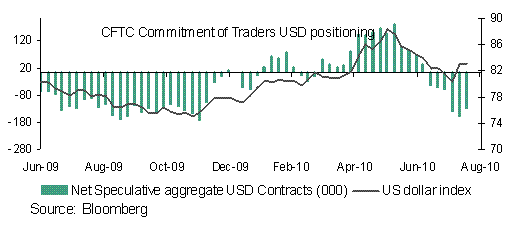
Despite all of this, the USD proved resilient and instead of the usual sell-off in the wake of soft data it benefited instead from increased risk aversion. The USD is set to retain some of this resilience though range-trading is likely to dominate over much of the weak. Reflecting the USD’s firmer stance, speculative positioning in the form of the CFTC IMM data revealed a reduction in aggregate USD short positioning in the latest week and although positioning is well below the three-month average, the improvement over the latest week and current magnitude of short positioning, highlights the potential and scope for further short-covering.

Negative data surprises have forced many to downgrade their forecasts for growth and policy implications, especially in the US. Markets will look for further clarity on the economic outlook this week but it is not clear that anything conclusive will be delivered. At the end of the week Q2 GDP will be revised sharply lower and whilst the data is backward looking it will reveal the weaker momentum of growth going into the second half of the year.

US Housing data will be mixed, with existing home sales set to drop in July as the impact of the expiration of home buyers tax credits continues to sink in whilst new home sales will likely increase but only marginally and will remain well below the April levels. Overall the picture of housing market activity remains bleak and this week’s data will do little to shake this off. On a more positive note July durable goods orders and August Michigan confidence will rise, the latter only marginally though. There will be plenty of attention on Fed Chairman Bernanke’s speech at the Jackson Hole Fed conference at the end of the week, especially given speculation of more quantitative easing in the pipeline.

The European data slate kicks off today with the release of manufacturing and service sector PMIs. Both are likely to register small declines, albeit from high levels. Nonetheless, taken together with a likely drop in the August German IFO survey on Wednesday and weaker June industrial orders tomorrow, the data will highlight that the momentum of growth in the region is coming off the boil, with the robust GDP outcome registered in Q2 2010 highly unlikely to be repeated. Against this background EUR/USD will find it difficult to make any headway. Technically further donwnside is likely over the short-term, with a test of 1.2605 support on the cards

Japan releases its slate of month end releases including jobs data, household spending and CPI. A slight improvement in job market conditions and increased spending will be insufficient to allay growth and deflation concerns, especially with CPI remaining firmly in negative territory. The onus will remain on the authorities to try to engineer a weaker JPY, which remains stubbornly around the 85.00 level versus USD. Talk of a BoJ / MoF meeting today has been dismissed, suggesting the prospect of imminent action is small. Meanwhile, speculative JPY positioning has dropped slightly in the last week but remain close to historical highs.

Aside from various data releases this week markets will digest the outcome of Australia’s federal elections. From the point of view of markets the outcome was the worst possible, with no clear winner as both the incumbent Prime Minister of the ruling Labour Party and opposition Liberal-National Party leader Tony Abbot failed to gain an outright majority. The outcome of a hung parliament will likely keep the AUD on the back foot, with trading in the currency likely be somewhat volatile until a clear outcome is established as both candidates try to garner the support of a handful of independents. However, it is notable that apart from an initial drop the AUD has managed to hold its ground. Nonetheless, the given the fluidity of the political situation there will be few investors wanted to take long positions at current levels around 0.8900 versus USD.

The Week Ahead

As last week progressed there was a clear deterioration in sentiment as growth worries crept back into the market psyche. It all started well enough, with a positive reaction to China’s de-pegging of the CNY but the euphoria faded as it became evident that there was still plenty of two-way risk on the CNY. A change in Prime Minister in Australia, which fuelled hopes of a resolution to a controversial mining tax, and an austere budget in the UK, were also key events. However, sentiment took a hit as the Fed sounded more cautious on the US economy in its FOMC statement.

The US Congress finalised a major regulatory reform bill towards the end of the week and markets, especially financial stocks, reacted positively as the bill appeared to give some concessions to banks and was not as severe as feared. However, equity market momentum has clearly faded against the background of renewed growth concerns including sprouting evidence of a double-dip in the US housing market as well as fresh worries about the European banking sector. As if to demonstrate this US Q1 GDP was duly revised lower once again, to a 2.7% annualised rate of growth.

The US Independence Day holiday and World Cup football tournament will likely keep liquidity thin in the run up to month and half year end. However, there is still plenty to digest this week including the all important employment report and consumer confidence data in the US. In Europe economic sentiment gauges, purchasing managers indices and the flash CPI estimate will be in focus. Elsewhere, Japan’s Tankan survey and usual slate of month end Japanese releases, Switzerland’s KoF leading indicator and Australian retail sales will be of interest.

On balance, economic data this week is unlikely to relieve growth concerns, with Eurozone, US and UK consumer and manufacturing confidence indicators likely to post broad based declines due to a host of factors. The data will further indicate a slowing in growth momentum following Q2 2010, with forward looking surveys turning lower, albeit gradually. Whilst a double-dip scenario still seems unlikely there can be no doubt that austerity measures and the waning of fiscal stimulus measures are beginning to weigh on growth prospects even if there is still plenty of optimism for emerging market and particularly Asian growth prospects.

This suggests that Q3 could turn into a period of heightened uncertainty in which equity markets and risk assets will struggle to gain traction. In addition to growth worries, some tensions in money markets remain in place whilst banking sector concerns seem to be coming back to the fore, especially in Europe and these factors will prevent a sustained improvement in risk appetite from taking place over the coming quarter. Some more clarity may come from the results of European stress tests but much will depend on just how stressful the tests are.

In the near term, the main focus of attention will be on the US June jobs report released at the end of the week. Non-farm payrolls are set to record a decline over the month due to a reversal in census hiring, with a consensus expectation of a 110k fall. Private sector hiring is likely to record a positive reading, however, suggesting some improvement in the underlying trend in jobs growth, albeit a very gradual one. Downside risks to consensus suggest plenty of scope for disappointment.

Interestingly, weaker US data of late, has managed to restrain the USD, suggesting that cyclical factors and not just risk aversion are beginning to play into FX movements. Notably the USD was on the back foot against a number of currencies as last week progressed. Even the beleaguered EUR managed to end the week well off its weekly low and close to where it closed the previous week whilst risk currencies such as the AUD and NZD as well as GBP also posted firm performances.

Perhaps some reversal of the optimism towards US recovery prospects give USD bulls some cause for concern, but pressure is likely to prove temporary, especially given that the US economy is still on course to outperform many other major economies. Over the short-term, especially ahead of the US jobs report markets are set to remain cautious with range trading likely to dominate in the week ahead, suggesting that EUR/USD is unlikely to breach the key level of 1.2500. GBP performance has been robust but even this currency is likely to make much headway above GBP/USD 1.5000, where there are likely to be plenty of sellers.

Why Buy Asian FX (Part 1)

Given all the attention on Greece and European fiscal/debt woes over recent weeks it’s been easy to forget about the success story of Asian economies. Of course, there has been a lot of attention on China and the international pressure to revalue its currency. However, the stability and resilience of Asian economies has been impressive throughout the financial crisis and recent Greek saga, helping to boost the attraction of Asian currencies.

Asia has managed to avoid the fiscal/debt problems associated with many developed economies, due to much better fiscal management over recent years. There are a couple of exceptions however, including the Philippines and India, but the fiscal positions in these countries have seen an improvement and are unlikely to lead to anywhere near the same sort of problems associated with Greece and other European countries.

So far this year capital inflows into Asian equity markets have much been stronger than 2009, albeit after a rocky start to the year when flows dried up due to rising risk aversion. Since then inflows have resumed strongly. The comparison to 2008 is even more dramatic as much of Asia registered significant capital outflows that year. South Korea, India and Taiwan, respectively, have led the way in term of inflows into equity markets in 2010, with inflows of $4.3 billion, $3.7 billion and $3.3 billion, respectively.

It is no coincidence that Asian currencies are most sensitive to the performance of Asian equity markets, with strong capital inflows and rising equities leading to stronger currency performance. Asia is set to continue to be a strong destination for equity flows over coming months, which given the high Asian equity correlation with local currencies, will lead to further appreciation in most Asian FX. A likely CNY revaluation in China will also help to fuel further Asian FX upside.