FX Tension

On September 22 1985 the governments of France, West Germany, Japan, US and UK signed the Plaza Accord which agreed to sharply weaken the USD. At this time it was widely agreed that the USD was overly strong and needed to fall sharply and consequently these countries engineered a significant depreciation of the USD.
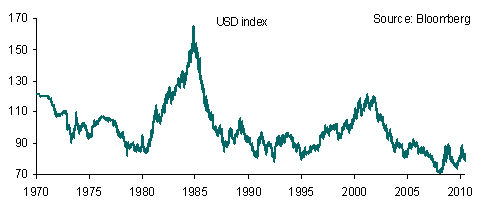
It is ironic that 25 years later governments are once again intervening in various ways and that the USD is once again facing a precipitous decline as the Fed moves towards implementing further quantitative easing. This time central banks are acting unilaterally, however, and there is little agreement between countries. For instance Japan’s authorities found no help from the Fed or any other central bank in its recent actions to buy USD/JPY.

So far Japan’s FX interventions have been discreet after the initial USD/JPY buying on 15 September. The fact that Japan is less inclined to advertise its FX intervention comes as little surprise given the intensifying pressure from the US Congress on China for not allowing its currency, the CNY to strengthen. Tensions have deepened over recent weeks and the backing of a bill last week by an important Congressional committee to allow US companies to seek tariffs on Chinese imports suggests that the situation has taken a turn for the worse.

The softly softly approach to Japan’s FX intervention and US/China friction reflects the fact that unlike in 1985 we may be entering a period in which currency and in turn trade tensions are on the verge of intensifying sharply against the background of subdued global economic recovery.

The Fed’s revelation that it is moving closer to implementing further quantitative easing has shifted the debate to when QE2 occurs rather than if, with a November move moving into focus. Clearly the USD took the news negatively and will likely remain under pressure for a prolonged period as the simple fact of more USD supply weighs heavily on the currency. Markets will be able to garner more clues to the timing of QE2, with a plethora of Fed speakers on tap over coming days.

This week the US economic news will be downbeat, with September consumer and manufacturing confidence surveys likely to register declines, with consumer sentiment weighed down by the weakness in job market conditions. Personal income and spending will also be of interest and gains are expected for both. There will be plenty of attention on the core PCE deflator given that further declines could give clues to the timing of QE2.

Attention in Europe will centre on Wednesday’s recommendations for legislation on “economic governance” from the European Commission. Proposed penalties for fiscal indiscipline may include withholding of funding and/or voting restrictions but such measures would be politically contentious. Measures to enforce fiscal discipline ought to be positive for markets given the renewed tensions in peripheral bond markets in the eurozone.

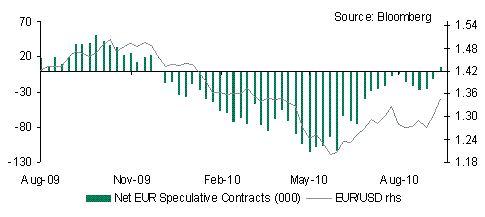
The EUR was a major outperformer last week benefiting from intensifying US QE speculation and will set its sights on technical resistance (20 April high) around 1.3523 in the short-term. Notably EUR speculative positioning has turned positive for the first time this year according to the CFTC IMM data, reflecting the sharp shift in speculative appetite for the currency over recent weeks. The EUR has been surprisingly resilient to renewed sovereign debt concerns and similarly softer data will not inflict much damage to the currency this week.
The Week Ahead

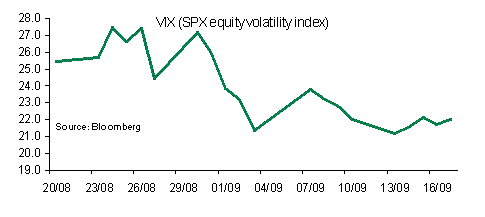
Equity markets and risk trades have generally performed well over the last couple of weeks, with for example the S&P 500 around 7.5% higher since its late August low, whilst equity and currency volatility have been generally low, the latter despite some hefty FX intervention by the Japanese authorities which did provoke a spike in USD/JPY volatility last week.

Risk appetite took a knock at the end of last week in the wake of worries that Ireland may seek EU / IMF assistance although this was denied by Irish officials. A similar worry inflicted Portugal, and as a result peripheral bond spreads were hit. Sovereign worries in Europe have not faded quickly and bond auctions in Greece, Spain and Portugal will garner plenty of attention this week. Renewed worries ahead of the auctions suggest that the market reception could be difficult.

Attention will swiftly turn to the outcome of the Fed FOMC meeting tomorrow and in particular at any shift in Fed stance towards additional quantitative easing following the decision at the August FOMC meeting to maintain the size of the Fed’s balance sheet. Given the recent improvement in US economic data the Fed is set to assess incoming data before deciding if further measures are needed.

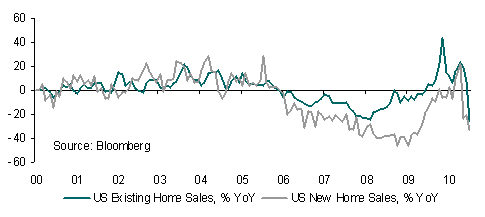
Housing data in the US will also garner plenty of attention, with several releases scheduled this week. Increases in August housing starts, building permits, existing and new home sales are also expected. Whilst this may give the impression of housing market improvement, for the most part the gains will follow sharp declines previously, with overall housing market activity remaining weak following the expiry of the government tax credit.

Weakness in house prices taken together with a drop in equity markets over the quarter contributed to a $1.5 trillion drop in US household net wealth in Q2. Wealth had been recovering after its decline from Q2 2007 but renewed weakness over the last quarter will not bode well for consumer spending. Household wealth is around $12.4 trillion lower than its peak at the end of Q2 2007.

Aside from the impact of renewed sovereign concerns, European data will not give the EUR much assistance this week either, with Eurozone September flash PMIs and the German IFO survey of business confidence set to weaken as business and manufacturing confidence comes off the boil. If the Fed maintains its policy stance whilst risk aversion increases over coming days the USD may find itself in a firmer position to recoup some of its losses both against the EUR and other currencies.

This will leave EUR/USD vulnerable to drop back down to around support in 1.2955 in the very short-term. As indicated by the CTFC IMM data there has been further short EUR position covering last week whilst sentiment for the USD deteriorated, suggesting increased room for short-USD covering in the event of higher risk aversion.

The impact of Sweden’s election outcome over the weekend is unlikely to do much damage to the SEK despite the fact that the coalition government failed to gain an outright majority. EUR/SEK has edged higher over recent days from its low around 9.1528 but SEK selling pressure is unlikely to intensify following the election, with EUR/SEK 9.3070 providing tough technical resistance.

What Stress?

Fed Chairman Bernanke has inadvertently fuelled an increase in risk aversion in the wake of his testimony to the Senate. Although Bernanke noted that he did not see the prospects of a double-dip as a high probability event he stated that the economic outlook is “unusually uncertain”. Nonetheless, although such measures would be implemented if the situation deteriorated further, the Fed was not planning on extending its non-traditional policy options in the near term.
USD benefits as Bernanke does not indicate more quantitative easing.

A combination of caution about growth prospects and disappointment that Bernanke stopped short of indicating that the Fed would embark on further non-conventional policy measures left equities weaker, but the USD was stronger, both due to higher risk aversion as well as less risk of the Fed turning the USD printing press back on again. Bernanke is back at Congress today, with a speech to the House Panel. Although this is effectively a repeat of yesterday’s testimony, the Q&A session may throw up additional clues to Fed thinking and potential for extending quantitative easing but I suspect the USD will retain its firmer tone.

In Europe, most attention remains on the upcoming release of EU bank stress test results. Leaks suggest most banks will likely pass the EU bank stress tests, with the notable exceptions of a few Spanish Cajas and German Landesbanks. Already governments in Germany, France, Greece and Belgium have said their banks are likely to pass. We should all be bracing ourselves for relief to flow through European financial markets, but somehow this does not feel like an environment that will welcome such a result. More likely questions will be asked about why did so few banks fail and why the tests were not rigorous enough?

For example, the test for “sovereign shock” is said to affect only the value of government bonds that banks mark to market, but what about the far larger proportion of government debt that is held in banking books? There are also question marks over the capital hurdle, with the most adverse scenario that banks need to reach a maximum Tier 1 capital ratio of at least 6% by end 2011. Moreover, there have also been reported divisions within European Union (EU) members about how much information to divulge. EUR has also ready lost ground over recent days but the currency could face much more selling pressure into next week if the tests are found to lack credibility.

Please note that econometer.org will take a break until the week of 16th August. Good Luck.

Euro Has That Sinking Feeling

The reaction to the US May jobs report shows that markets are particularly susceptible to negative US news at a time when growth fragilities in Europe are becoming increasingly apparent. Coupled with worries about Hungary, risk aversion has jumped.

Unsurprisingly the EUR took the brunt of pressure. Rhetoric over the weekend may help to assuage some fears but I suspect it is too late now that the cat is out of the bag. Hungary’s government maintained that it will meet this year’s budget deficit target of 3.8% of GDP. European Union officials also attempted to calm market concerns, downplaying any comparison of Hungary to Greece.

The overall EUR/USD downtrend remains intact. Renewed doubts about German participation in the EU/IMF rescue package, with the German constitutional court potentially blocking its contribution, will add to pressure as well as a UK press report titled EUR ‘will be dead in five years’ . The January 1999 EUR/USD introduction level around 1.1830 has now moved squarely into sight.

It is unlikely that data and events this week will do much to reverse the market’s bearish tone. Highlights include the ECB, BoE and RBNZ meetings in Europe, UK and New Zealand, respectively. The ECB (Thursday) is highly unlikely to shift its monetary policy stance. Given some opposition to bond purchases from within the ECB council the comments in the accompanying statement will be closely monitored. The BoE will also leave policy unchanged on the same day but the RBNZ is set to begin its hiking cycle with a 25bps move.

On the data front the US slate includes the Fed’s Beige Book, April trade data, May retail sales and June Michigan confidence. The Beige Book is likely to reveal some improvement in activity with little sign of inflation, whilst the trade deficit is set to widen further due to a higher oil import bill. Retail sales will reveal an autos led increase in the headline reading but more subdued core sales, whilst consumer confidence is set to rise for a second straight month.

There will be more attention on rhetoric from EU officials rather than eurozone data, with the Eurogroup of Finance Minister’s and Ecofin meetings garnering more interest. In Japan, politics will take centre stage, with the new cabinet line up in focus following the confirmation of Naoto Kan as Prime Minister. Comments by the new PM himself will be of interest, especially with regard to combating deflation and in particular any elaboration on his penchant for a weaker JPY.

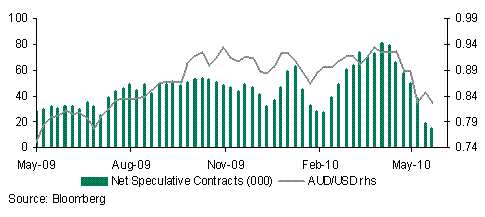
All-in-all, the week is unlikely to see a let up in pressure on risk trades and will start much as the last week ended. Although the market’s attention is on the EUR, it should be noted that the AUD has lost even more ground so far this month although the EUR remains the biggest loser in terms of major currencies so far this year (vs USD). In the case of the AUD the move reflects a massive unwinding of long positioning (as reflected in the latest CFTC IMM data which shows that speculative AUD positioning has dropped to its lowest since March 2009).

In contrast in the case of the EUR where positioning is already very negative, the move simply reflects deteriorating fundamentals. The fact that European officials are showing little concern about the decline in the EUR (why should they given that the currency is now trading around fair value) and in some cases encouraging it, suggests that there is little to stop EUR/USD from dropping much further and parity is looming a lot closer.

What To Watch This Week

The end of last week proved to be a calmer affair than the preceding few days. There was some encouraging news on the Greek front, with Germany finally approving its share of the European Union (EU) aid package whilst Greece appeared to be on track with its budget deficit reduction as the country recorded a cash deficit of EUR 6.3billion in the first four months of the year, a 42% reduction compared to a year earlier. EU officials also agreed on tougher sanctions for countries breaching austerity rules.

There were plenty of negatives to offset the good news however, as European business surveys including the German IFO index and flash eurozone purchasing managers indices (PMIs) revealed some loss of momentum in growth as well as increased divergence. European banking sector concerns intensified as the Bank of Spain was forced to take control of CajaSur, a small savings bank holding 0.6% of total Spanish banking assets, which faced difficulties due to distressed real estate exposure. Its woes highlighted the problems faced by many Spanish savings banks due to property market exposure.

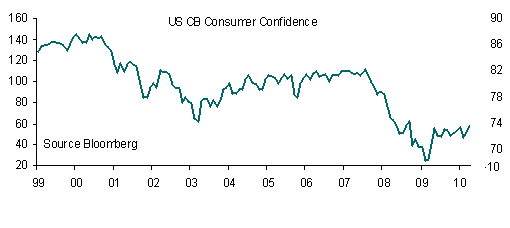
US data releases this week will confirm that economic recovery gathered steam in Q2. May consumer confidence data is likely to record a small gain, due in large part to improving job market conditions, whilst the Chicago PMI is set to retrace slightly in May, albeit from a healthy level. Both new and existing home sales are set to record gains in April, the former following a sizeable gain in March although the drop in house prices likely to be revealed by the Case-Shiller index will continue to fuel doubts about the veracity of the turnaround in the US housing market.

In Europe there is not much in terms of first tier releases and highlights include sentiment data such as German Gfk and French consumer confidence indices, and the May French business confidence indicator. The data are likely to be mixed, and as indicated by last week’s surveys will reflect a relatively healthy Q2 2010, but a worsening outlook for the second half of the year.

In the absence of UK data today there will be plenty of attention on the details of plans by Chancellor Osborne to cut GBP 6 billion from the budget deficit. The measures will be small change ahead of the emergency budget package on June 22nd when much bigger cuts are expected. Nonetheless, the first step today will be a crucial test of the new government’s ability to convince ratings agencies and markets that it is serious about reducing the burgeoning fiscal deficit.

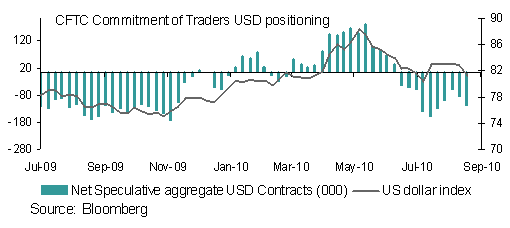
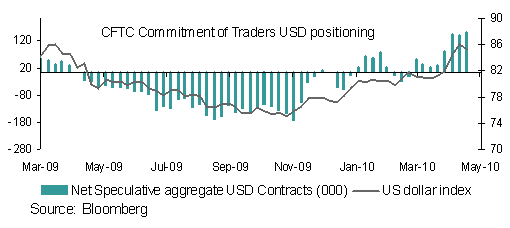
Following the massive positioning adjustments of the last week markets will look somewhat calmer over coming days but risk aversion is likely to remain elevated, suggesting little respite for most currencies against the USD. The recent moves have left net aggregate USD positioning registering an all time high according to the CFTC Commitment of Traders data, in the latest week, but after the slight retracement lower in the USD index, it is set to make further gains over coming days.

It was notable that EUR and GBP looked more composed at the tail end of the week whilst attention turned to the liquidation of long positions in CHF, AUD, NOK and SEK. These risk currencies are set to remain under pressure but there will be little respite for EUR which is set to drift lower, albeit a less aggressive pace than over recent weeks and a re-test of EUR/USD technical support around 1.2296 is likely. GBP/USD has showed some resilience over recent days but remains vulnerable to further downside pressure, with 1.4310 immediate support.