The Good, The Bad And The Ugly

GOOD: Positive earnings. The biggest earnings news of the day was from Goldman Sachs reporting that profits almost doubled in Q1. Apple also beat estimates and its shares surged. 82% of US earnings have beaten expectation so far. There is still a long way to go in the earnings season but the growth/earnings story is helping to maintain the positive bias to risk trades. There will be plenty of attention on earnings, including AT&T, eBay, Morgan Stanley, Starbucks, Boeing and Wells Fargo.

Data releases remain upbeat, with the April German ZEW investor confidence survey beating consensus, whilst central banks delivered hawkish messages across the board including the Reserve Bank of Australia policy meeting minutes, which pointed to another interest rate hike in May. However, the biggest impact came from the Bank of Canada which unsurprisingly left rates at 0.25%, but removed the conditional commitment to keep policy on hold until the end of Q2, leaving a rate hike on June 1 very likely.

The CAD jumped on the back of the outcome, with USD/CAD dropping below parity. I continue to like CAD alongside the AUD and NZD and believe they will be the star performers over the coming months despite lofty valuations.    Near term targets for CAD, AUD and NZD vs USD are 0.9953, 0.9407, and 0.7195, respectively. 

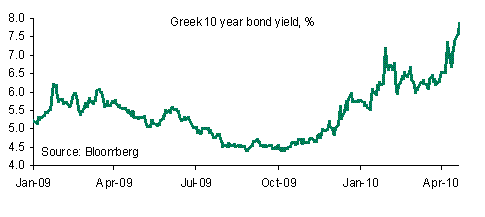
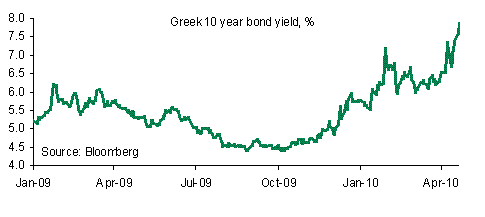
BAD: Talks between Greek officials and the IMF, ECB and EU on the conditions for a EUR 45 billion bailout loan will also be of interest although completion of talks could take weeks and in the meantime the situation is unlikely to improve, with Greece needing around EUR 10 billion to cover obligations by end May. Greek bond yields jumped to fresh record highs around 7.84% yesterday whilst the spread over German bunds also widened. Moreover, although Greece’s sale of EUR 1.95 billion in 13-week paper yesterday was heavily oversubscribed the, the yield was high at 3.65% which was far higher than the 1.67% yield at a similar sale in January.
In contrast to the likes of the CAD, AUD and NZD, the EUR is set to continue to suffer and as reflected in the widening in Greek bond spreads and high funding costs, Greek woes will keep plenty of pressure on the currency, with EUR/USD set to fall to support around 1.3300 in the short-term.

UGLY: UK regulator FSA will conduct a formal investigation of Goldman Sachs. The FSA will work closely with the US Securities and Exchange Commission SEC, which has accused the bank of Fraud though this has vehemently denied by Goldman Sachs. Although the negative market impact of the fraud case has been outweighed by good earnings and data the fallout is spreading. Some European politicians have even called for governments to stop working with the bank.
Singapore revalues, Asian currencies jump

The positive tone to risk appetite is keeping the USD on the back foot and for once FX attention has turned away from events in Greece. Before elaborating further and staying with Greece, it’s worth highlighting that the outcome of Greece’s note auction was reasonably solid, with more debt than anticipated being sold. However, the cost of borrowing for Greece rose compared to the previous auction in January, which means that the Greece will still suffer higher funding costs to roll over debt.

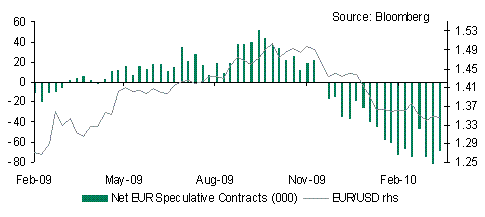
The positive reception to the debt offering was not particularly surprising given that it followed so closely after the EU/IMF loan package announcement but it is difficult to see sentiment for Greece and the EUR for that matter, getting much of a lift. The main positive for the EUR is the fact that market positioning remains very short but EUR/USD is likely to struggle to make much headway above technical resistance around 1.3653.

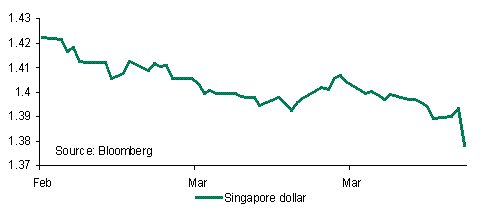
More interestingly Asian central banks are continuing on the track towards fighting rising inflation pressure and Asian currencies, in particular the SGD, were boosted by the Monetary Authority of Singapore (MAS) decision to revalue its currency. Singapore has moved back to a policy of a “modest and gradual appreciation” of the SGD from a policy of zero appreciation, which obviously implies openness to further FX appreciation in the weeks and months ahead.

The rationale for the decision was clear and as revealed in the strong first quarter Singapore GDP data which revealed a 13.1% annual rise. Stronger growth is fuelling growing inflationary concern and to combat this Singapore’s MAS will allow greater SGD appreciation. The reaction in other Asian currencies was also positive, with markets (quite rightly in my view) that other Asian central banks will be more tolerant of currency strength in their respective currencies.

Moreover, Singapore’s move was pre-emptive, perhaps with one eye on an imminent revaluation in China. The recent easing in tensions between the US and China has if anything increased the likelihood that China revalues its currency, the CNY, sooner rather than later, and most likely before the end of Q2 2010. Whatever the rationale, strengthening inflation pressure across the region, will mean a less FX interventionist stance in Asia, and likely stronger currencies over coming months.

Greek Aid Boosts Euro

Greece is never far from the headlines and the big news over the weekend was once again centred on this small (in terms of economy size) eurozone Country, with the agreement by Eurozone members to provide up to EUR 30 billion in loans to Greece. This will be supplemented by additional contributions from the IMF to the tune of around EUR 15 billion. The rate of around 5% for the three-year fixed loan is well below that yielding on Greek debt but above the International Monetary Fund (IMF) standard lending rate. In other words, the terms of the loan are far more favourable than they would currently face in the market.

After weeks of haggling the decision to detail the amount and terms of a loan for Greece will help reassure markets and likely result in a narrowing in Greek spreads over the near term. Further details will be finalised early in the week including conditions imposed on Greece as well as the exact amount of the IMF contribution but the real test of confidence will be the reception to Greece’s EUR 1.2 billion sale of 3 and 6-month paper at the beginning of the week.

Markets were already embarking on a short covering exercise in EUR/USD early last week according to the latest CFTC IMM report which showed a reduction in net EUR short speculative positions. As a result of the weekend’s agreement the EUR looks set to consolidate its gains into the beginning of this week. Further out, there are still plenty of risks ahead and sellers are likely to emerge around EUR/USD resistance at 1.3696.


Data releases this week will be conducive to maintaining further support for risk appetite whilst shoring up recovery expectations. In particular US March retail sales are set to jump on the back of strong autos spending (consensus 1.2% monthly gain). March industrial production is also likely to record a healthy reading (consensus 0.7% month-on-month), whilst gains in both manufacturing (Empire manufacturing and Philadelphia Fed) and consumer confidence (Michigan confidence) for April are likely.

There will also be plenty of attention on Chinese data this week with a plethora of releases over coming days including FX reserves, GDP, loans data, inflation, retail sales and industrial production. In short, the data will continue to reveal a robust economic performance, which will be good for risk appetite and Asian currencies, but will also add to the pressure to revalue the Chinese currency, CNY, soon.

The USD impact will depend on whether the market reacts to firmer risk appetite or signs of stronger US growth. I suspect the former will apply for now, likely keeping the USD on the back foot early in the week. The main beneficiaries include risk currencies such as AUD, NZD and CAD as well as most Asian currencies. AUD/USD is set to target technical resistance around 0.9407 whilst NZD/USD will set its sights on resistance around 0.7252 over the next few days.

Greece In The Spotlight (again)

Once again Greek worries are hogging the limelight and although the Greek saga has become a rather tedious affair for markets, concerns are well founded.  The latest issue is whether Greece is willing to adhere to potentially tough measures that would be associated with IMF assistance for the country.  Latest speculation suggests that Greece may side step the IMF to avoid such measures though this was belatedly denied by the Greek authorities. 

Given the huge amount of bonds Greece needs to sell over the coming weeks renewed nervousness does not bode well for a good reception to this issuance. As it is financing costs are rising once again in the wake of a renewed widening in Greek sovereign bond spreads and servicing this debt will add to the economic misery.  Greece has little by way of upside over coming months and years.  Tough and necessary austerity measures mean that sharp growth deterioration is inevitable, deepening recession.

The lack of flexibility for Greece to devalue its way out of its quagmire means much more economic pain with no release valve.   The same applies to the likes of Spain and Portugal.  The overall loser will be the EUR which looks likely to succumb to further weakness in the months ahead; the parity trade remains a prospect. Perversely a weaker EUR may be exactly what is necessary to alleviate some of the pain for Southern European economies though the EUR would need to weaken by much more than we forecast to be of much help.   

Aside from Greek gyrations the overall market tone looks somewhat positive.  The Fed’s dovish minutes of its March 16 meeting in which it marginally downgraded growth and inflation forecasts, highlights that interest rates are unlikely to be raised by the Fed this year. This will keep in place an accommodative policy stance conducive to further improvements in risk appetite.     Moreover, data releases such as the US ISM manufacturing and non-manufacturing surveys, have been generally supportive to recovery,

Easing tensions on China/US exchange rate policy have also helped sentiment as the issue has been put to one side after the US administration delayed the decision whether to officially label China as a currency manipulator.  Pressure from the US Congress suggests that the issue will not be on the back burner for long and the issue of CNY revaluation will likely be a topic at the during the various meetings between US and Chinese officials over coming weeks. 

Nonetheless, the delay in the US Treasury report will work in favour of a Chinese currency revaluation sooner rather than later as China will likely react more favourable to less international pressure to revalue.

Greek Confusion, India Tightening

It is highly interesting that markets could take fright from a rate hike in India but this appears to be what has happened. India’s surprise 25bps rate hike has provoked another bout of risk aversion whilst the lack of any concrete agreement on a framework for a Greek bail out dealt a further blow to confidence. FX tensions between the US and China have not helped, with China threatening retaliation to any US move to name the country as a currency manipulator in the mid April US Treasury report.

Should we really be worried by a rate hike in India or China? Whilst the India rate move reflects the fact that emerging market central banks are moving far more aggressively to raise rates than their G7 counterparts, global fears that India’s move will dampen recovery prospects are unfounded. Monetary tightening in India and China and other economies is taking place against the backdrop of economic strength not weakness.

As such the global impact on growth should be limited. Rising inflation pressure in Asia is reflection of the much quicker economic recovery, relatively low rates and undervalued currencies in the region. Not only will central banks in Asia have to raise interest rates but will also have to allow further currency appreciation.

There is still plenty of confusion about a bail out for Greece ahead of the 25-26th March EU summit. German Chancellor Merkel dampened expectations of a bailout by stating that it was not even on the agenda for the summit. In contrast, EU President Barroso has pushed EU members to agree on an explicit stand-by aid agreement for Greece as soon as possible.

There is also disagreement about whether there should be any IMF involvement, with Germany favouring some help from the Fund whilst France opposes it. Meanwhile, the Greek Prime Minister has reportedly given an ultimatum that should no aid plan be forthcoming at the EU summit, Greece will turn to the IMF for assistance.

All of this suggests more downside for EUR/USD, with a test of support around 1.3422 looming. In the event that the EU summit offers good news for Greece, EUR/USD sentiment could turn quickly so a degree of caution is warranted. Speculative sentiment for the EUR has improved according to the latest CFTC Commitment of Traders (IMM) data for the week to 16th March, with net short EUR positions at their lowest since the beginning of February. Nonetheless, the short covering seen over the past week could come to an abrupt end should there be no aid package for Greece.

The most volatile currency over the past week was GBP/USD and after hitting a high of around 1.5382 it has slid all the way back to around the 1.5000 level. Much of this was related to the gyrations in EUR/USD but GBP took on a life of its own towards the end of the week and has not been helped by comments by BoE MPC member Sentence who highlighted the risk of a “double-dip” recession in the UK.

GBP is highly undervalued and market positioning is close to a record low but a sustainable recovery looks unachievable at present. Attention this week will centre on the 2010 UK Budget announcement and markets will scrutinise the details of how the government plans to cut the burgeoning budget deficit. Failure to restore some credibility to the government’s plans will dent GBP sentiment further and lead to a sharper decline against both the EUR and USD.