Euro under growing pressure

A risk off tone has developed in the wake of disappointing economic data (Eurozone April purchasing managers indices, rise in March Eurozone and German unemployment, weaker US ADP jobs report). Additionally the second round of French Presidential elections is helping to keep Eurozone markets nervous. While hitting equities, the weaker market tone is likely to keep the USD buoyed.

The soft ADP report in particular highlights downside risks to the consensus for the April non-farm payrolls data, with analysts set to revise lower their forecasts fuelling concerns about a renewed weakening in the US jobs market. Ahead of this data, markets will contend with the outcome of the European Central Bank (ECB) policy meeting and bond auctions in France and Spain today. Several Fed speakers today will also be on tap.

The EUR will struggle to make any headway in the short term, having suffered in the wake of weak data. An unchanged policy decision from the ECB will give the EUR no assistance leaving EUR/USD vulnerable to a test of strong support around 1.3104. The ECB considers current policy settings as ‘appropriate’ but weaker growth data argue for lower rates.

The reality is that the ECB does not want to give Eurozone governments an excuse to renege on reforms. Should the ECB hint at lower rates in the near future it might actually play well for the EUR helping to alleviate growth concerns, but I suspect such a message is unlikely to emerge.

GBP has lost some ground after hitting a high just above 1.63 at the end of April but the currency looks reasonably well supported, especially against EUR. UK data remains relatively better looking as reflected in stronger readings for the PMI construction index, consumer credit and mortgage approvals.

EUR/GBP has broken its relationship with movements in EUR/USD for the time being, with independent GBP strength being seen. This is been reinforced by the shift in interest rate differentials between the UK and Eurozone, a move which has gone in favour of GBP strength. Indeed my quantitative model for EUR/GBP points to some further downside potential in this currency pair, with a test of technical support around 0.8067 on the cards.
GBP rebounds, RBNZ warns about NZD strength

The Fed unsurprisingly left policy on hold while lowering projections for unemployment and raising forecasts for higher near term inflation. The economy is still expected to grow at a ‘moderate’ pace in coming quarters, with the majority of FOMC members anticipating the first tightening in 2014 or beyond. The one sop to markets was the fact that the Fed is prepared to do more in terms of policy enhancement if needed. This helped to buoy risk assets overnight leaving the USD on the back foot. Data releases are thin on the ground today leaving markets to consolidate gains in a relatively ‘risk on’ environment.

GBP came tumbling down from its highs following news that the UK economy entered a technical recession after GDP surprisingly contracted by 0.2% in Q1. However, the drop was short lived, with GBP/USD recovering from its losses, helped by a stellar reading for UK Nationwide consumer confidence in March. Notably however, Nationwide cautioned that the bounce in confidence could be short lived and we would be cautious of reading too much into the data. GBP gains against the EUR look as though they have reached its limit, and our models suggest that EUR/GBP is trading close to short term ‘fair value’.

There was no change in policy from the RBNZ as expected, with policy rates on hold at 2.5%. However, governor Bollard did attempt to talk the NZD lower while highlighting concerns about the global outlook. Concerns about kiwi strength will raise the spectre of FX intervention although it may also mean a delay in rate hikes. The statement was relatively more positive on the domestic outlook. Although rates are ‘appropriate’ according to the RBNZ we still think there is a good chance of a rate hike in Q3. The NZD ignored Bollard’s comments, firming on the back of improved risk appetite. We still see downside risks to the currency, especially as the current risk environment remains fragile.

Euro and Swiss franc under pressure

Positive momentum in risk assets slowed, with higher core bond yields in the US and Europe weighing on sentiment. The USD in particular has been buoyed by higher US bond yields, with the move in line with my long held medium term view of a firmer yield led gain in the USD. Commodity prices in contrast have come under growing pressure, with gold and copper prices sliding in particular. Risk measures continue to improve including my risk barometer, suggesting that the overall tone to risk assets will remain positive.

The main focus today will be on a plethora of US data releases including industrial production, Philly Fed and Empire manufacturing confidence while in Europe attention will be on Spanish and French bond auctions. US data will likely remain upbeat, while the auctions should be well received.

EUR has pulled back sharply over recent not just against the USD but also on the crosses, with EUR/GBP finally playing some catch up yesterday. It’s interesting that the drop in the EUR has occurred despite generally improving conditions for peripheral Eurozone as reflected in narrowing yield spreads between peripheral countries and Germany.

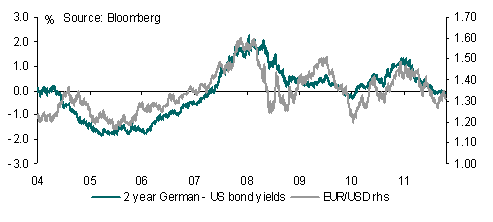
The bottom line is that the EUR is suffering from a widening in the US / Europe (Germany) bond yield differential as it is becoming increasingly clear that the US economy will strongly outperform the Eurozone economy this year. As noted at the beginning of the week EUR/USD was set to drop to below support around 1.3055. Having hit this level, strong support around the 1.2974 level moves into sight.

Ahead of today’s quarterly Swiss National Bank meeting at which no change in policy is widely expected, EUR/CHF has taken a sharp lurch higher, finally moving away from around the 1.2050 level it has been trading at over recent weeks. While I am bearish on the CHF over the medium term further upside in EUR/CHF will be limited over the short term given that the move in the currency is at odds with interest rate differentials which have actually narrowed between the Eurozone and Switzerland. Technical resistance around 1.2298 will cap gains over coming sessions.

As for USD/CHF the picture remains a bullish one, with general USD strength driven by higher yields, pushing the currency pair higher. I look for a test of resistance around 0.9393 over coming sessions.

Greece throws a spanner in the works

Having already retraced around 50% of its losses from its high around 4 April to its low on 27 October the USD index is on a firm footing and looks set to extend gains. The USD is benefitting both from the EUR’s woes and receding expectations of more US quantitative easing in the wake of less negative US data releases.

Whether the USD is able to build on its gains will depend on the outcome of the Fed FOMC meeting, accompanying statement and press conference today. While there have been some noises from Fed officials about the prospects of more QE, the Fed is likely to keep policy settings unchanged, leaving the USD on the front foot.

Greece has thrown a spanner in the works by calling a national referendum on the European deal. The fact that this referendum may not take place until January will bring about a prolonged period of uncertainty and further downside risks for the EUR against the USD and on the crosses. As a result of the increased uncertainty from the referendum, growing doubts about various aspects of last week’s agreement as well as hesitation from emerging market investors to buy into any European investment vehicle, peripheral bond spreads blew out further, and the EUR dropped.

The immediate focus will be on emergency talks today between European leaders in Cannes where Greek Prime Minister Papandreou has been summoned at a time when his grip on power appears to be slipping ahead of a government confidence vote on Friday. EUR/USD looks set to slip to support around 1.3525.

The Swiss National Bank’s floor under EUR/CHF has held up well since it was implemented in early September. How well it can be sustained going forward is questionable especially given that risk aversion is intensifying once again. A weaker than forecast reading for the Swiss October manufacturing PMI yesterday falling further below the 50 boom / bust reading to 46.9 highlights the growing economic risks and consequent pressure to prevent the CHF from strengthening further. However, now that Japan has shown its teeth in the form of FX intervention the CHF may find itself once again as the target of safe haven flows.

Technical indicators revealed that GBP was overbought and its correction lower was well overdue. However, GBP looks in better shape than the EUR even in the wake of some mixed UK data yesterday. On a positive note, UK Q3 GDP surprised on the upside in line with our expectations coming in at 0.5% QoQ. However, the forward looking PMI manufacturing index dropped more than expected in October, down to 47.4 suggesting that UK economic momentum is waning quickly.

EUR/GBP looks set to test its 12 September low around 0.8259 but GBP/USD remains vulnerable to a further pull back against a resurgent USD. Overall, GBP’s resilience despite the implementation of more quantitative easing by the Bank of England has been impressive and I expect it to continue to benefit from its semi safe haven status

Euro crisis intensifies

The blowout in eurozone non-core debt has intensified and unlike in past months the EUR has been a clear casualty. The lack of a concrete agreement over a solution given divergent views of EU officials, the European Central Bank (ECB) and private sector participants threatens a further ratcheting higher of pressure on markets over coming weeks.

The only real progress overnight as revealed in the Eurogroup statement appeared to be in the renewing the option of buying back Greek debt via the eurozone bailout fund, extending maturities and lowering interest rates on loans. This will be insufficient to stem the pressure on the EUR, with the currency verging on a sharp drop below 1.40.

The USD continues to take advantage of the EUR’s woes and has actually staged a break above its 100-day moving average yesterday after several attempts previously. This sends a bullish signal and the USD is set to remain supported given that there is little in sight of a resolution to the problems festering in the eurozone.

Today’s release of the June 22 Fed FOMC minutes will give some clues to Fed Chairman Bernanke’s testimony to the House of Representatives tomorrow, but as long as the minutes do not indicate a greater willingness to embark on more asset purchases, the USD is set to remain resilient.

GBP has also benefitted from the EUR’s weakness, and unlike the EUR has only drifted rather than dived versus the USD. However, the UK economy is not without its own problems as revealed in a further drop in retail sales overnight, albeit less negative than feared, with the British Retail Consortium (BRC) like for like sales falling 0.6% in June.

A likely increase in June CPI inflation in data today to a 4.8% annual rate will once again highlight the dichotomy between weak growth and high inflation. In turn, such data will only provoke further divisions within the Bank of England MPC. While further gains against the beleaguered EUR are likely, with a test of EUR/GBP 0.8721 on the cards in the short term, GBP will struggle to sustain any gain above 1.6000 versus USD.

Both AUD and NZD are vulnerable against the background of rising risk aversion and a firmer USD in general. However, both currencies are not particularly sensitive to risk aversion. Interestingly the major currency most sensitive to higher risk aversion in the past 3-months is the CAD and in this respect it may be worth considering playing relative CAD underperformance versus other currencies.

As for the AUD it is more sensitive to general USD strength, suggesting that it will be restrained over coming sessions too and given that market positioning is still very long AUD, there is scope for further downside pressure to around 1.0520 versus USD.