EUR/JPY set to slip further

The EUR looks set to plumb lower over coming weeks but how quickly will it fall given that market positioning is already at record low levels? The absence of official investors such as central banks who are normally strong buyers of EUR on dips, helped to pull the rug from under the EUR, resulting in a fairly sharp lunge lower. While it is easy to jump on the bandwagon expecting a further sharp fall this week, it may be worth taking some caution given the extent of short market positioning.

Admittedly officials in Europe are not too worried, and quite rightly so, given that the currency remains overvalued and still far too strong. Moreover, FX options market have also not reacted too much to the move, suggesting that for most, the decline in the EUR is not something to be too excited about. The underperformance of European data releases relative to the US over recent weeks adds further ammunition to those calling for a weaker EUR and assuming this divergence in data performance continues, the EUR will find it difficult to sustain much of a recovery.

Meanwhile the JPY continues to remain firm despite the generally firm USD tone this year. The JPY did give up some ground at the end of last week but shows little inclination to head back above the 78.0 level. Japanese official worries about JPY strength were evident in comments from Finance Minister Azumi who rolled out the usual mantra that they were watching FX market closely. He also expressed growing concerns about the drop in the EUR, highlighting concerns about the impact on Japanese exports as EUR/JPY drops to multi year lows.

Unfortunately for Japanese officials it appears that the EUR will get weaker and at least over the short term, the JPY stronger. EUR/JPY looks set to drop to its October 2000 low around 89.00 over coming weeks against the background of continued pressure in the Eurozone and elevated risk aversion.
FX sensitivities to yield differentials

A lot has been made about the hawkish language from a few Federal Reserve FOMC members over recent days and growing speculation about whether quantitative easing (QE2) will end earlier than initially planned. In turn, this has been noted as a positive factor for the USD. Undoubtedly there are a few in the Fed who are becoming more nervous about current policy settings but it is highly unlikely that the Fed will not complete its $600 billion in planned asset purchases by the end of June.

The biggest imponderable is how and when the Fed begins its exit policy and how effectively/efficiently it can be done. Whilst it is likely to be over a year before the Fed Funds rate is hiked, the USD will be sensitive to balance sheet reduction. Moreover, the way in which the Fed reduces the size of the balance will also be important given the likely active approach to liquidity withdrawal required.

For the present, it should be noted that even with the hawkish Fed rhetoric and increase in US bond yields (2 year yields have risen by close to 25bps over the last couple of weeks) the USD is actually lower versus EUR than where it was two weeks ago. The reality is that German bund yields have risen by even more than US yields ahead of the anticipated European Central Bank (ECB) rate hike on 7 April (the case for which appears to have been sealed by the above consensus 2.6% YoY reading for March eurozone CPI).

However, I would be cautious about ascribing general FX moves at present to yield / interest rate differentials given that it is only EUR crosses (including EUR/JPY, EUR/GBP, EUR/CAD, and EUR/USD) that hold a statistically significant relationship with yields. All of this implies EUR crosses look supported ahead of the upcoming ECB meeting, with EUR/USD unlikely to sustain a drop below 1.4000 ahead of the rate decision. What happens after depends on the press conference. Bearing in mind that markets have already priced in 75bps of rate hikes by the ECB it would take an even stronger tone from the ECB to push the EUR higher, something that looks unlikely

The Week Ahead

Housing and durable goods orders data will form the highlights of the US calendar this week. Speeches from several Fed speakers will also give some further guidance to the appetite for completing the Fed’s $600 billion in asset purchases. Overall it will be a slow start for FX markets with liquidity thinned by the Presidents Day holiday and as a result currencies are likely to remain in relatively tight ranges. The heavy tone of the USD seen last week is likely to persist over coming days given the absence of driving factors. Even the unrest in the Middle East has been unable to derail the improving trend in risk appetite, another factor dampening USD sentiment.

The EUR held up well last week recouping its early week losses to end on a firm note. The ability of the EUR to shake off various bits of bad news was impressive but whether it can continue to do so is debatable. Data releases are unlikely to provide much of a boost. Whilst eurozone business surveys set to remain at high levels, consistent with a rebound in Q1 GDP growth, further improvements are unlikely. The week kicks off with the February German IFO business confidence survey but at best this will reveal stable reading. The EUR may find some support from signs of higher and in Germany and an above consensus reading for M3 money supply growth though this is not usually a market mover. The data will likely feed nervousness about European Central Bank (ECB) tightening. Ireland could rock the boat however, with general elections likely to keep markets nervous about potential renegotiations of Ireland’s bailout terms.

Although deflationary pressures are easing in Japan there is a long way before the spectre of inflation will emerge. Nonetheless, the Bank of Japan (BoJ) revised up its growth outlook last week, suggesting that the likelihood of more aggressive measures to combat deflation is narrowing. A reminder of ongoing deflation will come with the release of January CPI data this week whilst trade data will be watched to determine what impact the strength of the JPY is having on exports. Both EUR/JPY and USD/JPY are close to the top of their recent ranges and the data are unlikely to provoke a break higher. USD/JPY will likely remain capped around 84.51 whilst EUR/JPY will find tough resistance around 114.02.

GBP performed even better than the EUR last week helped by an even more hawkish sounding than usual BoE Monetary Policy Committee (MPC) member Sentance and a letter from the BoE governor hinting at rate hikes. Even a relatively more slightly dovish Quarterly Inflation Report failed to halt GBP’s ascent. Further direction will come from the February MPC minutes in which we expect to see two dissenters, namely Sentence and Weale who likely voted for a rate hike. However, there is a risk that they may have been joined by at least one other, with speculation that MPC member Bean may have joined the dissenters. Such speculation alongside the jump in January UK retail sales at the end of last week will likely add to more upside potential for GBP, setting it up for another gain this week. Its upward momentum may however, be hampered by the large net long GBP positioning overhang.

Split personality

Markets are exhibiting a Strange Case of Dr Jekyll and Mr Hyde, with a clear case of split personality. Intensifying risk aversion initially provoked USD and JPY strength, with most crosses against these currencies under pressure. Both USD/JPY and EUR/JPY breezed through psychological and technical barriers, with the latter hitting a nine-year low. However, this reversed abruptly in the wake of extremely poor US existing home sales, which plunged 27.2% in July, alongside downward revisions to prior months, a much bigger drop than forecast.

Obviously double-dip fears have increased but how realistic are such fears? Whilst much of the drop in home sales can be attributed to the expiry of tax credits, investors can be forgiven for thinking that renewed housing market weakness may lead the way in fuelling a more generalized US economic downdraft. The slow pace of jobs market improvement highlights that the risks to the consumer are still significant, whilst tight credit and weaker equities, suggests that wealth and income effects remain unsupportive.

FX markets will need to determine whether to buy USDs on higher risk aversion or sell USDs on signs of weaker growth and potential quantitative easing. I suspect the former, with the USD likely to remain firm against most risk currencies. The only positive thing to note in relation to the rise in risk aversion is that it is taking place in an orderly manner, with markets not panicking (yet).

European data in the form of June industrial new orders delivered a pleasant surprise, up 2.5%, but sentiment for European markets was delivered a blow from the downgrade of Ireland’s credit rating to AA- from AA which took place after the close. The data suggests that the momentum of European growth in Q3 may not be as soft as initially feared following the robust Q2 GDP outcome.

Japan has rather more to worry about on the growth front, especially given the weaker starting point as revealed in recently soft Q2 GDP data. Japan revealed a wider than expected trade surplus in July but this was caused by a bigger drop in exports than imports, adding to signs of softening domestic activity. The strength of the JPY is clearly making the job of officials harder but so far there has been no sign of imminent official FX action.

Japan’s finance minister Noda highlighted that recent FX moves have been “one sided” and that “appropriate action will be taken when necessary”. The sharp move in JPY crosses resulted in a jump in JPY volatility, a factor that will result in a greater probability of actual FX intervention but the prospects of intervention are likely to remain limited unless the move in the JPY accelerates. USD/JPY hit a low of 83.60 overnight but has recovered some lost ground, with 83.50 seen as the next key support level. JPY crosses may see some support from market wariness on possible BoJ JPY action, but the overall bias remains downwards versus JPY.

Wait And See

It’s difficult to be too conclusive in my blog post today given that markets are in waiting mode for a number of events to pass. First and foremost is the US May jobs report. The consensus forecast is for a gain of 536k in nonfarm payrolls and a slight drop in the unemployment rate to 9.8%. Payrolls estimates range from a high of 750k to a low of 220k, the wide margin likely reflecting the uncertainty of the amount of census hiring.

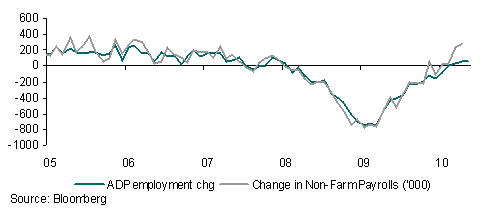
On the face of it a 500k+ gain in payrolls looks strong, but the bulk of this, probably about three-quarters, will made up of census hiring which by its nature is transitory. Therefore, only about 100k in payrolls will be due to private sector jobs growth, which is still not bad. Most of the clues leading up to the jobs data are consistent with the consensus, including the 55k increase in the May ADP.

The second event is the change in Prime Minister in Japan. Naoto Kan, the previous Finance Minister is set to take over the helm. His job is going to tough, with all eyes on how and when the government begins to get to grips with Japan’s burgeoning debt burden which is approaching 200% of GDP. Most of this, around 96% is held by domestic investors, so Japan is less exposed to foreign investor sentiment.

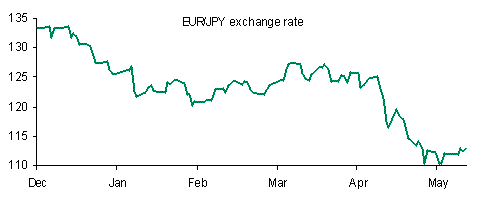
Nonetheless, even domestic investors including many large life insurance companies are increasing their overseas investments at the expense of Japanese debt. Kan is also a supporter of weaker JPY so at the least the rhetoric from Japanese officials to weaken the JPY will step up, especially given the very painful move in EUR/JPY over recent months.

Finally, the G20 meeting beginning today in South Korea will garner attention. Topics will include bank regulation and capital requirements, the European debt crisis, and policy tools such as the recent suggestion by South Korea to make permanent the currency swap agreements between central banks. Aside from a commitment to keep policy supportive, and likely talking up the efforts to combat the crisis in Europe, it is difficult to see anything particularly market moving emerge from the meeting.