Data and earnings focus

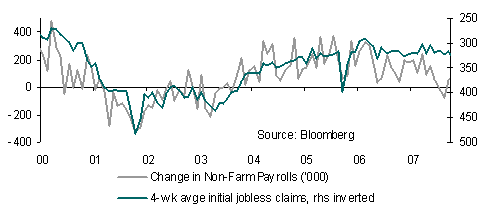
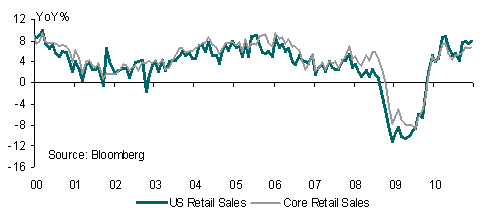
Friday’s round of US data were generally upbeat, highlighting that consumer spending is coming back to life. Inflation pressures however, remain benign at least on the core reading highlighting the Fed’s concern that inflation is running below the level consistent with its mandate. In other words it will be a long time, probably late into 2012 before policy rates increase.
While the Fed is no hurry to raise rates despite a few hawkish rumblings within the FOMC the European Central Bank (ECB) in contrast appears to have become more eager to pull the trigger for higher rates. ECB President Trichet’s hawkish press conference last week set the cat amongst the pigeons and marked a clear shift in ECB rhetoric towards a more hawkish stance.

A very big problem for the ECB is that the eurozone economy is not performing along the lines that its hawkish rhetoric would suggest, especially in the periphery. Growth momentum in the core in contrast, as likely reflected in the January ZEW investor confidence and IFO business confidence survey data this week in Germany, remains positive. Both surveys are likely to stabilize at healthy levels but how long can the likes of Germany drag along the eurozone periphery?

There will be relatively more attention on the meeting of Eurogroup/Ecofin officials, with focus on issues such as enlarging the size of the European Financial Stability Facility (EFSF) bailout fund and development of a “comprehensive plan” to contain the eurozone crisis. Don’t look for any conclusive agreements as this may have to wait until the European Union (EU) Council meeting on 4 February assuming (optimistically given ongoing German resistance) some agreement can even be reached.

Following the success (albeit at relatively high yields) of the eurozone debt auctions last week, sentiment for peripheral debt will face further tests this week in the form of debt sales in Spain, Belgium and Portugal.

The US Martin Luther King Jr. holiday will result in a quiet start to the week for markets but there will be plenty to chew on. This week’s key earnings reports include several banks scheduled to release Q4 earnings. Financials are a leading sector in the rally in equities at present and these earnings will be critical to determine whether the rally has legs.

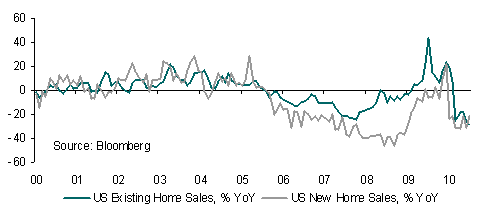
The US data slate includes January manufacturing surveys in the form of the Empire and Philly Fed, both of which are likely to post healthy gains whilst existing home sales are also likely to rise. This will not change the generally weak picture of the US housing market, with high inventories and elevated foreclosures characterizing conditions. As if to prove this, housing starts are set to drop in December. On the rates front, the Bank of Canada is likely to keep its policy rates on hold this week.
After coming under pressure last week much for the USD will depend on the eurozone’s travails to determine further direction. Concrete evidence of progress at the Ecofin may bolster the EUR further, with resistance seen around 1.3500 but don’t bank on it. The ability of eurozone officials to let down often lofty expectations should not be ignored. In any case following sharp gains last week progress over coming days for the EUR will be harder to achieve.
Ratings rampage hits Euro

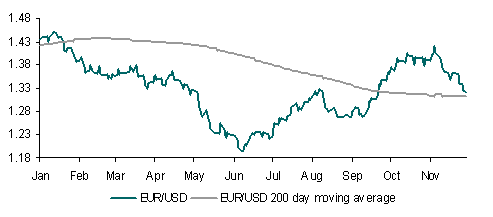
Both the data flow and market liquidity will be thin over the last couple of weeks of the year. After a bashing over much of H2 2010 it looks as though the USD will end the year in strong form having risen by over 6% since its early November low. In contrast the EUR is struggling having found no support from the meeting of European Union officials at the end of last week in which they agreed to a permanent sovereign debt resolution after 2013 but failed to agree on expanding the size of the bailout fund (EFSF). Similarly there was no traction towards a common euro bond. EUR/USD is now verging on its 200-day moving average around 1.3102, a break of which could see a drop to around 1.2960.

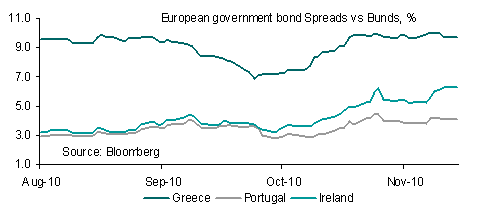
The failure to enlarge the size of the EFSF was disappointing given worries that it is perceived to be insufficient to cope with the bailout of larger eurozone countries if needed. It also highlight that the burden on the European Central Bank (ECB) to prop up eurozone bond markets until confidence improves. The increase in the size of ECB capital from EUR 5.8 billion to EUR 10.8 billion will help in this respect. Such support was clearly needed last week following the rampage across Europe by ratings agencies culminating in Moody’s five notch downgrade of Ireland’s credit ratings, surprising because of its severity rather than the downgrade itself. Ireland’s ratings are now just two notches above junk status and the negative outlook could mean more to come.

It was not just Ireland’s ratings that came under scrutiny. Ireland’s multi notch downgrade followed Moody’s decision to place Greece and Spain on review for a possible downgrade whilst S&P revised Belgium’s outlook to negative. Unsurprisingly peripheral debt markets came under renewed pressure as a result outweighing positive news in the form of strong flash eurozone PMI readings and firm German IFO business confidence survey. EUR did not escape and sentiment for the currency remains weak, with CFTC IMM speculative positioning data revealing a fourth straight week of net EUR short positioning in the week to 14th December.

In contrast, sentiment for the US economy continues to improve. Congress’ swift passage of President Obama’s fiscal plan will help to shore up confidence in US recovery. Data this week will be broadly positive too. On Wednesday, US Q3 GDP data is likely to be upwardly revised to a 2.8% QoQ annualized rate. Durable goods orders excluding transportation are set to increase by a healthy 2.0% (Thu) whilst both existing (Wed) and new (Thu) home sales will reveal rebounds in November following a drop in the previous month.

In the UK the main highlight is the Bank of England (BoE) MPC minutes. Another three way split is expected but this should not cause more than a ripple in FX markets. GBP/USD has slipped over recent days but there appears to be little other than general USD strength responsible for this. The currency pair looks vulnerable to a drop below 1.5500, with 1.5405 seen as the next support level. On balance, the USD will be in good form this week although the drop in US bond yields at the end of last week may take some of the wind out of its sails.

Euro support unwinding

The USD is set to end the year in firm form aided by rising US bond yields. Yesterday’s data supported this trend. The Empire manufacturing survey beat expectations rebounding nearly 22 points in December and industrial production rose 0.4% in November although there was a downward revision to the previous month. This was against the background of soft inflation, with headline and core CPI rising 0.1%, indicating that the Fed will remain committed to its $600 billion program of asset purchases.

EUR/USD dropped below support around 1.3280, weighed down by various pieces of negative news. Moodys downgrade of Spain’s credit ratings outlook dented sentiment but the bigger sell off in EUR followed the move in US bond yields. The prospect of EUR recovery over the short term looks limited. The issue of finding agreement on a permanent debt resolution fund continues to fuel uncertainty and will likely come to a head at the EU summit starting today.

Added to this Ireland’s main opposition party which will likely play a part in forming a new government early next year wants some of the debt burden shared with senior bank debt holders. The good news in Europe was few and far between but at least Ireland’s parliament backed the EU/IMF bailout for the country. Of course the backing could be derailed following elections in January. Perhaps the most surprising aspect of the move in EUR is that it’s not weaker. The next support level for EUR/USD is around 1.3160.

The divergence between the US and Europe on policy is stark, with loose fiscal and monetary policy in the US providing a significant prop to the US economy, whilst the much tighter fiscal stance and less loose monetary policy threatens to result in more pressure on eurozone growth especially against the background of an overvalued EUR. This divergence will manifest itself next year in the form of US growth outperformance and stronger USD vs. EUR.

The resilience of the UK consumer continues to surprise, with the CBI distributive trades survey coming in strong and rising further to +56 in December. The only problem with the survey data is that is has not tracked official data. November retail sales data today will give further clues to the strength of spending heading into Christmas. More worryingly from the Bank of England’s perspective is the fact that inflation continues to rise despite assurances that the increase in inflation is temporary. At the least the likelihood of more quantitative easing QE from the BoE has evaporated though it is still a long way off before interest rates are hiked. In the meantime GBP continues to underperform both EUR and USD though GBP/USD will find strong support around 1.5512.

Upward pressure on US yields and the USD us unlikely be derailed US data releases today. Housing starts are set to bounce back in November, with a 6% gain expected, whilst the trend in jobless claims will likely continue to move lower. The Philly Fed manufacturing survey is set to lose a little momentum reversing some of November’s sharp gain but will still remain at a healthy level.

Irish bailout leaves EUR unimpressed

As has been the case since the beginning of the global financial crisis policy makers have found themselves under pressure to deliver a solution to a potentially destabilising or even systemic risk before the markets open for a new week in order to prevent wider contagion. Last night was no different and following urgent discussions a EUR 85 billion bailout for Ireland to be drawn down over a period of 7 ½ years was agreed whilst moves towards a permanent crisis mechanism were brought forward. As was evident over a week ago a bailout was inevitable but the terms were the main imponderable.

Importantly the financing rate for the package is lower than feared (speculation centered on a rate of 6.7%) but still relatively high at 5.8%. Moreover, no haircuts are required for holders of senior debt of Irish banks and Germany’s call for bondholders to bear the brunt of losses in future crises was watered down. The package will be composed of EUR 45 bn from European governments, EUR 22.5 bn from the IMF and EUR 17.5 bn from Ireland’s cash reserve and national pension fund.

The impact on the EUR was stark, with the currency swinging in a 120 point range and failing to hold its initial rally following the announcement. A break below the 200-day moving average for EUR/USD around 1.3131 will trigger a drop to around 1.3020 technical support. Officials will hope that the bailout offers the currency some deeper support but this already seems to be wishful thinking. The EUR reaction following the Greek bailout in early May does not offer an encouraging comparison; after an initial rally the EUR lost close to 10% of its value over the following few weeks.

Although it should be noted that the bailout appears more generous than initially expected clearly the lack of follow through in terms of EUR upside will come as a blow. The aid package has bought Ireland some breathing space but this could be short lived if Ireland’s budget on December 7 is not passed. Moreover, the bailout will not quell expectations that Portugal and perhaps even Spain will require assistance. Indeed, Portugal is the next focus and the reaction to an auction of 12-month bills on 1 December will be of particular interest.

Taken together with continued tensions on the Korean peninsular, position closing towards year end ongoing Eurozone concerns will likely see a further withdrawal from risk trades over coming weeks. For Asian currencies this spells more weakness and similarly commodity currencies such as AUD and NZD also are likely to face more pressure. The USD remains a net beneficiary even as the Fed continues to print more USDs in the form of QE2.

Data and events this week have the potential to change the markets perspective, especially the US November jobs report at the end of the week. There is no doubt that payrolls are on an improving trend (145k consensus) in line with the declining trend in jobless claims but unfortunately the unemployment rate is set to remain stubbornly high at 9.6% and this will be the bigger focus for the Fed and markets as it implies not let up in QE. As usual further clues to the payrolls will be garnered from the ADP jobs report and ISM data on Wednesday.

Contrasting Stance

Despite some recent Fed speakers putting doubts into the minds of the many now looking for the Fed to embark on QE2 in November, the minutes of the 21 September FOMC meeting gave the green light to the commencement of asset purchases next month. Although there is clearly no unanimity within the FOMC the majority favour further easing. Incremental data dependent asset purchases will be the most likely path.

The minutes leave the USD vulnerable to further declines but extreme short USD positioning suggest that there is plenty of risk of short covering and more likely we are probably set for a period of consolidation over coming weeks before the USD resumes its decline.

Unlike the Fed, BoJ and BoE, which remain in easing mode the ECB is already veering towards an exit strategy, albeit one that is unlikely to take effect for some time. Hawkish comments by the ECB’s Weber overnight managed to give a lift to the EUR in the wake of a further widening in interest rate differentials between the eurozone and US. Indeed, interest rate differentials (2nd contract futures) are at the widest since Feb 2009, a factor that is providing plenty of underlying support for the EUR.

Further out the follow through on the EUR will depend on whether markets believe Weber’s stance is credible. Germany’s economy is doing well but it is highly likely that Southern European officials would oppose any premature tightening in policy given the parlous state of their economies. The stronger EUR will also do some damage to growth, with its recent appreciation acting as a de facto monetary tightening.

Despite the positive influence of Weber’s comments short-term technical indicators show that the trend in EUR is vulnerable, with clear signs of negative divergence as the spot rate is still trending higher whilst the relative strength indices (RSI) are trending lower. Moreover, EUR speculative positioning is at its highest in a year, albeit still well of its all time highs. Speculators may be reluctant to build on longs in the near term. A clean and sustained break above EUR/USD 1.4000 level still looks like a stretch too far though any downside is likely to be limited to strong support around 1.3895.

Unlike the perception that the ECB is highly unlikely to follow the Fed in a path of QE2 the policy stance of the BoE is far more uncertain, a fact that continues to weigh on GBP, especially against the EUR. Recent data in the UK has played into the hands of the doves, with housing market activity and prices coming under renewed pressure, retail sales surveys revealing some deterioration and consumer confidence as revealed in the Nationwide survey overnight, weakening further.

BoE MPC member Miles summarized the situation by highlighting that the UK faces “some big risks” and even hinted that the BoE may “come to use QE”. UK jobs data today is unlikely to give any support to sentiment for GBP although as per its recent trend GBP is likely to remain resilient against the USD whilst remaining under pressure against the EUR, with a move to resistance around EUR/GBP 0.8946 on the cards in the short-term