AUD and NZD outperformance

Just as the euro looked as though it was showing some signs of rebounding following the battering it received in the wake of the downgrade of Greece’s credit ratings, S&P placed Spain on credit watch negative from neutral, which helped drag EUR/USD all the way down again. Expect more to come as sovereign risk concerns / fiscal deficit remain in focus. EUR/USD was helped by the usual sovereign demand, preventing a test of technical support around 1.4625 but another push lower is likely over the short term.

Despite a tough budget from Ireland yesterday, it alongside the likes of Latvia, Ireland, Hungary and Portugal will remain on the ratings agencies’ hit lists. Eurozone periphery bond spreads have widened sharply against bunds but even larger countries in Europe such as Italy have seen an increase in funding costs. Added to these concerns are the lingering uncertainties about Dubai as reflected in the continued rise in CDS.

In contrast, growth worries are receding quickly in Australia where another robust jobs report was released. Employment rose 31.2k in November, with an upward revision to the previous month, to 27.2k from 24.5k initially. The details looked good too, with much of the jobs increase coming from full time hires (30.8k). The jobless rate fell to 5.7% compared to 5.8% in October. Taken together with the hawkish slant to the RBNZ statement, the data will help keep the AUD and NZD resilient to any sell off in risk trades.

The decision by the RBNZ to leave interest rates unchanged at 2.5% came as no surprise. However, Governor Bollard did shift away from the earlier pledge not to hike interest rates until H2 10 and stated that a hike could come around the middle of 2010. The RBNZ also upgraded its growth forecasts. A rate hike could come even earlier in my view, a factor likely to keep the NZD well supported.

Markets will digest more interest rate decisions today, in the UK and Switzerland. No change is likely from both the BoE and SNB but the issue of QE will remain at the forefront, especially given the split decision by the BoE MPC at the last meeting. As for the SNB the usual concerns about CHF strength are likely to be expressed but the tone of the SNB’s comments are likely to remain dovish, expressing little urgency to begin implementing an exit strategy.

The US data slate is light but does include weekly jobless claims and October trade data. There will be more interest than usual on the claims data given the surprise in last week’s payrolls report. Claims have been on an improving trend declining at a more rapid pace than previous recessions and markets will eye the numbers to determine whether they point to further improvement in payrolls or whether they suggest the November data was merely an aberration.
Gold / FX correlations

There is no shortage of cash rich investors in Asia even amidst the current troubles in Dubai. Indeed, sentiment in the gemstones market is particularly upbeat, with a rare five-carat pink diamond selling for a record HK$84.24 million in Hong Kong. Perhaps this is a good reflection of abundant liquidity and of course wealth in Asia and in particular China, with talk that mainland Chinese investors were strong participants in the diamond auction.

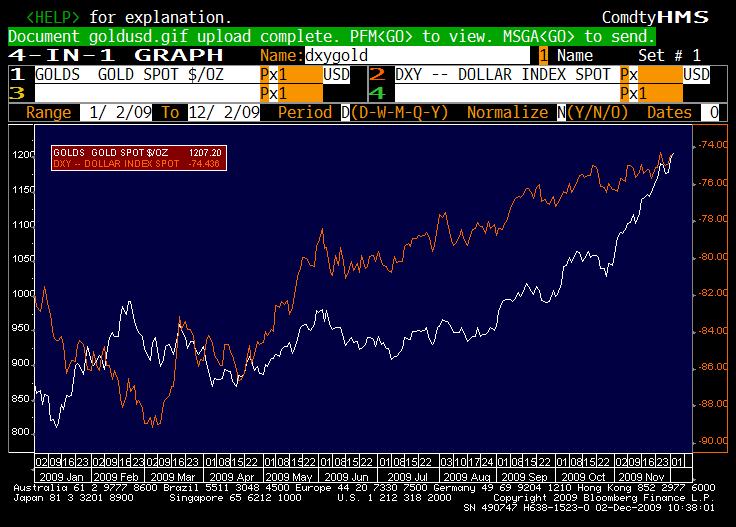
It’s not just diamonds that are selling for record prices; gold hit a fresh high above $1,200 and once again at least part of this is attributable to the appetite of Asian central banks as well as demand from China as the country tries to increase its gold reserves. The rise in gold prices has coincided with a bullish announcement from the world’s top gold producer that it has completely eliminated its market hedges earlier than forecast due to the positive outlook on prices and waning supply.

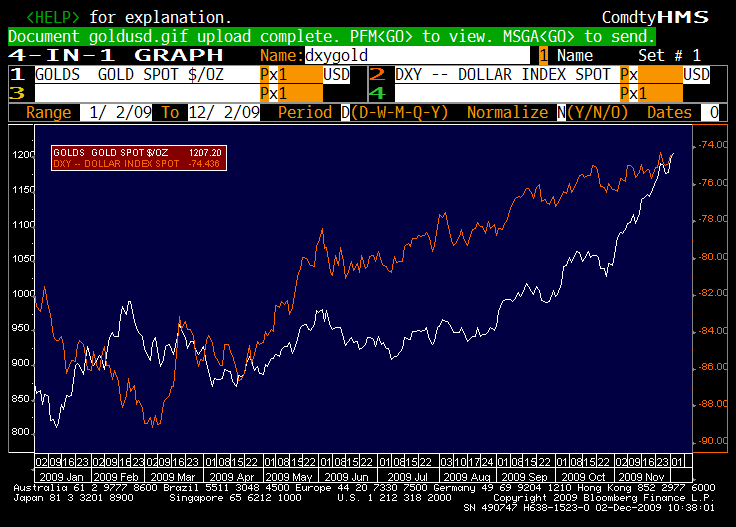
The correlation between gold prices and the USD remains very strong at -0.88 over the last 3-months, with firmer gold prices, implying further USD weakness. In fact, the gold / USD correlation has been consistently strong over the past few months and is showing little sign of diminishing.

Over the past 6-months the correlation has been -0.91 and over the past 1-month it was -0.75.  Assuming that anything above 0.70 can be considered statistically significant, the relationship shows that USD weakness has been well correlated with gold strength and that despite talk of a breakdown in the relationship it appears to remain solid. 

As long as the bullish trend in gold continues, the pressure on the USD will remain in place.  Adding to this pressure is the fact that risk is back on for now. Markets took the news of a fall in the ISM manufacturing index and in particular the drop in the employment component in its stride even though it supports the view of a weaker than consensus drop in payrolls in November when it is published on Friday.

There are still plenty of reasons to be cautious in the weeks ahead and although we appear to be back in a “risk on” environment markets are likely to gyrate between “risk on” and “risk off” over coming weeks. At least for now, the USD looks to remain under pressure but if risk aversion creeps back up as I suspect it may then the USD will see a bit more resilience into year end. 

Moreover, central banks globally are reaching the limits of their tolerance of USD weakness and will be tested once again, with EUR/USD back above 1.5000, EUR/CHF moving back below 1.5100 and the USD/JPY set to re-test 85.00 following the relatively benign measures announced by the BoJ in which the Bank did little to stem deflationary pressure or weaken the JPY.

Buffer for risk trades

Firmer data, most recently in the form of the stronger than expected US consumer confidence and dovish Fed comments as reiterated in the Fed FOMC minutes will provide a buffer for risk trades, supporting the USDs role as the prime funding currency over coming weeks.  Nonetheless, any improvement in sentiment will have to push against the weight of position adjustment into year-end as investors book profits on risk trades.  The net effect could be an increase in volatility especially in thinning liquidity expected in the wake of holidays in Japan and the Thanksgiving holiday in the US.

This could make it difficult for many asset markets to sustain key psychological and technical levels.  Whether the S&P 500 can hold gains above 1100 could prove significant as could EUR/USD’s ability to hold onto gains above 1.50.  The expiry of last week’s EUR/USD 1.48/1.51 option may provoke a move out of its range but there seems to be little appetite for a sustained break above the 23rd October high around 1.5061.  Even so, an upside bias is more likely given the likely softer tone to the USD. EUR/USD looks well supported around 1.4865.

Position adjustment towards the end of the year has been particularly evident in FX markets.  For instance, the latest CFTC Commitment of Traders’ data revealed that speculative investors have sharply reduced net long EUR positions into last week whilst there was a significant degree of short covering of GBP positions.  It is worth noting however, that aggregate USD net short speculative positions actually increased, largely due to a sharp jump in net JPY positioning, suggesting that overall sentiment for the USD remains very negative.

It is difficult to see a strong reversal in USD sentiment into year-end and the Fed’s commitment to maintaining interest rates at a low-level for an “extended period” taken together with hints of extending asset purchase programmes suggests little support to the USD over the short-term unless there is a more significant increase in risk aversion and or profit taking/book closing into year-end.  It seems that the impact of improved risk appetite is winning for now, giving no respite to the USD.

CNY appreciation speculation hits EUR

The USD index is trading close to a 15-month low and direction remains firmly downwards as risk appetite continues to improve and the USD’s status as a funding currency remains unaltered.   Whether it’s a weak USD driving stocks higher or vice-versa, US stocks are currently trading at 13-month highs, maintaining the negative correlation with the USD index. 

One currency that has failed to take advantage of the weak USD over recent days is EUR/USD and its failure to make a sustainable break above 1.50 highlights that momentum in the currency is fading.  EUR/USD looks vulnerable on the downside in the short term, with resistance seen around 1.5050.  Speculation that China will resume CNY appreciation has taken some of the steam out of the EUR given that it implies less recycling of intervention flows into the currency.  

The speculation that China will allow a stronger CNY follows a significant change by China’s central bank, the PBOC to its stated FX policy. The Bank removed the statement  that it will keep the CNY “basically stable” and noted instead that foreign exchange policy would take into account “capital flows and major currency movements”.   

Although this does not mean the CNY will immediately strengthen it will add to speculation that China will allow some appreciation next year following a long stretch in which the CNY has effectively been stuck in a very tight range against the USD.   The timing of the change in rhetoric should come as little surprise as it coincides with greater international calls for a stronger CNY to help rebalance the global economy as well as an improvement in economic data domestically.  

Any change in stance on the CNY could be a significant factor in determining the direction for the EUR given that it not only implies less flows into EUR from China but also from other central banks in Asia which may take China’s cue and allow greater strengthening of their currencies versus USD.  Given that central banks in Asia had been intervening to prevent local currency strength and then recycling this USD buying into other currencies, especially EURs, the change in stance could play negatively for the EUR. 

Currencies are also a focus of the APEC meeting of finance ministers, with the draft statement agreeing that flexible exchange rates and interest rates are critical in obtaining balanced and sustainable growth.  This has interesting implications given the FX intervention by Asian central banks to prevent their respective currencies from strengthening and attention will focus squarely on China’s CNY policy.

Searching for inspiration

After an eventful week which included several central bank meetings and the US Jobs report there is less for markets to get their teeth into this week.  Despite the weak US jobs report risk appetite looks relatively resilient suggesting that the USD will struggle to make much headway over coming days.  

Despite all of the events last week markets have been uninspired.  Even the G20 meeting delivered little to be excited about with no further developments on how to rebalance the global economy and the USD’s role in the process.  The lack of attention on the USD will leave it with little directional influence this week, with equity markets likely to the main driver once again.

One currency that may look a little better supported over coming days is the EUR.  GDP data later in the week is likely to reveal an expansion over Q3 after several quarters of contraction as indicated by various PMI data. Although it will likely be led by inventories and exports rather than domestic demand it will nonetheless come as good news, albeit backward looking.  Going forward growth in Europe is unlikely to match the pace of recovery in the US but for now the GDP data will be EUR supportive helping EUR/USD to gravitate around 1.50 and beyond. 

Meanwhile, central banks may also do their part in influencing currencies given their differing stances on monetary policy.  Although the Fed did not deliver any big surprises last week the FOMC statement will play for a softer USD as the currency looks to maintain its funding currency status for an “extended period”.   In contrast the RBA hiked rates as expected and despite hinting at more gradual rate increases in the months ahead the AUD continues to stand to benefit.   Going in the opposite direction the BoE increased its asset purchases but GBP avoided a significant negative fall out as the move is likely to be seen as the final step in the BoE’s asset purchase programme.