Ready for Fed QE2

The USD was already under pressure ahead of the Fed FOMC decision last night, with the EUR benefiting in particular from successful debt auctions in Ireland and Spain. The Fed statement resulted in a further lurch lower for the USD index as it fell through the 81.00 level on its way to testing the August low of 80.09. EUR/USD broke important technical resistance levels moving above its 200-day moving average (1.3215). In contrast, gold prices continued to surge hitting a new record high whilst 2-year Treasury yields fell to an all-time low.

The US Federal Reserve confirmed that it was ready to ease if needed. Although the decision to leave the Fed funds target rate at 0% to 0.25% unchanged and commitment to maintain exceptionally low levels of the rate for an “extended period” came as no surprise there was a subtle change in the language of the statement regarding further easing. The Fed noted that it was “prepared to provide additional accommodation if needed” a shift from the previous wording that it “will employ its tools as necessary”.

It appears to be a case of not if but when the Fed embarks on further quantitative easing and/or other policy accommodation. Once again the Fed offered no guideposts to determine the timing of easing and the decision will ultimately be data dependent. Nonetheless, the bias has clearly shifted towards more balance sheet expansion.

We expect core inflation to decline further over the coming months although we do not forecast a drop to as low as 0.5%. Nonetheless, declining core CPI could lead to the Fed’s disinflation concerns intensifying. Indeed, providing further rationale for the Fed’s conditional easing bias was the particularly dovish stance on inflation in the FOMC statement.

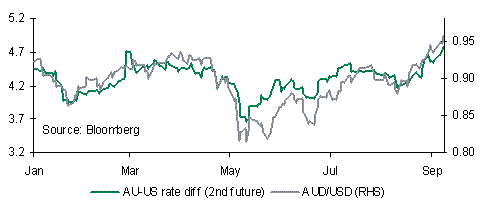
If it wasn’t obvious before it has become increasingly clear now that the USD will not relinquish its role as the ultimate funding currency for a long time to come. Although interest rate differentials are not yet the main driver for most currency pairs, with risk aversion retaining this role for now, there is a very high correlation between certain high yielding currencies and their respective interest rate differentials against the USD.

For instance, there is a high and significant correlation between interest rate differentials between Japan, Australia, Canada and the US and their respective currency pairs. AUD/USD is one to watch as the currency hit a fresh 25 month high overnight. Although the AUD looks rich at current levels, the shift in relative yield with the US overnight provides a further underpinning to the currency, with parity being talked about once again.
Even USD/JPY moved lower in the wake of the Fed statement dropping just below 85.00 although the threat of further official Japanese FX intervention will likely prevent a sharp drop in the currency pair. It will be interesting to see how far the market is prepared to go, with further threats of FX intervention by Prime Minister Kan overnight. Despite the threats the narrowing in US / Japan bond yields overnight suggests more downside pressure on USD/JPY and a fresh challenge for the Japanese authorities.

No Let Up in USD Pressure

At the end of a momentous week for currency markets it’s worth taking stock of how things stand. Much uncertainty remains about the global growth outlook, especially with regard to the US economy, potential for a double-dip and further Fed quantitative easing. Although there is little chance of QE2 being implemented at next week’s Fed FOMC meeting speculation will likely remain rife until there is clearer direction about the path of the US economy.

In Europe, sovereign debt concerns have eased as reflected in the positive reception to debt auctions this week. Nonetheless, after a strong H1 2010 in terms of eurozone economic growth the outlook over the rest of the year is clouded. Such uncertainty means that markets will also find it difficult to find a clear direction leaving asset markets at the whim of day to day data releases and official comments.

The added element of uncertainty has been provided by Japan following its FX intervention this week. Whilst Japanese officials continue to threaten more intervention this will not only keep the JPY on the back foot but will provide a much needed prop for the USD in general. Indeed Japan’s intervention has had the inadvertent effect of slowing but not quite stopping the decline in the USD, at least for the present.

The fact that Japanese officials continue to threaten more intervention suggests that markets will be wary of selling the USD aggressively in the short term. The headwinds on the USD are likely to persist for sometime however, regardless of intervention by Japan and/or other Asian central banks across Asia, until the uncertainty over the economy and QE2 clears.

Japan’s intervention has not gone down well with the US or European authorities judging by comments made by various officials. In particular, the FX intervention comes at a rather sensitive time just as the US is piling on pressure on China to allow its currency the CNY to strengthen further. Although US Treasury Secretary Geithner didn’t go as far as proposing trade and legal measures in his appearance before Congress yesterday there is plenty of pressure from US lawmakers for the administration to take a more aggressive stance, especially ahead of mid-term Congressional elections in November. Ironically, the pressure has intensified just as China has allowed a more rapid pace of CNY nominal appreciation over recent days although it is still weaker against its basket according to our calculations.

Another country that has seen its central bank intervening over many months is Switzerland, with the SNB having been aggressively intervening to prevent the CHF climbing too rapidly. However, in contrast to Japan the SNB is gradually stepping back from its intervention policy stating yesterday that it would only intervene if the risk of deflation increased. Even so, Japan may have lent the Swiss authorities a hand, with EUR/CHF climbing over recent days following Japan’s intervention.

The move in EUR/CHF accelerated following yesterday’s SNB policy meeting in which the Bank cut its inflation forecasts through 2013, whilst stating that the current policy stance in “appropriate”. Moreover, forecasts of “marked” slowdown in growth over the rest of the year highlight the now slim chance of policy rates rising anytime soon. Markets will eye technical resistance around 1.3459 as a near term target but eventually the CHF will likely resume its appreciation trend, with a move back below EUR/CHF 1.3000 on the cards.

What Stress?

Fed Chairman Bernanke has inadvertently fuelled an increase in risk aversion in the wake of his testimony to the Senate. Although Bernanke noted that he did not see the prospects of a double-dip as a high probability event he stated that the economic outlook is “unusually uncertain”. Nonetheless, although such measures would be implemented if the situation deteriorated further, the Fed was not planning on extending its non-traditional policy options in the near term.
USD benefits as Bernanke does not indicate more quantitative easing.

A combination of caution about growth prospects and disappointment that Bernanke stopped short of indicating that the Fed would embark on further non-conventional policy measures left equities weaker, but the USD was stronger, both due to higher risk aversion as well as less risk of the Fed turning the USD printing press back on again. Bernanke is back at Congress today, with a speech to the House Panel. Although this is effectively a repeat of yesterday’s testimony, the Q&A session may throw up additional clues to Fed thinking and potential for extending quantitative easing but I suspect the USD will retain its firmer tone.

In Europe, most attention remains on the upcoming release of EU bank stress test results. Leaks suggest most banks will likely pass the EU bank stress tests, with the notable exceptions of a few Spanish Cajas and German Landesbanks. Already governments in Germany, France, Greece and Belgium have said their banks are likely to pass. We should all be bracing ourselves for relief to flow through European financial markets, but somehow this does not feel like an environment that will welcome such a result. More likely questions will be asked about why did so few banks fail and why the tests were not rigorous enough?

For example, the test for “sovereign shock” is said to affect only the value of government bonds that banks mark to market, but what about the far larger proportion of government debt that is held in banking books? There are also question marks over the capital hurdle, with the most adverse scenario that banks need to reach a maximum Tier 1 capital ratio of at least 6% by end 2011. Moreover, there have also been reported divisions within European Union (EU) members about how much information to divulge. EUR has also ready lost ground over recent days but the currency could face much more selling pressure into next week if the tests are found to lack credibility.

Please note that econometer.org will take a break until the week of 16th August. Good Luck.

Q2 Economic Review: Double-Dip Recession or Prolonged Recovery?

I was recently interviewed by Sital Ruparelia for his website dedicated to “Career & Talent Management Solutions“, on my views on my view on the Q2 Economic Review: Double-Dip Recession or Prolonged Recovery?

Sital is a regular guest on BBC Radio offering career advice and job search tips to listeners. Being a regular contributor and specialist for several leading on line resources including eFinancial Careers and Career Hub (voted number 1 blog by ‘HR World’), Sital’s career advice has also been featured in BusinessWeek online.

Please see below to read my article

Since we last discussed the economic outlook at the end of quarter 1, much has happened and unfortunately there has not been a great deal of positive news. I retained a cautiously optimistic outlook for economic recovery for the Q1 Economic Review: elections, recovery and underemployment discussion article, but highlighted that recovery would be a long and drawn-out process, with western economies underperforming Asian economies.

The obstacles to recovery discussed then continue to apply now, including consumers paying down debt, high unemployment, tight credit conditions and weak confidence.

Click here to read the rest…

The Week Ahead

As last week progressed there was a clear deterioration in sentiment as growth worries crept back into the market psyche. It all started well enough, with a positive reaction to China’s de-pegging of the CNY but the euphoria faded as it became evident that there was still plenty of two-way risk on the CNY. A change in Prime Minister in Australia, which fuelled hopes of a resolution to a controversial mining tax, and an austere budget in the UK, were also key events. However, sentiment took a hit as the Fed sounded more cautious on the US economy in its FOMC statement.

The US Congress finalised a major regulatory reform bill towards the end of the week and markets, especially financial stocks, reacted positively as the bill appeared to give some concessions to banks and was not as severe as feared. However, equity market momentum has clearly faded against the background of renewed growth concerns including sprouting evidence of a double-dip in the US housing market as well as fresh worries about the European banking sector. As if to demonstrate this US Q1 GDP was duly revised lower once again, to a 2.7% annualised rate of growth.

The US Independence Day holiday and World Cup football tournament will likely keep liquidity thin in the run up to month and half year end. However, there is still plenty to digest this week including the all important employment report and consumer confidence data in the US. In Europe economic sentiment gauges, purchasing managers indices and the flash CPI estimate will be in focus. Elsewhere, Japan’s Tankan survey and usual slate of month end Japanese releases, Switzerland’s KoF leading indicator and Australian retail sales will be of interest.

On balance, economic data this week is unlikely to relieve growth concerns, with Eurozone, US and UK consumer and manufacturing confidence indicators likely to post broad based declines due to a host of factors. The data will further indicate a slowing in growth momentum following Q2 2010, with forward looking surveys turning lower, albeit gradually. Whilst a double-dip scenario still seems unlikely there can be no doubt that austerity measures and the waning of fiscal stimulus measures are beginning to weigh on growth prospects even if there is still plenty of optimism for emerging market and particularly Asian growth prospects.

This suggests that Q3 could turn into a period of heightened uncertainty in which equity markets and risk assets will struggle to gain traction. In addition to growth worries, some tensions in money markets remain in place whilst banking sector concerns seem to be coming back to the fore, especially in Europe and these factors will prevent a sustained improvement in risk appetite from taking place over the coming quarter. Some more clarity may come from the results of European stress tests but much will depend on just how stressful the tests are.

In the near term, the main focus of attention will be on the US June jobs report released at the end of the week. Non-farm payrolls are set to record a decline over the month due to a reversal in census hiring, with a consensus expectation of a 110k fall. Private sector hiring is likely to record a positive reading, however, suggesting some improvement in the underlying trend in jobs growth, albeit a very gradual one. Downside risks to consensus suggest plenty of scope for disappointment.

Interestingly, weaker US data of late, has managed to restrain the USD, suggesting that cyclical factors and not just risk aversion are beginning to play into FX movements. Notably the USD was on the back foot against a number of currencies as last week progressed. Even the beleaguered EUR managed to end the week well off its weekly low and close to where it closed the previous week whilst risk currencies such as the AUD and NZD as well as GBP also posted firm performances.

Perhaps some reversal of the optimism towards US recovery prospects give USD bulls some cause for concern, but pressure is likely to prove temporary, especially given that the US economy is still on course to outperform many other major economies. Over the short-term, especially ahead of the US jobs report markets are set to remain cautious with range trading likely to dominate in the week ahead, suggesting that EUR/USD is unlikely to breach the key level of 1.2500. GBP performance has been robust but even this currency is likely to make much headway above GBP/USD 1.5000, where there are likely to be plenty of sellers.