Switching risk on and off

There are several words that can be used to describe current highly risk averse market dynamics including panicked, nervous, fickle, tense, jittery, risky, volatile etc, all of which spark negative thoughts in the minds of investors. Aside from real worries such as renewed banking sector concerns, especially in Europe and in particular with regard to Spanish savings banks, there are also plenty of rumours afflicting market sentiment. In this environment deriving fact from fiction is not particularly easy whilst battling against the heavy weight of negative sentiment.

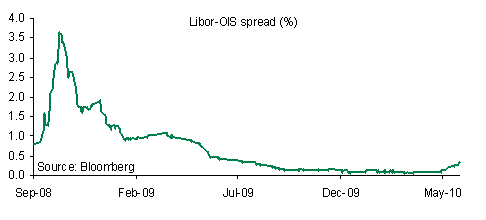
Although the pull back in risk appetite over recent weeks looks small compared to the peak in risk aversion during the financial crisis, the pace of the drop in markets has been dramatic and the withdrawal of risk seeking capital has been particularly aggressive. For example, in less than one month Asian equity markets have registered an outflow of around half of the total equity capital flows so far this year. Worryingly and despite the backstop in terms of central bank liquidity provision there are signs of renewed tensions in the money markets, with the libor-OIS spread and TED spread widening over recent days.
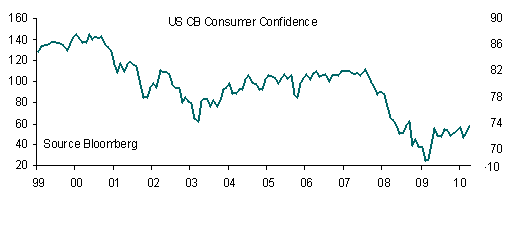
One of the most interesting observations in the current environment is that risk aversion has been increasing despite encouraging economic data. Not only has economic data been positive but in general has been coming in above consensus, showing that the market has underestimated the bounce in growth in the second quarter. Why is positive data not soliciting a more positive market reaction? Recent data is perhaps being seen as backward looking, and there is growing concern about the likely downdraft on economic activity in H2 2010, especially in Europe as deficit cutting measures bite.

News on the budget front in Europe has been relatively positive too, with Greece registering a sharp decline in its deficit, as well as announcing plans to tighten tax administration procedures. Meanwhile, the Italian cabinet reportedly approved a package of measures to reduce its deficit. On the flip side budget cuts across Europe are leading to growing public opposition, testing the resolve of eurozone governments to pass austerity measures. The public opposition means that the real test is in the implementation and execution of austerity measures. Signs of progress on this front will be key to turn confidence in the EUR around.

The USD remains king in the current environment and any pull back is likely to be bought into though Moody’s ratings agency’s warnings that the US AAA sovereign rating may come under pressure if there was no improvement in the US fiscal position, highlights the risks over the medium term to this currency. The EUR is set to remain under pressure though it is worth noting that the pace of its decline appears to be slowing, leaving open the potential for some consolidation. Near-term technical support for EUR/USD is seen at 1.2142 but a broader range of around 1.18.23-1.2520 is likely to develop over coming weeks.
What To Watch This Week

The end of last week proved to be a calmer affair than the preceding few days. There was some encouraging news on the Greek front, with Germany finally approving its share of the European Union (EU) aid package whilst Greece appeared to be on track with its budget deficit reduction as the country recorded a cash deficit of EUR 6.3billion in the first four months of the year, a 42% reduction compared to a year earlier. EU officials also agreed on tougher sanctions for countries breaching austerity rules.

There were plenty of negatives to offset the good news however, as European business surveys including the German IFO index and flash eurozone purchasing managers indices (PMIs) revealed some loss of momentum in growth as well as increased divergence. European banking sector concerns intensified as the Bank of Spain was forced to take control of CajaSur, a small savings bank holding 0.6% of total Spanish banking assets, which faced difficulties due to distressed real estate exposure. Its woes highlighted the problems faced by many Spanish savings banks due to property market exposure.

US data releases this week will confirm that economic recovery gathered steam in Q2. May consumer confidence data is likely to record a small gain, due in large part to improving job market conditions, whilst the Chicago PMI is set to retrace slightly in May, albeit from a healthy level. Both new and existing home sales are set to record gains in April, the former following a sizeable gain in March although the drop in house prices likely to be revealed by the Case-Shiller index will continue to fuel doubts about the veracity of the turnaround in the US housing market.

In Europe there is not much in terms of first tier releases and highlights include sentiment data such as German Gfk and French consumer confidence indices, and the May French business confidence indicator. The data are likely to be mixed, and as indicated by last week’s surveys will reflect a relatively healthy Q2 2010, but a worsening outlook for the second half of the year.

In the absence of UK data today there will be plenty of attention on the details of plans by Chancellor Osborne to cut GBP 6 billion from the budget deficit. The measures will be small change ahead of the emergency budget package on June 22nd when much bigger cuts are expected. Nonetheless, the first step today will be a crucial test of the new government’s ability to convince ratings agencies and markets that it is serious about reducing the burgeoning fiscal deficit.

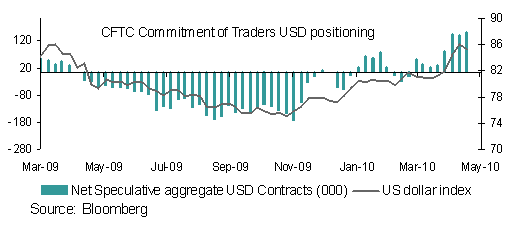
Following the massive positioning adjustments of the last week markets will look somewhat calmer over coming days but risk aversion is likely to remain elevated, suggesting little respite for most currencies against the USD. The recent moves have left net aggregate USD positioning registering an all time high according to the CFTC Commitment of Traders data, in the latest week, but after the slight retracement lower in the USD index, it is set to make further gains over coming days.

It was notable that EUR and GBP looked more composed at the tail end of the week whilst attention turned to the liquidation of long positions in CHF, AUD, NOK and SEK. These risk currencies are set to remain under pressure but there will be little respite for EUR which is set to drift lower, albeit a less aggressive pace than over recent weeks and a re-test of EUR/USD technical support around 1.2296 is likely. GBP/USD has showed some resilience over recent days but remains vulnerable to further downside pressure, with 1.4310 immediate support.

Will the ECB intervene to support the Euro? (Part 2)

Click here to read Part 1

The last official intervention by the European Central Bank (ECB) in the currency markets took place in November 2000 and at the time the Bank stated that “the external value of the EUR does not reflect the favourable conditions of the euro area”. The ECB also noted the impact of a weaker EUR on price stability, with inflation at the time running above the ECB’s 2% threshold. This followed intervention a couple of months earlier in September 2000 when the ECB jointly intervened with the US Federal Reserve, Bank of Japan and other central banks in a concerted manner due to “shared concerns about the potential implications of recent movements in the euro exchange rate for the world economy”.

Conditions in the euro area could hardly be described as favourable at present, suggesting that this rationale would be very unlikely to be used to justify intervention. Conversely, a weaker EUR may actually contribute to making conditions in the eurozone more favourable. The rationale used for the September 2000 intervention holds more sway in the current environment. Nonetheless, the move in the EUR is very unlikely to do any serious damage to the world economy even if some Japanese exporters are suffering.

In the past the ECB has given various verbal warnings about the volatility of the EUR being too high, and this could potentially be utilized as rationale for FX intervention. However, implied volatility in EUR/USD is not particularly high when compared to the levels it reached during the recent financial crisis. Currently 3-month implied volatility is at its highest level since June 2009 but well below the peak in volatility recorded in December 2008. Clearly if EUR/USD volatility continues to rise there will be a greater cause for concern but at current levels the ECB is unlikely to even crank up verbal intervention let alone actual FX intervention.

One of the main benefits of the decline in the EUR is the support that it will provide to the eurozone economy. At a time when growth in Europe is slowing EUR weakness will be particularly welcome. Germany and other countries in Northern Europe will be major beneficiaries of EUR weakness given their export dependence. Given such benefits and the currently limited risks to inflation, the ECB is highly unlikely to intervene to strengthen the EUR.

Given the current very negative mood in the market, officials in Europe would do better to rectify some of the structural issues that markets are concerned about. This may provoke a more sustainable rally in the EUR but until there are concrete signs of progress on the fiscal front sentiment towards the EUR will remain negative. Against this background FX intervention to prop up the EUR would face more of a risk of failure, and in turn damage to the credibility of the ECB. This is perhaps as good a reason as any not to expect intervention.

EUR/USD to test 1.2510, GBP/USD heading for 1.4500

Following on from the EUR 750 billion EU / IMF package European governments are starting to hold up to their end of the bargain. Spain announced a bunch of austerity measures. The measures aim at cutting the country’s budget deficit by an additional EUR 15 billion from 11.2% of GDP in 2009 to close to 6% in 2011. This was accompanied by some better economic news as Spain edged out of a close to 2-year recession in Q1 2010.

Evidence that some action is being taken on the fiscal front in Europe accompanied a slightly stronger than expected reading for Eurozone GDP in Q1 2010, helping risk appetite to improve overnight. Portugal was also able to find some success in its sale of EUR 1 billion of 10-year bonds, with a bid to cover ratio of 1.8 and a premium of only 18bps above the yield at April’s sale. Portugal has also pledged to cuts its budget deficit further than initially planned, aiming for a deficit of 7.3% of GDP this year.

Of course, pledges need to be followed by action and implementation and execution will be essential to bring markets back on side given the likely damage inflicted on confidence in the whole EUR project. Continued skepticism explains why EUR/USD has failed to take much notice to the developments in Spain and Portugal, with the currency continuing to languish, heading towards technical support around 1.2510 in the short-term.

The new UK coalition government is also moving quickly to appease markets, with plans to cut the budget deficit in the country by GBP 6 billion this year. The plans failed to have a lasting impact on GBP, which was dealt a blow by the dovish interpretation of the Bank of England’s quarterly inflation report released yesterday. GBP/USD continues to struggle to gain a foothold above 1.5000 and technical indicators suggest the currency pair is still heading lower, with a move to 1.4500 likely over the short-term.

The Dust Settles

As the dust settles on the massive “shock and awe” package announced over the weekend it is become painfully apparent that markets are not at all convinced that underlying issues surrounding Europe’s woes are on the path to being resolved. Undoubtedly the EUR 750 billion provided by the European Union (EU) and International Monetary Fund (IMF) will go a long way towards fixing the symptoms of the crisis but it will take a lot more action to convince markets that the measures to cut budget deficits, improve productivity and enact structural reforms are being carried out.

As a result of ongoing skepticism EUR/USD dropped to its lowest level since March 2009. The currency pair shows little sign of turning around and over the short-term EUR/USD is likely to test its 2010 low around 1.2510. Market positioning remains heavily short EUR suggesting some scope for short covering but any rebound in EUR/USD is being met with plenty of sellers and the upside is likely to be restricted to around 1.2885.

The size of the EU/IMF package means that financing issues for eurozone peripheral countries will not be a major concern and spreads are likely to continue to narrow against core debt. However, attention has turned to the next step in the process, in particular the path of fiscal consolidation necessary in the months ahead and the negative impact on the economies in Europe that this will entail. As US Fed Chairman Bernanke noted, the package from the EU/IMF is “not a panacea”.

Overall, the measures may have cheapened the long term value of the EUR rather than boost it as it has highlighted the many problems in having a single currency to encompass a wide variety of countries. The stark reality in having differing fiscal policies across the euro region whilst maintaining a single monetary policy has proven to be highly problematic.

At least for now, the economic data in the eurozone is providing some support, though it is questionable how long this will continue. Eurozone GDP grew by 0.2% in the first quarter of 2010 compared to the previous quarter, which was stronger than expected and growth in the second quarter actually looks like it will have picked up from this pace based on the indications from recent monthly data.

Further out, the real damage will begin and in particular economic activity in southern European countries will slow sharply even as the German economy remains resilient due to relatively strong export performance. Deficit cutting measures in Portugal, Spain and Italy will begin to bite into growth later this year and into 2011. The weakness in growth in Europe relative to the US economy, which is likely to perform relaitvely better, will provide further rationale to sell EUR/USD, though at some point markets may just shift their attention back to the burgeoning US fiscal deficit.