Is EUR/USD Parity Inevitable?

Reading this article in the WSJ “Hedge Funds Try ‘Career Trade’ Against Euro“, it would seem that there is an increasing amount of investors, especially hedge funds, looking for the EUR to fall to parity against the USD.  It is hard to believe that only a few months ago it looked as though the EUR was heading back towards its previous highs around 1.60 hit in April 2008. 

Following the surge in the USD during the financial crisis EUR/USD dropped to below 1.25 in November 2008 and then managed to eek out some gains as risk appetite improved and the USD came under pressure during most of 2009.

The picture towards the end of 2009 reversed as initially investors covered short USD positions and then bought USDs on rising risk aversion and growing problems in Greece.  The trend looks well set now and a move even lower beckons for EUR/USD.  

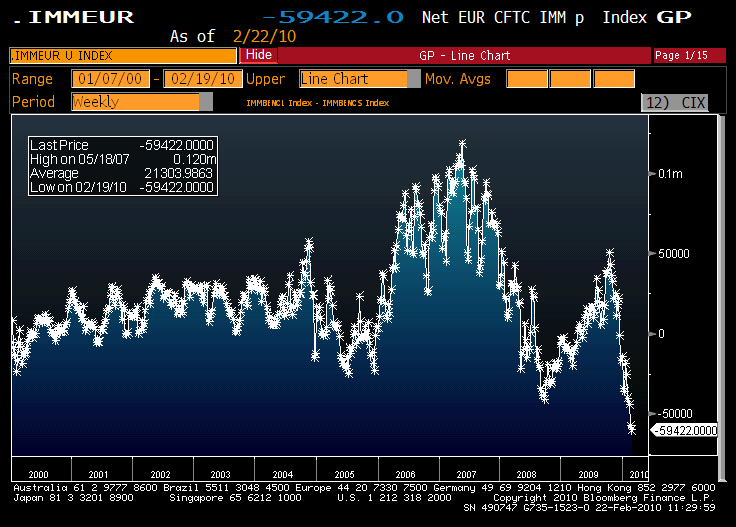
So how low will it go?  It is tempting to say that record short speculative positioning in EUR/USD means that the market is already stretched and like an elastic band pulled too far the EUR could rebound sharply.  On the other hand the band could also snap and in the case of EUR/USD this would imply a collapse in the currency as other investors join the bandwagon of selling EUR.

It is difficult to see any quick resolution to the problems in Europe at present.  Growing social/ labour unrest in the wake of austerity measures to cut burgeoning fiscal deficits highlight that implementing budget cuts mean tough political choices.   Greece has borne the brunt of this unrest but it appears to be spreading across Europe.   

In the past countries could devalue their way out of their debt problems but this solution is not available to individual countries in the eurozone.  Another option is to inflate your way out of the debt but again this is something that the European Central Bank (ECB) will not tolerate and could do much greater long term damage.  

So the only viable solution is to cut spending, raise taxes, implement reforms and raise retirement ages, all of which will fuel plenty of tensions in the countries concerned.  The difficulty of raising taxes was highlighted by the fact that even Greek tax inspectors have gone on strike, a fact which makes a mockery out of the government’s plans.  

Assuming that austerity measures are actually carried out it will mean that growth in Greece and many of the other bigger countries in Europe that carry out these measures will weaken further, making a “double-dip” scenario for the eurozone economy more likely.  

The bottom line is that it is extremely difficult to see the EUR make a sustainable recovery against this background.  Yes, the market is positioned short but so what? We may see short positioning increase further before any stability in the EUR is achieved.   

The last time EUR/USD was at parity was in December 2002.  Given the lack of alternatives in Europe at present another test of parity does not look as inconceivable as it did only a few months ago.
Risk Appetite Puts Dollar On The Back Foot

Markets look somewhat calmer going into this week helped by comments by Fed members who noted that the discount rate hike did not signal a shift in monetary policy, something which is likely to be repeated by Fed Chairman Bernanke in his testimony to Congress on Wednesday and Thursday.  A tame US January CPI report last Friday helped too, giving further support to the view that the Fed will not hike the Fed Funds rate for some time yet; a rate hike this year seems highly unlikely in my view.  

Data this week will be conducive to a further improvement in risk appetite and despite the lingering concerns about Greece the EUR may find itself in a position to extend gains.  In Europe all eyes will be on the February German IFO survey and eurozone sentiment indicators, which following the surprising strength in the manufacturing Purchasing Managers Indices (PMIs), are likely to reveal solid gains. 

The main highlights in Japan this week includes January trade data and industrial production. The trade numbers will be particularly important to determine whether the rebound in exports due in large part to robust Asian demand, has continued whilst the bounce back in exports will be a key factor in fuelling a further gain in industrial output. 

In the US aside from the testimonies by Fed Chairman Bernanke there are plenty of releases on tap including consumer confidence, new and existing home sales, durable goods orders and a likely upward revision to Q4 GDP.  For the most part the data will show improvement and play for a further improvement in risk appetite. 

FX direction will depend on whether markets focus on the potentially positive USD impact of a reduction in USD liquidity or on the likely firmer tone to risk appetite this week.  Given expectations of firmer data and the soothing tone of the Fed, risk currencies will likely perform better, with crosses such as AUD/JPY favoured.  The USD will likely be placed on the back foot, especially given the very long market positioning in the currency.

The EUR will be helped by the fact that speculative market, according to the CFTC IMM data, holds record short positions in the EUR (as of the week ended 16 February) giving plenty of potential for short-covering.   The more timely Tokyo Financial Exchange (TFX) data also reveals that positioning in EUR/JPY has continued to be scaled back.  

CFTC Commitment of Traders (IMM) data – Net EUR speculative positioning

EUR/USD bounced smartly from its lows around 1.3444 on Friday, partly reflecting some short covering and the drop in FX volatility suggests the market is more comfortable with EUR/USD around these levels.  A positive IFO survey and improved risk appetite could see EUR/USD test resistance around 1.3774, its 20 day moving average, over coming days.  Ongoing Greek concerns suggest that any EUR bounce will be limited, however. 

USD/JPY looks well supported and although data this week will suggest that exports are improving despite JPY strength, the relatively more aggressive stance of the Fed compared to the BoJ, long JPY positioning, and improved risk appetite, give plenty of scope for the JPY to extend losses, with technical USD/JPY support seen around 91.28.

Dollar on top as central banks deliberate

There has been a veritable feast of central bank activity and decisions with most attention having been on the Fed’s decision.  In the event the FOMC meeting delivered no surprises in its decision and statement.  Basically the Fed acknowledged the recent improvement in economic activity but continued to see inflation as subdued and maintained that policy rates will remain low for an “extended period”.  The Fed also noted that most liquidity facilities were on track to expire on 1 February suggesting that they remain on track to withdraw liquidity.  

There was similarly no surprise in the Riksbank’s decision in Sweden to leave interest rates unchanged, with the Bank reiterating that it would maintain this stance through the autumn of 2010.  The SEK has been stung by outflows due to annual payments of premiums to mutual funds by the Pension Authority but the impact of this has now largely ended leaving the currency in better position.  Norway’s Norges Bank unexpectedly raised interest rates, for a second time, increasing its deposit rate by 25bps to 1.75%, with the surprise evident in the rally in NOK following the decision.   The other central bank to surprise but in the opposite direction was the Czech central bank which cut interest rates by 25bps.  

In contrast to the Norges Bank’s hawkish surprise the RBA has helped to toned down expectations for further rate hikes in Australia, with Deputy Governor Battellino suggesting that monetary policy was back in a “normal range” in contrast to the perception that policy was still very accommodative.   Weaker than expected Q3 GDP (0.2% QoQ versus forecasts of a 0.4% QoQ rise) data fed into the dovish tone of interest rate markets fuelling a further scaling back of rate hike expectations, casting doubt on a move at the February 2010 RBA meeting and pushing the AUD lower in the process.  Against this background AUD continues to look vulnerable in the short term, especially under the weight of year end profit taking and the resurgent USD.  

There was also some surprise in the amount of lending by the ECB, with the Bank lending EUR 96.9 bn in third and final tender of 1-year cash despite the cost of the loan being indexed to the refi rate over the term of the loan rather than being fixed at 1%.  There was also a sharp decline in the number of banks bidding compared to earlier 1-year auctions but at a much higher average bid.  This implies that some banks in Europe remain highly dependent on ECB funding despite the improvement in market conditions.   The EUR continues to struggle and its precipitous drop has shown little sign of reversing, with the currency set for a soft end to the year.  A break below technical support around 1.4407 opens the door to a fall to around 1.4290.   

The USD is set to retain its firmer tone in the near term though we would caution at reading its recent rally as marking a broader shift in sentiment.  The move in large part can be attributed to position adjustment into year end and is being particularly felt by those currencies that have gained the most in recent months.  Hence, the softer tone to Asian currencies and commodity currencies which appear to be bearing the brunt of the rebound in the USD.   Going into next year USD pressure is set to resume but for now the USD is set to remain on top, with the USD index on track to break above 78.000.

Risk appetite firms

Risk appetite is slightly firmer at the end of the week.  US data failed to deliver much guidance on Thursday following a better than forecast trade deficit but disappointment on jobless claims. US retail sales came in better than expected on Friday, rising 1.3% and 1.2% ex-autos, likely helping the firmer tone to risk appetite.  This followed the release of a set of positive data releases in China on Friday revealing that the recovery in the country remains strong.

Fiscal concerns, especially in Europe continue to linger like a bad smell maintaining a degree of caution for markets and capping the EUR, with strong technical resistance seen around the November 20 low of 1.4794.   On this note GBP could struggle given the growing criticism of the pre-budget report on Wednesday.   However, worries about a ratings  downgrade have eased somewhat following comments from Moody’s that there was no threat to UK or US ratings for now, which has given GBP some likely short-lived breathing room.

I still favour AUD and NZD and out of the two NZD looks the better, especially given further likely unwinding of long AUD/NZD positions into year-end.  Markets will continue to ignore jawboning by RBNZ governor attempting to talk down the kiwi and focus on the shift in rhetoric following the RBNZ meeting pointing to an earlier rate hike than previously indicated.    However, the sharp drop in AUD/NZD over recent days has brought the currency cross back in line with my regression model estimates, which suggests that much of the pull back has already taken place.  The JPY is the main casualty of the improving trend in risk appetite edging back towards the 90.0 level.

Where will interest rates go up next?

Following the decision by the Reserve Bank of Australia to raise interest rates attention has swiftly turned to which central bank will move next. Indeed, there has been a reassessment of global interest rate decisions following Australia’s move. The hike in Australia is unlikely, however, to be quickly followed by the US, Japan, Europe or UK where policy is set to remain highly accommodative for long while.

Attention will however, turn to the Bank of Korea as well as the RBNZ and Norges Bank. In particular, the Norges Bank may be the next to hike when it meets on October 28. Norway has already appears to be priming markets for a rate hike. The RBNZ is likely to be slower to hike given the still slow pace of recovery in New Zealand and comfortable inflation backdrop.

The impact on currencies is not straightforward as the bigger influence on currency markets throughout the crisis has been risk appetite rather than interest rates. However, the influence of risk on currencies is beginning to wane and although interest rates have not been a major driver of currencies over recent months the move by the RBA likely accelerates the process of yield re-emerging as a key currency driver.

This is a big problem for the US dollar given that the Fed is unlikely to be quick to raise interest rates even if quantitative easing is withdrawn sooner. This means that the dollar will suffer from a growing yield disadvantage as interest rate hikes are priced in elsewhere. Taken together with improving risk appetite as reflected in the resilience of global equity markets, the main casualty will be the dollar, hit both from a yield and risk appetite perspective.

Risk currencies and those currencies with the greater prospect of higher rates will do well meaning further upside for the Australian dollar and New Zealand dollar as well as the Norwegian krone. Asian currencies look to continue to strengthen with the Korean won remaining an outperformer despite intervention threats by the Korean central bank. The euro will benefit from dollar weakness but is unlikely to benefit from anything euro specific given the likely slower pace of recovery in the eurozone. Meanwhile sterling is likely to remain under pressure, not helped by yield or risk appetite, and sentiment hit afresh by weak data.