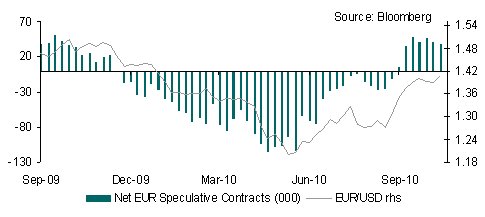
Euro support unwinding

The USD is set to end the year in firm form aided by rising US bond yields. Yesterday’s data supported this trend. The Empire manufacturing survey beat expectations rebounding nearly 22 points in December and industrial production rose 0.4% in November although there was a downward revision to the previous month. This was against the background of soft inflation, with headline and core CPI rising 0.1%, indicating that the Fed will remain committed to its $600 billion program of asset purchases.

EUR/USD dropped below support around 1.3280, weighed down by various pieces of negative news. Moodys downgrade of Spain’s credit ratings outlook dented sentiment but the bigger sell off in EUR followed the move in US bond yields. The prospect of EUR recovery over the short term looks limited. The issue of finding agreement on a permanent debt resolution fund continues to fuel uncertainty and will likely come to a head at the EU summit starting today.

Added to this Ireland’s main opposition party which will likely play a part in forming a new government early next year wants some of the debt burden shared with senior bank debt holders. The good news in Europe was few and far between but at least Ireland’s parliament backed the EU/IMF bailout for the country. Of course the backing could be derailed following elections in January. Perhaps the most surprising aspect of the move in EUR is that it’s not weaker. The next support level for EUR/USD is around 1.3160.

The divergence between the US and Europe on policy is stark, with loose fiscal and monetary policy in the US providing a significant prop to the US economy, whilst the much tighter fiscal stance and less loose monetary policy threatens to result in more pressure on eurozone growth especially against the background of an overvalued EUR. This divergence will manifest itself next year in the form of US growth outperformance and stronger USD vs. EUR.

The resilience of the UK consumer continues to surprise, with the CBI distributive trades survey coming in strong and rising further to +56 in December. The only problem with the survey data is that is has not tracked official data. November retail sales data today will give further clues to the strength of spending heading into Christmas. More worryingly from the Bank of England’s perspective is the fact that inflation continues to rise despite assurances that the increase in inflation is temporary. At the least the likelihood of more quantitative easing QE from the BoE has evaporated though it is still a long way off before interest rates are hiked. In the meantime GBP continues to underperform both EUR and USD though GBP/USD will find strong support around 1.5512.

Upward pressure on US yields and the USD us unlikely be derailed US data releases today. Housing starts are set to bounce back in November, with a 6% gain expected, whilst the trend in jobless claims will likely continue to move lower. The Philly Fed manufacturing survey is set to lose a little momentum reversing some of November’s sharp gain but will still remain at a healthy level.
US bonds sell off, USD rallies

US Treasuries didn’t like it but the compromise agreement to extend Bush era tax cuts, as well as a 13-month unfunded extension of long term unemployment benefits and a $120 billion payroll tax holiday will provide the US economy with further support and likely to lead to some upgrading of US growth forecasts. The agreement changes the dynamic of fiscal support for the US economy and means that the US is the only major country not tightening fiscal policy. It also implies less heavy lifting needed from the Federal Reserve.

Whilst some US taxpayers will not now face tax increases following the end of the year, the longer term question of fiscal adjustment and reform appears to have been postponed. US bond yields jumped on the news as the agreement effectively adds $1 trillion to US debt over the next couple of years. The contrasting fiscal stance with Europe could eventually haunt US markets as focus eventually return to US fiscal issues, with negative implications for the country’s credit ratings. However, at present, attention remains firmly fixed on European sovereign risk rather than US deficit fears.

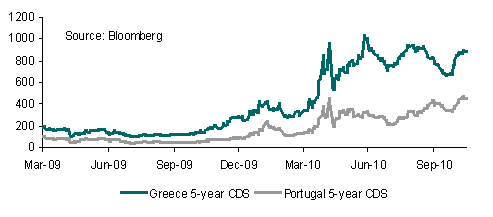
There has been some relief to European debt markets, albeit temporarily, with debt markets ignoring the news that European Finance Ministers have not agreed to extend the size of the support fund (EFSF) and have also failed to agree on the introduction of recently touted “E-bonds”. ECB buying of peripheral bonds has given some support whilst the passage of the first votes of the Irish budget has eased tensions in its bond markets. Nonetheless as highlighted by the IMF, Europe’s ”piecemeal” response to the debt crisis in the region is insufficient to stem the crisis, suggesting that the current easing in pressure could prove short-lived.

The jump in US bond yields has given the USD some support but I wouldn’t overplay the impact on the USD of bond yields at present. Correlations reflecting the sensitivity of bond yields to various currencies remain relatively low suggesting that the influence of yield on FX is still limited. That said, the correlation is likely to increase over coming months as US yields move higher. The impact on USD/JPY is likely to be particularly sharp, with the currency pair likely to move higher over coming months. The USD has likely rallied due to the likelihood that the tax cut extensions will mean prospects of less quantitative easing by the Fed and prospects of relatively firmer US growth.

An ongoing concern for markets is the prospects of higher interest rates in China. As regular readers of Econometer many note, my blog posts have been a bit sporadic lately. This is not down to laziness but the fact that I have been on the road quite a bit travelling in Asia (and UK) visiting clients. One of the clear concerns that I have heard often repeated is the potential for China’s measures to curb real estate speculation, rising inflation, and lending, to slow China’s growth sharply and cause problems for the rest of the world. This is the topic of another post for another day, but against the background of such concerns the AUD and other high beta currencies are likely to fail to make much headway.

Caught In The Headlights

For a prolonged period of time market attention had firmly focused on the Fed and prospects for quantitative easing (QE2). Now that QE has been delivered with little surprise, as the Federal Reserve arguably did a good job of living up to market expectations, it is Europe that is back in the limelight. Until recently the major surprise about Europe was how well the economy and the EUR were doing and how quickly the European Central Bank (ECB) would diverge from the Fed in its policy path.

This all looks premature and as if to confirm the shift in outlook the slowing in eurozone growth in Q4 (0.4% QoQ) revealed last week is likely to mark the beginning of a sharp and diverging deceleration in growth over coming quarters. The EUR may still have some life left in it given the ongoing purchases via recycled intervention flows from Asian central banks but weaker growth and peripheral worries are undermining this vestige of support.

Unfortunately for Europe the region is now not being caste in a good light and the peripheral trio of Ireland, Greece and Portugal are all staring into the headlights with nowhere to run. A crash of sorts seems inevitable but will there be any casualties? Markets are being whipsawed as they determine what will happen next in this slow motion saga.

Irish officials have maintained they do not need any aid package following discussions held over the weekend. Any bailout would likely come from a EUR 60 billion fund from the European Commission meaning a quick distribution but Ireland’s refusal will likely see pressure resume on peripheral debt markets in Europe as well as the EUR.

Portugal is also in the spotlight following comments by its foreign minister that the country may be forced to abandon the EUR if there is a failure to adopt a broad coalition government to deal with the crisis. This sounds like scaremongering but nonetheless highlights the political tensions in the country.

In Greece the second round of regional elections reveals the ruling Pasok party candidates are in the lead, reducing the prospect of early general elections. Nonetheless, this will do little to alleviate pressure as the EU is set to revise higher Greece’s 2009 deficit and debt estimates implying even more difficulty in meeting this year’s targets.

An EU/IMF team will visit Greece to assess progress as well as decide on whether the country should receive its 3rd instalment of a EUR 110 billion loan. Suggestions from PM Papandreou that he does not rule out having to extend the repayment of the loan will not auger well for sentiment. Finally, the government is set to present its 2011 final budget on Thursday, suggesting plenty of event risk this week.

A meeting of EU finance ministers tomorrow and Wednesday will also garner attention. Germany’s stance that investors will only have to take the brunt of losses from debt rescheduling only from 2013 still remains a contentious issue amongst officials even though it is a slightly softer stance than previously stated. Agreement on this as well as pressure on Ireland to accept funding will be key points of discussion.

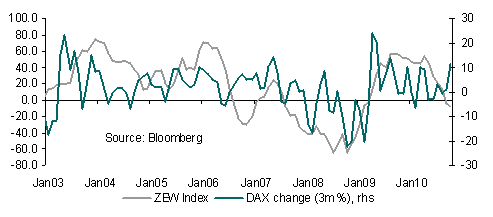
Event wise, an auction of T-bills in Greece tomorrow as well as a Spanish debt auction on Thursday will be watched to determine how far the contagion of Irish woes have spread. The news is unlikely to be good, with higher yields likely. Unfortunately tomorrow’s German November ZEW investor confidence survey will provide further signs of retreating investor sentiment in the wake of renewed peripheral debt concerns.

All eyes on G20

Although we move from feast to famine this week in terms of data there are still a few events that are noteworthy. In the US the September trade balance (Wed) will be of interest with a narrowing expected. Net exports negatively impacted GDP in Q3 but this is likely to reverse in Q4. Michigan confidence at the end of week is also likely to reveal better news with a rebound expected in October in the wake of firming equities, whilst the October budget statement is likely to reveal a sharp narrowing compared to October last year. Several Fed speakers over the week will be also be in focus as markets try to gauge the level of support within the FOMC for the QE2 announced last week.

There are a few data releases of interest in the eurozone including the preliminary estimate of Q3 GDP. Worryingly the divergence across the eurozone between healthier northern Europe and weaker performing in Southern Europe is becoming increasingly stark, a big headache for the Eurozone Central Bank with its one size fits all policy. Elsewhere, in the UK the Bank of England Quarterly Inflation Report will be scrutinized to determine whether recently firmer data and sticky inflation has pushed the BoE away from following the Fed into QE2. Japan’s volatile machinery orders data marks the highlight of its calendar, with a sharp drop expected in September following two strong months.

The main event of the week is the G20 leaders meeting in Seoul at the tail end of the week. Rhetoric going into the meeting suggests little support for the US plan to limit current account surpluses to 4% of GDP and even US officials appear to have cooled on the idea. Moreover the G20 meeting will probably elicit further reaction to the Fed’s QE2 announcement. Reaction was highly critical initially but seems to have softened lately. Currencies will nonetheless, remain the major topic of discussion although expectations of a global agreement are likely to be disappointed.

The Fed’s QE2 announcement helped provide a prop to risk assets and weighed on the USD last week despite the amount of asset purchases being within expectations. The USD will remain a sell on rallies this week and once again the best way to play USD weakness is likely via the higher yielding commodity currencies, especially AUD and NZD. Scandinavian currencies also offer a good way to capitalize on USD weakness.

The EUR may also struggle this week given worries about peripheral Europe and widening in peripheral bond spreads. Ireland’s budget cuts announced last week have so far failed to shore up confidence whilst political uncertainties are also rising. Greece’s regional elections revealed that the ruling socialist party narrowly retained control allowing the government to continue with reforms suggesting a modicum of support for its debt. Nonetheless, with Irish and Portuguese sovereign worries continuing, the EUR will continue to lag. Notably the CFTC IMM data revealed that speculative EUR sentiment deteriorated in the latest week to its lowest in over a month. EUR/USD is likely to target 1.3864 after dropping swiftly below the 1.4000 level.

Perhaps best way to play EUR vulnerability is versus the AUD, with a further decline through 1.3800 likely to pave the way for a drop below the 13 September low around 1.3660. AUD/JPY may also be another cross worth exploring especially as Japan’s new fund begins buying JGBs today, which could limit JPY upside. A test of AUD/JPY 83.65 is on the cards shortly. If Australia’s October employment report on Thursday reveals another strong reading it will likely give the currency further support into the end of the week.

G20 Leaves The US Dollar Under Pressure

The G20 meeting of Finance Ministers and Central bankers failed to establish any agreement on clear targets or guidelines. Perhaps the problem of trying to achieve consensus amongst a variety of sometimes conflicting views always pointed to an outcome of watered down compromise but in the event the G20 summit appears to pass the buck to November’s summit of G20 leaders in Seoul where more concrete targets may be outlined.

Officials pledged to “move towards more market determined exchange rate systems” and to “refrain from competitive devaluation of currencies”. What does this actually mean? The answer is not a great deal in terms of practical implications. The first part of the statement is the usual mantra from such meetings and the addition of the latter part will do little to stop central banks, especially in Asia from continuing to intervene given that no central bank is actually devaluing their currency but rather preventing their currencies from strengthening too rapidly.

The communiqué highlighted the need for advanced economies being “vigilant against excess volatility and disorderly movements in exchange rates”, but once again this is the mantra found in the repertoire of central bankers over past years and is unlikely to have the desired effect of reducing the “excessive volatility in capital flows facing some emerging countries”. In other words many emerging countries will continue to have an open door to impose limited restrictions on “hot money” flows.

Although the language on currencies was stronger than in previous summits it arguably changes very little in terms of the behaviour of central banks and governments with respect to currencies. The communiqué is wide open to varying interpretations by countries and is unlikely to prevent the ongoing trend of USD depreciation and emerging market country FX appreciation and interventions from continuing over coming weeks.

The onus has clearly shifted to the November summit of G20 leaders but once again it seems unlikely that substantial agreements will be found. In the interim the November 3 Fed FOMC meeting will be the next major focus and if the Fed embarks on renewed asset purchases as widely expected FX tensions will remain in place for some time yet.

So whilst a “currency war” was always unlikely “skirmishes” will continue. In the meantime the USD is set to remain under pressure although it’s worth noting that speculative positioning has recorded a reduction in net aggregate USD short positions over the last couple of weeks, suggesting that some of the USD selling pressure may have abated. Whether this reflected caution ahead of the G20 meeting (as the data predates the G20 meeting) or indicated the USD having priced in a lot of quantitative easing (QE2) expectations already, is debatable.

The path of least resistance to USD weakness remains via major currencies including AUD, CAD and NZD. Officials in Europe are also showing little resistance to EUR strength despite the premature tightening in financial conditions and negative impact on growth that it entails. Scandinavian currencies such as SEK and NOK have also posted strong gains against the USD and will likely continue to show further outperformance.

The JPY has been the best performing major currency this year followed not far behind by the CHF despite the FX interventions of the authorities in Japan and Switzerland. Although USD/JPY is fast approaching the 80.00 line in the sand level expected to result in fresh FX intervention by the Japanese authorities, the path of the JPY remains upwards. Japan is unlikely to go away from the G20 meeting with any change in policy path as indicated by officials following the weekend deliberations.