Quantitative easing and the USD

US earnings are coming in ahead of expectations, with Q2 income at the 42 S&P 500 companies reporting so far beating estimates by 11% whilst revenues are 3.3% ahead of forecasts, according to Bloomberg. The overall tone to equities looks positive helped by expectations of an agreement by BP to sell some of its assets and strong earnings reported by Apple after the close of US trade.

Market sentiment was also boosted by speculation that the Fed will embark on fresh monetary stimulus measures. Although there has been no indication that Fed Chairman Bernanke will announce such measures at his semi-annual testimony to the Senate today and to the House tomorrow, speculation of Fed action is rife and there is likely to be some questioning of Bernanke on the issue in the Q&A. If in any way quantitative easing is hinted at by Bernanke, it will act to undermine the USD.
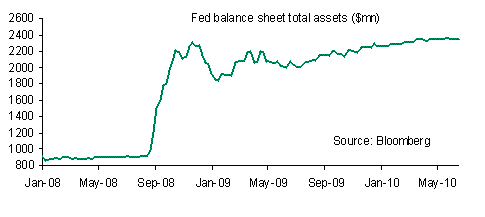
US economic data is helping to compound expectations of further quantitative easing, with yet another weaker than forecast release in the form of a 5.0% drop in June housing starts as hinted at by the bigger than expected drop in homebuilders confidence on the previous day. Separately ABC consumer confidence declined more than expected in the week to July 18, its third consecutive weekly decline, supporting the evidence that consumer confidence is deteriorating once again.

In the absence of major data releases Bernanke’s testimony will be the main driver for markets but earnings from Coca-Cola and Morgan Stanley will also be of interest. Elsewhere the minutes of the Bank of England’s July MPC meeting will be under scrutiny. MPC member Sentance is expected to have voted for a rate hike at the meeting, but any sign that other members joined him, will give GBP a lift. Sentiment for European assets continues to improve, with Greece concluding a well received T-bill auction and Ireland auctioning EUR 1.5bn in 6 and 10-year bonds. Both were heavily oversubscribed although concerns over Hungary continue to linger.

There continue to be various leaks about the European bank stress tests. Banks are expected to detail three scenarios in the results including estimated Tier 1 capital ratios under a benchmark for 2011, an adverse scenario and finally, a “sovereign shock”, according to a document from the Committee of European banking Supervisors. Importantly and perhaps a factor that could hit the credibility of the tests, the sovereign shock scenario is said to not include a scenario of default on sovereign debt.

I continue to see downside risk for the EUR in the wake of the test results, with a “buy on rumour, sell on fact” reaction likely. EUR/USD is vulnerable to a short-term drop to technical support around 1.2763 but much depends on Bernanke’s speech today. Leaks, suggest that around 10-20 banks could fail the bank stress tests, with a total funding requirement in the region of EUR 70-90 billion. Confirmation will have to wait for the official release on Friday ahead of which most currencies are likely to remain range-bound.

EUR strength is overdone

The latest in a long line of disappointing US data was released on Friday. University of Michigan consumer confidence sent an alarming signal about the propensity of the US consumer to contribute to economic recovery. Confidence dropped much more than expected, to its lowest level since August 2009, fuelling yet more angst about a double-dip in growth.

The Fed’s relatively dovish FOMC minutes last week contributed to the malaise and undermined the USD in the process as attention switched from the timing of exit strategies to whether the Fed will expand quantitative easing. Friday’s benign June CPI report left no doubt that the Fed has plenty of room on its hands, with core inflation remaining below 1% and likely to decelerate further over the coming months. Against this background Fed Chairman Bernanke’s semi-annual testimony to the US Congress (Wed/Thu) will be a particular focus, especially if he hints at potential for further QE, a possibility that appears remote, but could harm the USD.

Arguably the biggest event of the week is the European bank stress test results on Friday. Although several European governments have suggested that the banks in their countries will pass the tests there is still a considerable event risk surrounding the announcement. 91 banks are being tested and much will depend on how rigorous the tests are perceived to be. Should they be seen not to be sufficiently thorough, for instance in determining a realistic haircut on sovereign debt holdings, the potential for pressure on the EUR to increase once again will be high. Similarly debt auctions across Europe this week will also garner interest but similar success to last week’s Spanish auction cannot be guaranteed.

The big question in FX markets is whether the EUR can hold onto its recent gains and whether the USD will be punished further amidst growing double-dip worries. Interestingly the USD’s reaction on Friday to the soft consumer confidence data was not as negative as has been the case recently, with higher risk aversion once again outweighing negative cyclical influences. Various risk currencies actually came under pressure against the USD and this is likely to extend into this week. Despite a threat to the USD from any QE hints by Bernanke, speculative positioning has turned net short USD once again suggesting potential for less USD selling.

The bigger risk this week is to the EUR, which could face pressure on any disappointment from the bank stress test results. The EUR was strong against most major currencies last week, suggesting that the strengthening in EUR/USD is less to do with USD weakness, but more related to EUR strength. This strength in the EUR is hard to tally with the worsening economic outlook in the eurozone and the fact that a stronger EUR from an already overvalued level will crimp eurozone growth further. The latest CFTC IMM data has revealed a further covering of short positions, but this is likely to be close to running its course. Technically EUR/USD has broken above its ‘thick’ Ichimoku cloud, and the weekly MACD is turning above its signal line from oversold levels suggesting a period of further strength but its gains are set to be short-lived.