World Cup FX Positioning/Data Highlights

The market tone felt decidedly better over the course of the last week although it was difficult to tell if this was due to position squaring ahead of the World Cup football or a genuine improvement in sentiment. There was no particular event or data release that acted as a catalyst either, with the European Central Bank (ECB) and Bank of England (BoE) meetings passing with little fanfare.

US data ended the week mixed, with retail sales disappointing in May but in contrast June consumer confidence beating expectations. Although questions about the pace of recovery remain, other data such as the Fed’s Beige Book suggest that recovery remains on track, sentiment echoed, albeit cautiously by Fed Chairman Bernanke last week.

Attention this week will centre on inflation data. Expected benign CPI readings will support the view that the Fed will take its time to raise interest rates. Speeches by the Fed’s Bullard, Plosser and Bernanke this week will be eyed for further clues on Fed thinking.

Central banks in Brazil and New Zealand hiked rates last week but this is not likely to be echoed this week. No change is likely from both the Bank of Japan and Swiss National Bank although there will be plenty of attention on the SNB’s comments on the CHF following recent data showing a surge in FX reserves due to currency intervention. The BoJ is unlikely to announce anything new but perhaps some further detail on the loan support plan could be forthcoming.

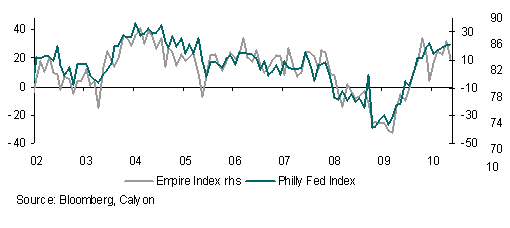
Manufacturing data will also garner some attention, with the US June Empire and Philly Fed surveys and May industrial production on tap. All three reports will confirm the improving trend in manufacturing activity in the US. Housing data will look weaker, with starts set to pull back in starts in May following the expiry of government tax incentive programmes though permits are set to rise.
In Europe, the June German ZEW (econ sentiment) investor sentiment survey will likely slip slightly due to ongoing fiscal/debt worries but this will be countered by stronger domestic data. In any case the index remains at a high level and a slight drop is unlikely to derail markets.

GBP may find some support form upgrade of UK growth forecasts by the CBI to 1.3% for 2010 and relatively hawkish comments from the BoE’s Sentance in the weekend press warning that inflation is higher than expected, indicating that the Bank may need to hike rates sooner than expected.

Further GBP/USD direction will come from CPI and retail sales data this week as well as public borrowing figures and a report by the new Office of Budget Responsibility on the UK’s fiscal position ahead of the June 22 budget. A break above GBP/USD resistance around 1.4760 is unlikely to materialise.

Despite the many data releases this week, the overall tone is likely to be one of consolidation and reduced volatility in the days ahead. This may allow EUR/USD to gain some ground due to short covering, with the CFTC commitment of traders (IMM) report revealing a further increase in net short speculative positions last week, close to the record set a few weeks back, though we suspect that there will be strong resistance around 1.2227.
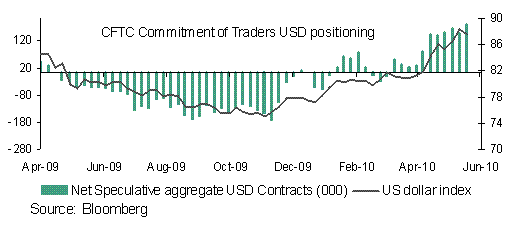
The fact that the IMM data revealed that net aggregate net USD long positions reached an all time high last week, highlights the potential for profit taking this week. USD/JPY will look to take out resistance around 92.55 but this looks unlikely unless the BoJ dishes up anything particularly dovish from its meeting.
Renewed concerns

Despite some positive US data, with both the May ISM manufacturing index and April construction spending coming in stronger than forecast, market sentiment soured. The relative calm that was exhibited at the end of May is giving way to renewed fears as equity markets weaken, volatility increases and risk aversion intensifies. Risk trades are set to remain on the back foot, with the EUR likely to remain the weakest link. After testing support close to 1.2110 EUR/USD bounced but remains vulnerable to a fresh test of this level in the short-term.

A combination of concerns including rumours of ratings downgrades, with France the new target, Middle East tensions, weaker Chinese manufacturing activity and worries about increasing bank writedowns in Europe, have conspired to drag markets lower. The failure to stem the hue oil-leak in the US contributed to the malaise as the US government announced a criminal probe.

For the most part, data releases were unhelpful to risk appetite as the majority of global purchasing managers indices (PMIs) slipped in May, led by China. Only a few increased, including India and notably Ireland, whilst the Spanish and Greek PMIs fell. Although the US ISM index slipped the components looked positive, especially the employment component which moved higher, suggesting some upside potential for Friday’s May payrolls data for which we look for a 500k increase.

A picture of divergence appears to be growing in the eurozone, which will act as another source of pressure on the EUR. Germany’s outperformance is widening as reflected by the fact the German unemployment dropped to 7.7% in May in contrast to a rise in eurozone unemployment, to 10.1%. Moreover, Germany was the only country where its PMI was actually revised higher relative to the flash reading. There are also growing divisions within the European Central Bank (ECB), in particular towards the purchase of government bonds, with German ECB members particularly critical.

Will the ECB intervene to support the Euro? (Part 2)

Click here to read Part 1

The last official intervention by the European Central Bank (ECB) in the currency markets took place in November 2000 and at the time the Bank stated that “the external value of the EUR does not reflect the favourable conditions of the euro area”. The ECB also noted the impact of a weaker EUR on price stability, with inflation at the time running above the ECB’s 2% threshold. This followed intervention a couple of months earlier in September 2000 when the ECB jointly intervened with the US Federal Reserve, Bank of Japan and other central banks in a concerted manner due to “shared concerns about the potential implications of recent movements in the euro exchange rate for the world economy”.

Conditions in the euro area could hardly be described as favourable at present, suggesting that this rationale would be very unlikely to be used to justify intervention. Conversely, a weaker EUR may actually contribute to making conditions in the eurozone more favourable. The rationale used for the September 2000 intervention holds more sway in the current environment. Nonetheless, the move in the EUR is very unlikely to do any serious damage to the world economy even if some Japanese exporters are suffering.

In the past the ECB has given various verbal warnings about the volatility of the EUR being too high, and this could potentially be utilized as rationale for FX intervention. However, implied volatility in EUR/USD is not particularly high when compared to the levels it reached during the recent financial crisis. Currently 3-month implied volatility is at its highest level since June 2009 but well below the peak in volatility recorded in December 2008. Clearly if EUR/USD volatility continues to rise there will be a greater cause for concern but at current levels the ECB is unlikely to even crank up verbal intervention let alone actual FX intervention.

One of the main benefits of the decline in the EUR is the support that it will provide to the eurozone economy. At a time when growth in Europe is slowing EUR weakness will be particularly welcome. Germany and other countries in Northern Europe will be major beneficiaries of EUR weakness given their export dependence. Given such benefits and the currently limited risks to inflation, the ECB is highly unlikely to intervene to strengthen the EUR.

Given the current very negative mood in the market, officials in Europe would do better to rectify some of the structural issues that markets are concerned about. This may provoke a more sustainable rally in the EUR but until there are concrete signs of progress on the fiscal front sentiment towards the EUR will remain negative. Against this background FX intervention to prop up the EUR would face more of a risk of failure, and in turn damage to the credibility of the ECB. This is perhaps as good a reason as any not to expect intervention.

Will the ECB intervene to support the Euro? (Part 1)

The EUR has lost around 23% since it all time high in April 2008 when it traded close to 1.6000. The EUR failed to rally even in the wake of the EUR 750 billion European Union / International Monetary Fund support package, a fact that has highlighted the weight of negative sentiment towards the currency. The latest blow to the currency came from the announcement of unilateral measures from Germany to ban naked short selling on sovereign debt and some financial stocks, actions that only highlighted the lack of policy co-ordination within the eurozone.

The rationale for further EUR/USD weakness is clear and justified partly by growth divergence within the eurozone countries, with Germany on the one extreme and weaker Southern European countries on the other. Moreover, relatively weaker overall growth in the eurozone compared to the US economy, a delay in interest rate hikes by the European Central Bank (ECB) and ongoing concerns about implementation and execution of deficit cutting plans, will also weigh on the EUR.

The EU/IMF support package and in particular ECB interventions in the Eurozone bond market have managed to alleviate some of the strain on European bond markets, but without similar intervention in the FX markets the EUR has become the release valve for Europe’s fiscal and debt problems. As a result the EUR’s fall has accelerated over recent weeks, only showing any sign of stability as fears of currency intervention increased.

The quickening pace of EUR depreciation has led to growing speculation of FX intervention by the ECB and other central banks to support the currency. I believe intervention is highly unlikely and see little reason for panic about the drop in the EUR. Once markets realise that there is indeed little risk of intervention the EUR will resume its downtrend.

One of the main reasons behind this view is that the EUR is not particularly “cheap” at current levels. In fact, “fair value” estimates based on the OECD measure of purchasing power parity (PPP) suggest that EUR/USD is around 5.6% overvalued at current levels, based on an implied PPP rate of around 1.17. Therefore, the drop in the EUR over recent months has only brought it back close to PPP fair value estimates.

Moreover despite the fact that there has been a large nominal depreciation of the EUR its trade weighted exchange rate has declined by much less, around 8.5% since the beginning of the year and around 11.3% since its high in October 2009. Although the trade weighted EUR is around its lowest level since October 2008, taking a longer term view shows that it is slightly above its average over the past 20-years.

Capital Flowing Out of Europe

When investors’ concerns shift from how low will the EUR go to whether the currency will even exist in its current form, it is blatantly evident that there is a very long way to go to solve the eurozone’s many and varied problems. As many analysts scramble to revise forecasts to catch up with the declining EUR, the question of the long term future of the single currency has become the bigger issue. Although the EUR 750 billion support package was hailed by EU leaders as the means to prevent further damage to the credibility of the EUR, it has failed to prevent a further decline, but instead revealed even deeper splits amongst eurozone countries.

Although the European Central Bank (ECB) confirmed that it bought EUR 16.5 billion in eurozone government bonds in just over a week, with the buying providing major prop to the market, private buyers remain reluctant to renter the market. As a result of the ECB’s sterilised interventions bond markets have stabilised but the EUR is now taking the brunt of the pressure, a reversal of the situation at the beginning of the Greek crisis, when the EUR proved to be far more resilient. Reports that some large institutional investors have exited from Greek and Portuguese debt markets whilst others are positioning for a eurozone without Greece, Portugal and Spain, suggest that the ECB may have taken on more than it has bargained for in its attempts to prop up peripheral eurozone bond markets.

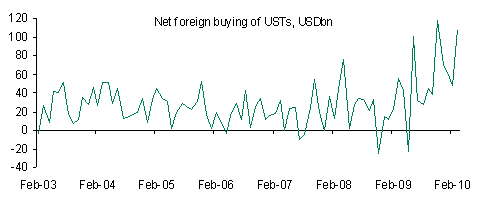
As was evident in the US March Treasury TICS report it appears that a lot of the outflows from Europe are finding their way into US markets. The data revealed that net long-term TIC flows (net US securities purchases by foreign investors) surged to $140.5 billion in March. The bulk of this flow consisted of safe haven buying of US Treasuries ($108.5 billion), although it was notable that securities flows into other asset classes were also strong especially agencies and corporate bonds, which recorded their biggest capital inflow since May 2008. Asian central banks also reversed their net selling of US Treasuries, with China investing the most into Treasuries since September 2009. Anecdotal evidence corroborates this, with central banks in Asia diversifying far less than they were just a few months ago.

This reversal of flows is unlikely to stop anytime soon. It is clear that enhanced austerity measures in the eurozone will result in weaker growth and earnings potential. This will play negatively on the EUR especially given expectations of a superior growth and earnings profile in the US. Evidence of implementation, action and a measure of success on the fiscal front will be necessary to begin the likely long process of turning confidence in the EUR around. This will likely take a long time to be forthcoming. EUR/USD has managed to recover after hitting a low of around 1.2235 but remains vulnerable to further weakness. The big psychological barrier of 1.20 looms followed by the EUR launch rate of around 1.1830.