Euphoria fades, risk currencies weaker

The euphoria emanating from last week’s eurozone agreement will likely fade into this week as renewed doubts creep in. Details of how the EFSF bailout fund will be leveraged or how the special purpose vehicle will be utilised have yet to emerge while the firewall to protect countries such as Italy and Spain may still be insufficient given that the use of the European Central Bank (ECB) to provide unlimited support has been ruled out.

With more questions than answers markets will be hungry for further details over coming weeks and until then it is difficult to see risk appetite stretching too far. One indication of such concern was the fact that Italy’s borrowing costs climbed to euro-era highs the day after the European Union (EU) plan was agreed. The G20 meeting on 3-4 November will be eyed for further developments as well as further reaction to the EU agreement.

There are plenty of events to digest this week that could add to any market nervousness. In terms of central banks we do not expect to see any change in policy stance from the ECB, Federal Reserve or Reserve Bank of Australia (RBA) this week but the decisions may be close calls. The ECB under the helm of new President Draghi will be under pressure to ease policy as growth momentum has clearly weakened but the Bank will likely hold off for the December meeting when new growth and inflation forecasts will be released.

The RBA may also take some solace from a better global economic and market climate but the market disagrees having priced in a cut this week. The Fed will look to see how ‘Operation Twist” is faring before moving again but recent indications from some Fed officials suggest growing support for purchases of mortgage backed securities.

On the data front eurozone inflation today will be the key number in Europe while the US jobs report at the end of the week will be the main release in the US. Ahead of the payrolls data, clues will be garnered from the ISM manufacturing data and ADP jobs report. The consensus is for a 95k increase in non-farm payrolls and the unemployment to remain at 9.1% maintaining the trend of only gradual improvement in the US jobs market.

Recent data releases have turned less negative, however, and at the least have helped to alleviate renewed recessionary concerns. Overall, I suspect that markets will come back down to the reality of slow growth and unanswered questions this week, with risk assets likely to lose steam over coming days.
Euro fails too hold on to gains

Any improvement in sentiment following the USD liquidity support announcement by various central banks last week is already filtering away against the background of European Union (EU) officials’ failure to make any headway at the Ecofin meeting over the weekend, a delay in the approval of the next bailout tranche for Greece and ongoing collateral dispute between Greece and Finland. On top of all of this German Chancellor Merkel suffered a further setback in regional elections over the weekend.

Greece will remain in focus this week and markets will look for signs that the country is back on track on its austerity plans and its next loan tranche. Prime Minister Papandreou cancelled a trip to the US while the Greek cabinet are apparently deciding on new fiscal measures. Attention will turn to a teleconference today from the Greek Finance Minister with EU and IMF officials.

Speculative sentiment for the EUR has already soured further and according to the latest CFTC IMM report, positioning in EUR is at its lowest since the end of June 2010. EUR/USD will continue to look very vulnerable having already dropped sharply from a high of around 1.3899 in Asian morning trading as the bad weekend news hit the currency. EUR/USD will find some technical support just below 1.3500 this week but any upside is set to prove limited unless some concrete announcements are delivered relating to Greece over coming days.

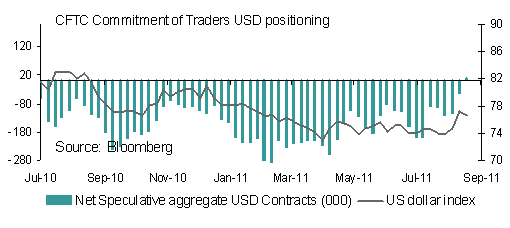
In contrast to the EUR, USD speculative appetite has turned net long for the first time since July 2010. The extended Fed FOMC meeting will help to dictate USD sentiment as markets wait for further measures to stimulate the economy. The Federal Reserve has already committed to hold rates steady until at least mid 2013 and the extended two day meeting this week will likely discuss further options. However, more quantitative easing (QE3) appears unlikely at this stage while an ‘Operation Twist’ type approach is more probable. The USD will benefit from a lack of further quantitative easing but this is largely already priced in.

EU Deal Boosts Euro But Momentum To Fade

The European Union deal for Greece was clearly on the positive side of expectations and from that perspective helped to buoy sentiment for European assets. The fact that EU leaders managed to work over differences and emerge with a solid deal will help remove some of the uncertainty about Greece’s future and lower the risks of contagion.

To recap EU leaders announced a EUR 109 billion second aid package for Greece. Private bondholders will contribute a target of a further EUR 37 billion via bond swaps or rolling over existing debt for new bonds maturing in 30 years. Investors will have the option to exchange existing debt into four instruments. The aim is to obtain 90% participation from Greek bondholders.

Moreover, it appears that governments will guarantee any defaulted Greek debt offered as collateral until the country can return to the market. Effectively this means that even if ratings agencies declare a default rating on Greek debt, Greek banks may still be able to obtain funding from the European Central Bank (ECB) as the debt is guaranteed by national governments.

Greece, Portugal and Ireland will benefit from lower interest rates on loans and longer maturities. Moreover, the European Financial Stability Facility (EFSF) bailout fund will have a wider scope for bond buying directly from investors. This lets the ECB off the hook to avoid further use of its own bond purchase programme and removes any further impairing of its balance sheet. The idea of a tax on banks was removed, as criticism of the workability of such a plan increased.

The downside of the deal includes the fact that:
1) European tax payers are on the line for a potentially unlimited amount to guarantee defaulted Greek debt,
2) The bondholder programme is only limited to Greece, so there is no contingency should something similar be needed in other countries
3) The participation rate for private bondholders is yet to be known (but will most likely be high).
3) The deal will lead to a default on Greek debt given the programme amounts to a 21% drop in value but a credit event is unlikely to be triggered.
4) Greece still has a highly ambitious privatisation and austerity plan to implement which even some Greek officials have admitted is overly optimistic and at worst could turn into a fire sale of Greek assets.
5) EFSF bond purchases will need the “mutual agreement” of member states which is by no means guaranteed.
6) The fund size is not large enough should Italy and Spain need similar bailouts especially as leaders have stressed that the Greek package will not be replicated for other countries.

The EUR rallied on the outcome of the European talks. However, the EUR has plenty of other worries to deal with including divergence in growth across the eurozone, overly long EUR market positioning, EUR overvaluation, likely growth underperformance versus the US and a likely rebound in general for the USD over coming months especially if the Fed does not embark on QE3 and agrees a deal to raise the debt ceiling. EUR/USD is likely to remain supported in the near term, with near term resistance around 1.4467. I still suspect that the momentum will not last, with EUR/USD looking particularly rich at current levels.

EUR higher but resistance looms

EUR and risk currencies in general were buoyed by the passage of the austerity bill in the Greek parliament. The implementation bill is also likely to be passed later today opening the door for the disbursement of EUR 12 billion from the European Union / IMF from the EUR 110 bailout agreed for the country. Combined with news that German banks are progressing towards agreeing on a mechanism to roll over Greek debt alongside French banks as well as likelihood of an European Central Bank (ECB) rate hike next week, the EUR is set to remain supported over the short term.

Nonetheless, it once again looks as though a lot of good news is priced in and it would be surprising if EUR/USD could extend to above strong resistance around 1.4557 given the many uncertainties ahead, not the least of which includes the stance of ratings agencies on any Greek debt rollover.

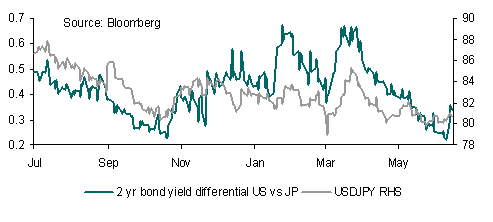
USD/JPY is the only major currency pair that is correlated with bond yield differentials at present (2-year yields) and therefore it should not come as a surprise that USD/JPY has moved higher as the yield differential between the US and Japan has widened by around 10bps over the past week. Indeed, yesterday’s move above 81.00 was spurred by the move in yield differentials although once again the currency pair failed to build sufficient momentum to close above this level.

Further gains will require US bond yields to move even higher relative to Japan but perhaps the end of QE2 today may mark a turning point for US bond markets and currencies. The end of QE2 taken together with a jump in bond supply over coming months, will see US Treasury yields will move sharply higher, implying much more upside for USD/JPY.

AUD has bounced back smartly over recent days, with the currency eyeing resistance around 1.0775 versus USD. A general improvement in risk appetite has given the currency some support but markets will be unwilling to push the currency much higher ahead of the Reserve Bank of Australia (RBA) meeting next week. On the plus side, there are no rate hikes priced in for Australia over the remainder of the year, suggesting an asymmetric risk to next week’s meeting.

In other words, unless the RBA openly discusses rate cuts in the statement, the AUD will likely remain supported. Conversely any indication that a rate hike may be in prospect will be AUD supportive. In any case we continue to believe the AUD offers better value especially relative to NZD and maintain our trade idea to buy AUD/NZD.

US dollar on the rise

Risk aversion is on the rise as uncertainties about Greece and worries about weaker economic data weigh on sentiment. A number of key events rather than data will be the main drivers this week. First and foremost amongst these is the vote in the Greek parliament on the country’s budget reform plan, which if passed will pave the way for the way for a disbursement of EUR 12 billion from the European Union / IMF and a new bailout package.

Meanwhile in the US talks on raising the debt ceiling are likely to resume in earnest, with the market likely to become increasingly nervous about the lack of resolution on the issue. Nonetheless, it is Europe that will dominate the headlines and on this front even if the reform plan is passed any market relief is likely to be limited given the ongoing uncertainty about private sector participation in any Greek debt roll over. This suggests that the EUR will remain under pressure over the week despite reassuring comments from Chinese Premier Wen.

Data releases will be relegated to background noise but what there is will not help sentiment. Signs of slowing activity remain evident as revealed in disappointing eurozone manufacturing surveys last week and this will be echoed in the US ISM manufacturing survey at the end of this week. Economic sentiment gauges in Europe are also set to reveal a decline. Given the lack of ammunition and/or unwillingness to risk using further stimulus from the Fed, the sensitivity of markets to weak data will be high, keeping risk aversion elevated.

Indeed, although well flagged the end of the Fed’s QE2 this week will mark a major shift in market dynamics, especially in currency markets where the USD will finally see a massive weight lifted from its shoulders. As indicated by Fed Chairman Bernanke following the FOMC meeting the Fed is not considering a further round of asset purchases, a fact that will help the USD to find firmer support.

Notably the USD index moved has above its 100-day moving average providing a positive technical signal given that it has failed on its last two attempts. The USD index now looks set to break its April high around 76.610.