Greek Decision Delayed

European Union Finance Ministers have agreed that additional funding for Greece will come from both official and private investors, with the later likely through a voluntary rollover of existing Greek debt as per the ‘Vienna Initiative’ of 2009 applied at the time to Emerging Europe. Agreement was reached following the decision by Germany to ease its demands for private sector participation in a debt restructuring. The news brought some relief to markets on Friday.

However, the announcement today that a final decision on a further tranche of aid and a second bailout package will not take place until early July will come as a blow to markets and likely lead to a more cautious start to this week. The onus is now on Greek Prime Minister Papandreou to gain approval for further austerity measures following the recent government cabinet reshuffle and in the face of a no confidence vote tomorrow. Failure to pass the confidence motion could provoke a political crisis, leading to likely contagion across Europe.

Europe has given the Greek government until the end of this month to implement measures including budget cuts and asset sales, with failure to pass further austerity measures likely to lead to a delay of any further aid. There will be plenty of noise surrounding Greece over coming days, with the issue likely to dominate the EU summit in Brussels on June 23-24. In the meantime the EUR/USD looks like it will settle into a range over the short-term, with support around the 100 day moving average of 1.4165.

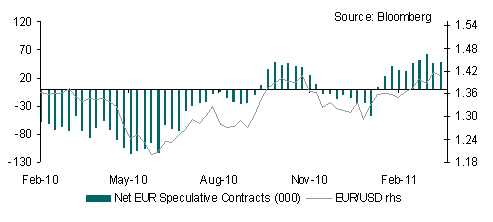
EUR speculative positioning is currently around its 3-month average, with the market continuing to hold a sizeable long position in EUR/USD according to the CFTC IMM data. The risks remain skewed to the downside as nervousness about a Greek deal grows. Should the Greek Prime Minister pass a no confidence motion there will be some short term relief but tensions are likely to persist for a long while yet. Moreover, other eurozone countries are not in the clear yet as reflected by Moody’s announcement that Italy’s AA2 government bond rating is on review for possible downgrade.
Asia Helps The Euro Again

Following the pressure on markets over recent days there is some relief filtering through markets today although sentiment remains fickle. Weaker than expected US April durable goods orders data failed to dent confidence with equity markets ending in positive territory overnight even though the data added to a plethora of global data disappointments over recent weeks.

Once again the EUR has been saved by Asian demand, this time not directly for the EUR itself but by reports that China and other Asian investors will purchases EFSF bailout bonds, with China apparently reported to be “clearly interested” in the mid June sales of Portuguese bailout bonds, with Asian investors representing a “strong proportion” of the buyers.

Despite the reassuring news about Asian official interest in eurozone debt, problems in the periphery remain a major drag on the EUR. Developments at the two day G8 heads of governments meeting in Deauville and various speeches by officials from the European Financial Stability Facility (EFSF), European Union (EU) and European Central Bank (ECB) regarding Greece’s travails will be particularly important for EUR direction.

The various speakers are likely to maintain the pressure on peripheral countries to continue their austerity programmes in order to gain external support. Nonetheless, there still appears to be conflicting comments about what Greece will do with regard to its debt burden. Whilst some EU officials have espoused the benefits of extending Greek debt maturities on a voluntary basis, the ECB has steadfastly stood against any form of restructuring.

Other than the events above, in the US the second reading of Q1 GDP will be released. The consensus looks for an upward revision to a 2.1% annual rate from an initial estimate of 1.8% due mainly to an upward revision to inventories. US weekly jobless claims will also be of interest especially as the recent increase in the 4-week average for jobless claims has provoked renewed fears about the jobs market recovery.

Risk Aversion Creeps Higher

The USD index has dropped by around 17% since June 2010 high and despite a slight bounce this week it is unlikely to mark the beginning of a sustained turnaround. Nonetheless, I would caution about getting carried away with positioning for USD weakness. Whilst an imminent recovery looks unlikely the risk/reward of shorting the USD is becoming increasingly unfavourable.

Until then Federal Reserve comments will be watched closely for clues on policy and there are plenty of Fed speakers this week including a speech by Boston Fed’s Rosengren today and Fed Chairman Bernanke tomorrow. The USD will also gain some direction from jobs data and markets will be able to gauge more clues for Friday’s non-farm payrolls data , with the release of the April ADP employment report today.

The EUR is one currency that has suffered this week. News that Portugal’s caretaker government has reached an agreement with the European Union / International Monetary Fund on a bailout of as much as EUR 78 billion has so far been greeted with a muted response. EUR attention is still very much focussed on the ECB meeting tomorrow and prospects of a hawkish press statement suggest that EUR/USD downside will be limited, with support seen around 1.4755.

The JPY has strengthened by around 5% versus USD since its 6th April USD/JPY high around 85.53, confounding expectations that Japan’s FX intervention following the county’s devastating earthquake marked a major turning point in the currency. A combination of narrowing interest rate differentials with the US (2 year US/Japan yield differentials have narrowed by around 20bps in the past month), strong capital inflows to Japan (net bond and equity flows in the last four weeks have increased to their highest this year), and rising risk aversion have all played their part in driving the JPY higher.

As a result USD/JPY is fast approaching the psychologically important level of 80, a level that if breached will likely lead to FX intervention. Although Golden Week holidays in Japan this week suggest that JPY liquidity may be quite thin, Japanese authorities are likely to remain resistant to further gains in the JPY, likely using thinning liquidity to their advantage.

Despite the JPY’s recent strength speculative positioning over the past four weeks has remained net short JPY, whilst Japanese margin traders have also increased their long USD/JPY bets, suggesting that these classes of investors are not to blame for the JPY’s appreciation. This suggests that FX intervention may not be as successful given that the market is already short JPY.

Given the risk of intervention on USD/JPY, the CHF appears to be an easier choice for safe haven demand against the background of rising risk aversion. The currency has risen to a record high against the USD, gaining around 8.3% so far this year. Given the hints of higher interest rates by the Swiss National Bank (SNB) and resilience economic performance, downside risks for CHF are limited at present unless risk appetite improves sharply. Further gains are likely with USD/CHF likely to test the 0.8570 support level over the short-term.

Australian Dollar Looking Stretched

Central bank decisions in Japan, Europe and UK will dictate FX market direction today. No surprises are expected by the Bank of Japan (BoJ) and Bank of England (BoE) leaving the European Central Bank (ECB) decision and press conference to provide the main market impetus. Although a hawkish message from ECB President Trichet is likely the market has already priced in a total of 75 basis points of tightening this year. We retain some caution about whether the EUR will be able to make further headway following the ECB meeting unless the central bank is even more hawkish than already priced in.

EUR/USD easily breached the 1.4250 resistance level and will now eye resistance around 1.4500. News that Portugal formally requested European Union (EU) aid came as no surprise whilst strong German factory orders provided further support to the EUR. The data highlights upside risks to today’s February German industrial production data. The EUR will find further support versus the USD from comments by Atlanta Fed’s Lockhart who noted that he doesn’t expect the Fed to hike interest rates by year end.

USD/JPY is now around 7.5% higher than its post earthquake lows. Japanese authorities will undoubtedly see a measure of success from their joint FX intervention. To a large degree they have been helped by a shift in relative bond yields (2-year US / Japan yield differentials have widened by close to 30 basis points since mid March, and are finally having some impact on USD/JPY as reflected in the strengthening in short-term correlations. Whilst the BoJ is unlikely to alter its policy settings today the fact that it is providing plenty of liquidity to money markets, having injected around JPY 23 trillion or about 5% of nominal GDP since the earthquake, is likely playing a role in dampening JPY demand.

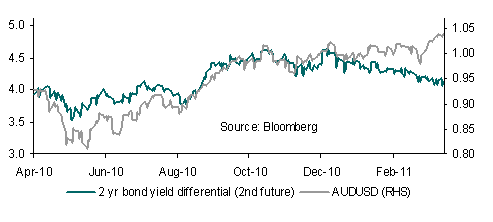
AUD/USD has appreciated by close to 6% since mid March and whilst I would not recommend selling as yet I would be cautious about adding to long positions. My quantitative model based on interest rate / yield differentials, commodity prices and risk aversion reveals a major divergence between AUD/USD and its regression estimate. Clearly the AUD has benefitted from diversification flows as Asian central banks intervene and recycle intervention USDs. However, at current levels I question the value of such diversification into AUD.

Speculative AUD/USD positioning as indicated by the CFTC IMM data reveals that net long positions are verging on all time highs, suggesting plenty of scope for profit taking / position squaring in the event of a turn in sentiment. Moreover, AUD gains do not match the performance of economic data, which have been coming in worse than expected over recent weeks. Consequently the risks of a correction have increased.

Euro’s Teflon Coating Wearing Thin

EUR has suffered a setback in the wake some disappointment from the European Union summit at the end of last week and the major defeat of German Chancellor Merkel and her ruling Christian Democratic Union party in yesterday’s election in Baden-Wuerttemberg. The EUR had been fairly resistant to negative news over recent weeks but its Teflon like coating may be starting to wear thin.

The setbacks noted above + others (see previous post) follow credit rating downgrades for Portugal by both S&P and Fitch ratings and growing speculation that the country is an imminent candidate for an EU bailout following the failure of the Portuguese government to pass its austerity measures last week and subsequent resignation of Portugal’s Prime Minister Socrates.

For its part Portugal has stated that it does not need a bailout but looming bond redemptions of around EUR 9 billion on April 15 and June 15 against the background of record high funding costs mean that the pressure for a rescue is intense. Complicating matters is the fact that fresh elections cannot be held earlier than 55 days after being announced, meaning that policy will effectively be in limbo until then. A June vote now appears likely.

After what was perceived to be a positive result of the informal EU leaders summit a couple of weeks ago, the outcome of the final summit last week failed to deliver much anticipated further details whilst more negatively the EU bailout fund’s paid-in capital was scaled back to EUR 16 billion (versus EUR 40 billion agreed on March 21) due to concerns expressed by Germany.

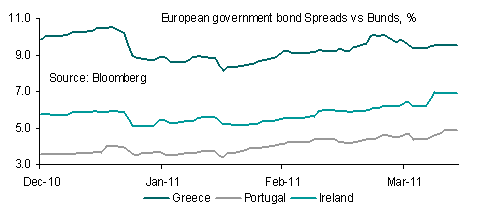
Ireland is also in focus ahead of European bank stress tests results on March 31. Ireland is pushing for increased sharing of bank losses with senior bondholders as part of a “final solution” for financial sector. Meanwhile the new government remains unwilling to increase the country’s relatively low corporation tax in exchange for a renegotiation of terms for the country’s bailout. This point of friction also threatens to undermine the EUR.

The bottom line is that the bad news is building up and the ability of the EUR to shake it off is lessening. Considering the fact that the market long EUR, with positioning well above the three-month average the EUR is vulnerable to position adjustment. After slipping over recent days EUR/USD looks supported above 1.3980 but its upside is looking increasingly restricted against the background of various pieces of bad news.