Risk on mood prevails

The end of the year looks as though it will finish in a firmly risk on mood. Equity volatility in the form of the VIX index at its lowest since July 2007. FX volatility remains relatively low. A lack of market participants and thinning volumes may explain this but perhaps after a tumultuous year, there is a certain degree of lethargy into year end.

Whether 2011 kicks off in similar mood is debatable given the many and varied worries remaining unresolved, not the least of which is the peripheral sovereign debt concerns in the eurozone. It is no surprise that the one currency still under pressure is the EUR and even talk that China offered to buy Portuguese sovereign bonds has done little to arrest its decline.

Reports of officials bids may give some support to EUR/USD just below 1.31 but the various downgrades to ratings and outlooks from ratings agencies over the past week has soured sentiment for the currency. The latest move came from Fitch ratings agency which placed Greece’s major banks on negative ratings watch following the move to place the country’s ratings on review for a possible downgrade.

The USD proved resilient to weaker than forecast data including a smaller than forecast 5.6% gain in existing home sales in November. The FHFA house price index recorded a surprise gain of 0.7% in October, which mitigated some of the damage. The revised estimate of US Q3 GDP revealed a smaller than expected revision higher to 2.6% QoQ annualized from a previous reading of 2.5%. Moreover, the core PCE was very soft at 0.5% QoQ, supporting the view that the Fed has plenty of room to keep policy very accommodative.

Despite the soft core PCE reading Philadelphia Fed President Plosser who will vote on the FOMC next year indicated that if the economy continues to strengthen he will look for the Fed to cut back on completing the $600 billion quantitative easing (QE) program. Although the tax deal passed by Congress will likely reduce the need for QE3, persistently high unemployment and soft core inflation will likely see the full $600 billion program completed. Today marks the heaviest day for US data this week, with attention turning to November durable goods orders, personal income and spending, jobless claims, final reading of Michigan confidence and November new home sales.

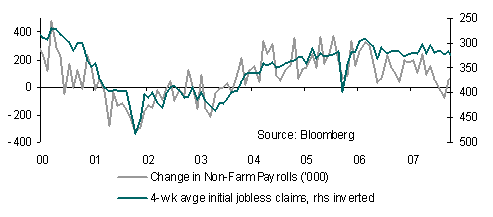
Overall the busy US data slate will likely maintain an encouraging pattern, with healthy gains in income and spending, a rebound in new home sales and the final reading of Michigan confidence likely to hold its gains in December. Meanwhile jobless claims are forecast to match the 420k reading last week, which should see the 4-week average around the 425k mark. This will be around the lowest since August 2008, signifying ongoing improvement in payrolls. The data should maintain the upward pressure on US bond yields, which in turn will keep the USD supported.

Please note that this will be the last post on Econometer.org this year. Seasons greatings and best wishes for the new year to all Econometer readers.
Ratings rampage hits Euro

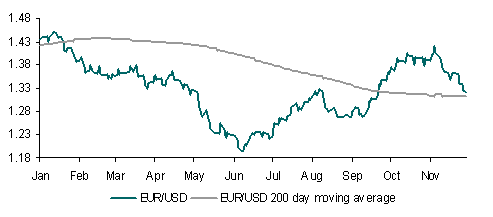
Both the data flow and market liquidity will be thin over the last couple of weeks of the year. After a bashing over much of H2 2010 it looks as though the USD will end the year in strong form having risen by over 6% since its early November low. In contrast the EUR is struggling having found no support from the meeting of European Union officials at the end of last week in which they agreed to a permanent sovereign debt resolution after 2013 but failed to agree on expanding the size of the bailout fund (EFSF). Similarly there was no traction towards a common euro bond. EUR/USD is now verging on its 200-day moving average around 1.3102, a break of which could see a drop to around 1.2960.

The failure to enlarge the size of the EFSF was disappointing given worries that it is perceived to be insufficient to cope with the bailout of larger eurozone countries if needed. It also highlight that the burden on the European Central Bank (ECB) to prop up eurozone bond markets until confidence improves. The increase in the size of ECB capital from EUR 5.8 billion to EUR 10.8 billion will help in this respect. Such support was clearly needed last week following the rampage across Europe by ratings agencies culminating in Moody’s five notch downgrade of Ireland’s credit ratings, surprising because of its severity rather than the downgrade itself. Ireland’s ratings are now just two notches above junk status and the negative outlook could mean more to come.

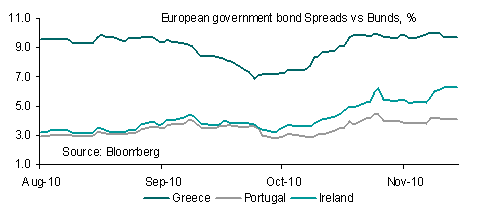
It was not just Ireland’s ratings that came under scrutiny. Ireland’s multi notch downgrade followed Moody’s decision to place Greece and Spain on review for a possible downgrade whilst S&P revised Belgium’s outlook to negative. Unsurprisingly peripheral debt markets came under renewed pressure as a result outweighing positive news in the form of strong flash eurozone PMI readings and firm German IFO business confidence survey. EUR did not escape and sentiment for the currency remains weak, with CFTC IMM speculative positioning data revealing a fourth straight week of net EUR short positioning in the week to 14th December.

In contrast, sentiment for the US economy continues to improve. Congress’ swift passage of President Obama’s fiscal plan will help to shore up confidence in US recovery. Data this week will be broadly positive too. On Wednesday, US Q3 GDP data is likely to be upwardly revised to a 2.8% QoQ annualized rate. Durable goods orders excluding transportation are set to increase by a healthy 2.0% (Thu) whilst both existing (Wed) and new (Thu) home sales will reveal rebounds in November following a drop in the previous month.

In the UK the main highlight is the Bank of England (BoE) MPC minutes. Another three way split is expected but this should not cause more than a ripple in FX markets. GBP/USD has slipped over recent days but there appears to be little other than general USD strength responsible for this. The currency pair looks vulnerable to a drop below 1.5500, with 1.5405 seen as the next support level. On balance, the USD will be in good form this week although the drop in US bond yields at the end of last week may take some of the wind out of its sails.

Drastic Action Needed

There has been no let up in pressure on eurozone markets and consequently risk aversion continues to increase. The failure of Ireland’s bailout package to stem the haemorrhaging in eurozone bond markets highlights the difficulties in finding in a lasting solution and worsening liquidity conditions in several eurozone bond markets highlights the urgency to act.

Indeed, if spreads continue to widen as they have since late October, by early to mid 2011, Portuguese, Spanish and Italian Euribor spreads would be higher than the EFSF loan spread. In the (admittedly extreme) case that sovereigns could not raise money in the market, peripherals would run out of money early in 2011. Policy makers will try to not let the situation get so out of hand but what can be done to stem the damage?

The European Central Bank (ECB) may be forced to delay its exit strategy by maintaining unlimited liquidity allotments to banks into next year and/or implement further liquidity support measures. The ECB meeting will be closely scrutinized for details, with ECB President Trichet having to adjust policy accordingly. A further option could be for the ECB to step up its bond buying programme which may provide some relief to peripheral eurozone bond markets and the EUR.

Whether this offers a lasting solution however, is debatable. The risk of action by the ECB tomorrow may fuel some caution in the market towards selling the EUR further in the short term and could even prompt some short EUR covering around the meeting which could see EUR/USD regain a sustainable hold above 1.3000 again but this may be temporary, offering better levels to sell.

Meanwhile, speculation of a break up of the eurozone into a core euro and a peripheral euro has intensified given the growing divergence in growth and competitiveness across the region. Such speculation looks far fetched. The eurozone project has been politically driven from the start and over the last 60 years or so internal economic strains have been papered over by politicians. The political will is likely to remain in place even if the divergence in fundamentals across Europe has continued to widen.

Bond market sentiment was not helped by the fact that S&P put Portugal’s ratings on creditwatch negative citing downward economic pressure and concerns over the government’s credit worthiness. Importantly S&P still expects Portugal to remain at investment grade if downgraded. Note that Portugal’s central bank highlighted that the country’s banking sector faced “intolerable” risk unless the government implements planned austerity measures.

In contrast the US story is looking increasingly positive, highlighting that the USD’s strength is not merely a reaction to EUR weakness but more likely inherent and broad improvement in USD sentiment. US consumer confidence, Chicago PMI and the Milwaukee PMI beat forecasts in November, continuing the trend of consensus beating data releases over recent weeks.
Although this does not change the outlook for quantitative easing (QE) as the Fed remains focused on core CPI and the unemployment rate, the data paints an encouraging picture of the economy.

Irish bailout leaves EUR unimpressed

As has been the case since the beginning of the global financial crisis policy makers have found themselves under pressure to deliver a solution to a potentially destabilising or even systemic risk before the markets open for a new week in order to prevent wider contagion. Last night was no different and following urgent discussions a EUR 85 billion bailout for Ireland to be drawn down over a period of 7 ½ years was agreed whilst moves towards a permanent crisis mechanism were brought forward. As was evident over a week ago a bailout was inevitable but the terms were the main imponderable.

Importantly the financing rate for the package is lower than feared (speculation centered on a rate of 6.7%) but still relatively high at 5.8%. Moreover, no haircuts are required for holders of senior debt of Irish banks and Germany’s call for bondholders to bear the brunt of losses in future crises was watered down. The package will be composed of EUR 45 bn from European governments, EUR 22.5 bn from the IMF and EUR 17.5 bn from Ireland’s cash reserve and national pension fund.

The impact on the EUR was stark, with the currency swinging in a 120 point range and failing to hold its initial rally following the announcement. A break below the 200-day moving average for EUR/USD around 1.3131 will trigger a drop to around 1.3020 technical support. Officials will hope that the bailout offers the currency some deeper support but this already seems to be wishful thinking. The EUR reaction following the Greek bailout in early May does not offer an encouraging comparison; after an initial rally the EUR lost close to 10% of its value over the following few weeks.

Although it should be noted that the bailout appears more generous than initially expected clearly the lack of follow through in terms of EUR upside will come as a blow. The aid package has bought Ireland some breathing space but this could be short lived if Ireland’s budget on December 7 is not passed. Moreover, the bailout will not quell expectations that Portugal and perhaps even Spain will require assistance. Indeed, Portugal is the next focus and the reaction to an auction of 12-month bills on 1 December will be of particular interest.

Taken together with continued tensions on the Korean peninsular, position closing towards year end ongoing Eurozone concerns will likely see a further withdrawal from risk trades over coming weeks. For Asian currencies this spells more weakness and similarly commodity currencies such as AUD and NZD also are likely to face more pressure. The USD remains a net beneficiary even as the Fed continues to print more USDs in the form of QE2.

Data and events this week have the potential to change the markets perspective, especially the US November jobs report at the end of the week. There is no doubt that payrolls are on an improving trend (145k consensus) in line with the declining trend in jobless claims but unfortunately the unemployment rate is set to remain stubbornly high at 9.6% and this will be the bigger focus for the Fed and markets as it implies not let up in QE. As usual further clues to the payrolls will be garnered from the ADP jobs report and ISM data on Wednesday.

Edging Towards A Bailout

A confluence of factors have come together to sour market sentiment although there appeared to be some relief, with a soft US inflation reading (core CPI now at 0.6% YoY) and plunge in US October housing starts reinforcing the view that the Fed will remain committed to carry out its full QE2 program, if not more.

However any market relief looks tenuous. Commodity prices remain weak, with the CRB commodities index down 7.4% in just over a week whilst the Baltic Dry Index (a pretty good forward indicator of activity and sentiment) continues to drop, down around 21% since its recent high on 27 October. Moreover, oil prices are also sharply lower. Increasingly the drop in risk assets is taking on the form of a rout and many who were looking for the rally to be sustained into year end are getting their fingers burnt.

Worries about eurozone peripheral countries debt problems remains the main cause of market angst, with plenty of attention on whether Ireland accepts a bailout rumoured to be up EUR 100 billion. Unfortunately Ireland’s reluctance to accept assistance has turned into a wider problem across the eurozone with debt in Portugal, Greece and also Spain suffering. An Irish bailout increasingly has the sense of inevitability about it. When it happens it may offer some short term relief to eurozone markets but Ireland will hardly be inspired by the fact that Greece’s bailout has had little sustainable impact on its debt markets.

Ireland remains the primary focus with discussions being enlarged to include the IMF a well as ECB and EU. What appears to be becoming clearer is that any agreement is likely to involve some form of bank restructuring, with the IMF likely to go over bank’s books during its visit. Irish banks have increasingly relied on ECB funding and a bailout would help reduce this reliance. Notably the UK which didn’t contribute to Greece’s aid package has said that it will back support for Ireland, a likely reaction to potential spillover to UK banks should the Irish situation spiral out of control. Any bailout will likely arrive quite quickly once agreed.

Although accepting a bailout may give Ireland some breathing room its and other peripheral county problems will be far from over. Uncertainties about the cost of recapitalising Ireland’s bank will remain whilst there remains no guarantee that the country’s budget on December 7 (or earlier if speculation proves correct) will be passed. Should Ireland agree to a bailout if may provide the EUR will some temporary relief but FX markets are likely to battle between attention on Fed QE2 and renewed concerns about the eurozone periphery, suggesting some volatile price action in the days and weeks ahead.

Reports of food price controls of and other measures to limit hot money inflows into China as well as prospects for further Chinese monetary tightening, are attacking sentiment from another angle. China’s markets have been hit hard over against the background of such worries, with the Shanghai Composite down around 10% over the past week whilst the impact is also being felt in many China sensitive markets across Asia as well as Australia. For instance the Hang Seng index is down around 7% since its 8 November high.