Euro support unwinding

The USD is set to end the year in firm form aided by rising US bond yields. Yesterday’s data supported this trend. The Empire manufacturing survey beat expectations rebounding nearly 22 points in December and industrial production rose 0.4% in November although there was a downward revision to the previous month. This was against the background of soft inflation, with headline and core CPI rising 0.1%, indicating that the Fed will remain committed to its $600 billion program of asset purchases.

EUR/USD dropped below support around 1.3280, weighed down by various pieces of negative news. Moodys downgrade of Spain’s credit ratings outlook dented sentiment but the bigger sell off in EUR followed the move in US bond yields. The prospect of EUR recovery over the short term looks limited. The issue of finding agreement on a permanent debt resolution fund continues to fuel uncertainty and will likely come to a head at the EU summit starting today.

Added to this Ireland’s main opposition party which will likely play a part in forming a new government early next year wants some of the debt burden shared with senior bank debt holders. The good news in Europe was few and far between but at least Ireland’s parliament backed the EU/IMF bailout for the country. Of course the backing could be derailed following elections in January. Perhaps the most surprising aspect of the move in EUR is that it’s not weaker. The next support level for EUR/USD is around 1.3160.

The divergence between the US and Europe on policy is stark, with loose fiscal and monetary policy in the US providing a significant prop to the US economy, whilst the much tighter fiscal stance and less loose monetary policy threatens to result in more pressure on eurozone growth especially against the background of an overvalued EUR. This divergence will manifest itself next year in the form of US growth outperformance and stronger USD vs. EUR.

The resilience of the UK consumer continues to surprise, with the CBI distributive trades survey coming in strong and rising further to +56 in December. The only problem with the survey data is that is has not tracked official data. November retail sales data today will give further clues to the strength of spending heading into Christmas. More worryingly from the Bank of England’s perspective is the fact that inflation continues to rise despite assurances that the increase in inflation is temporary. At the least the likelihood of more quantitative easing QE from the BoE has evaporated though it is still a long way off before interest rates are hiked. In the meantime GBP continues to underperform both EUR and USD though GBP/USD will find strong support around 1.5512.

Upward pressure on US yields and the USD us unlikely be derailed US data releases today. Housing starts are set to bounce back in November, with a 6% gain expected, whilst the trend in jobless claims will likely continue to move lower. The Philly Fed manufacturing survey is set to lose a little momentum reversing some of November’s sharp gain but will still remain at a healthy level.
FX sensitivity to yield

It’s all about yield. The back up in US bond yields in reaction to the US tax compromise from the Obama administration has been particularly sharp. US 10 year bond yields jumped around 35bps this week prior to a small correction in yields overnight whilst 2s were up 21bps. US bond yields are now back where they were in June, a fact that makes a mockery out of the Fed’s attempts to drive bond yields lower via quantitative easing (QE). Yields elsewhere increased too but by a smaller degree whilst equity market sentiment has been dampened by the rise in global yields although US stocks still ended higher overnight.

There is plenty of commentary discussing the impact on currencies of the move in bond yields so it’s worth looking in more detail how sensitive FX markets have been to yield. The most sensitive currencies i.e. those with the highest 3-month correlations with relative bond yield differentials (2 year) are the AUD/USD, EUR/USD, and of course USD/JPY. However, there is less sensitivity to gyrations in 10 year yields with no currency pair registering a statistically significant correlation with 10-year bond yield differentials over the past 3-months.

Assuming that US bond yields continue to push higher into 2011, with much lager increases in both nominal and yields expected, this means that AUD, EUR and JPY will face the most pressure relative to the USD. Moreover, the stimulus measures agreed by the US administration will likely lead to many analysts penciling in higher growth forecasts over 2011 whilst reducing the prospects of QE3 from taking place, all of which is USD positive. I still retain a degree of caution in Q1 2011, especially with regard to a potential bounce in EUR, especially if the ECB becomes more aggressive in its bond buying, but even so, any EUR rally is likely to prove termporary.

The impact of higher US yields on the AUD may be more limited however, despite the high correlation with relative bond yields, as Australian bond yields are also likely to rise somewhat given the resilience of its economy. This was clearly demonstrated by Australian November employment data released overnight revealing yet another consensus beating outcome of +54.6k, with all the gains coming from full time employment. Against the background of a generally firm USD, the best way to play AUD resilience is via the NZD, with the currency pair likely break through resistance around 1.3220 (21 October high).

Drastic Action Needed

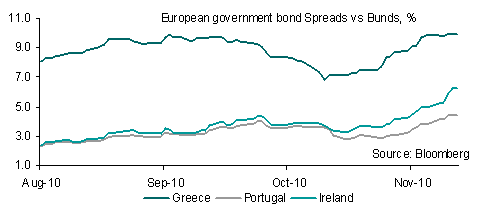
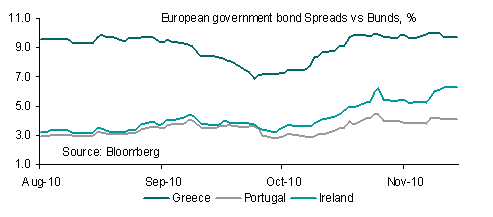
There has been no let up in pressure on eurozone markets and consequently risk aversion continues to increase. The failure of Ireland’s bailout package to stem the haemorrhaging in eurozone bond markets highlights the difficulties in finding in a lasting solution and worsening liquidity conditions in several eurozone bond markets highlights the urgency to act.

Indeed, if spreads continue to widen as they have since late October, by early to mid 2011, Portuguese, Spanish and Italian Euribor spreads would be higher than the EFSF loan spread. In the (admittedly extreme) case that sovereigns could not raise money in the market, peripherals would run out of money early in 2011. Policy makers will try to not let the situation get so out of hand but what can be done to stem the damage?

The European Central Bank (ECB) may be forced to delay its exit strategy by maintaining unlimited liquidity allotments to banks into next year and/or implement further liquidity support measures. The ECB meeting will be closely scrutinized for details, with ECB President Trichet having to adjust policy accordingly. A further option could be for the ECB to step up its bond buying programme which may provide some relief to peripheral eurozone bond markets and the EUR.

Whether this offers a lasting solution however, is debatable. The risk of action by the ECB tomorrow may fuel some caution in the market towards selling the EUR further in the short term and could even prompt some short EUR covering around the meeting which could see EUR/USD regain a sustainable hold above 1.3000 again but this may be temporary, offering better levels to sell.

Meanwhile, speculation of a break up of the eurozone into a core euro and a peripheral euro has intensified given the growing divergence in growth and competitiveness across the region. Such speculation looks far fetched. The eurozone project has been politically driven from the start and over the last 60 years or so internal economic strains have been papered over by politicians. The political will is likely to remain in place even if the divergence in fundamentals across Europe has continued to widen.

Bond market sentiment was not helped by the fact that S&P put Portugal’s ratings on creditwatch negative citing downward economic pressure and concerns over the government’s credit worthiness. Importantly S&P still expects Portugal to remain at investment grade if downgraded. Note that Portugal’s central bank highlighted that the country’s banking sector faced “intolerable” risk unless the government implements planned austerity measures.

In contrast the US story is looking increasingly positive, highlighting that the USD’s strength is not merely a reaction to EUR weakness but more likely inherent and broad improvement in USD sentiment. US consumer confidence, Chicago PMI and the Milwaukee PMI beat forecasts in November, continuing the trend of consensus beating data releases over recent weeks.
Although this does not change the outlook for quantitative easing (QE) as the Fed remains focused on core CPI and the unemployment rate, the data paints an encouraging picture of the economy.

Irish bailout leaves EUR unimpressed

As has been the case since the beginning of the global financial crisis policy makers have found themselves under pressure to deliver a solution to a potentially destabilising or even systemic risk before the markets open for a new week in order to prevent wider contagion. Last night was no different and following urgent discussions a EUR 85 billion bailout for Ireland to be drawn down over a period of 7 ½ years was agreed whilst moves towards a permanent crisis mechanism were brought forward. As was evident over a week ago a bailout was inevitable but the terms were the main imponderable.

Importantly the financing rate for the package is lower than feared (speculation centered on a rate of 6.7%) but still relatively high at 5.8%. Moreover, no haircuts are required for holders of senior debt of Irish banks and Germany’s call for bondholders to bear the brunt of losses in future crises was watered down. The package will be composed of EUR 45 bn from European governments, EUR 22.5 bn from the IMF and EUR 17.5 bn from Ireland’s cash reserve and national pension fund.

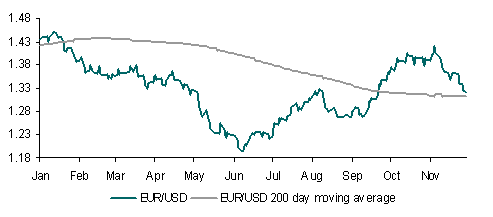
The impact on the EUR was stark, with the currency swinging in a 120 point range and failing to hold its initial rally following the announcement. A break below the 200-day moving average for EUR/USD around 1.3131 will trigger a drop to around 1.3020 technical support. Officials will hope that the bailout offers the currency some deeper support but this already seems to be wishful thinking. The EUR reaction following the Greek bailout in early May does not offer an encouraging comparison; after an initial rally the EUR lost close to 10% of its value over the following few weeks.

Although it should be noted that the bailout appears more generous than initially expected clearly the lack of follow through in terms of EUR upside will come as a blow. The aid package has bought Ireland some breathing space but this could be short lived if Ireland’s budget on December 7 is not passed. Moreover, the bailout will not quell expectations that Portugal and perhaps even Spain will require assistance. Indeed, Portugal is the next focus and the reaction to an auction of 12-month bills on 1 December will be of particular interest.

Taken together with continued tensions on the Korean peninsular, position closing towards year end ongoing Eurozone concerns will likely see a further withdrawal from risk trades over coming weeks. For Asian currencies this spells more weakness and similarly commodity currencies such as AUD and NZD also are likely to face more pressure. The USD remains a net beneficiary even as the Fed continues to print more USDs in the form of QE2.

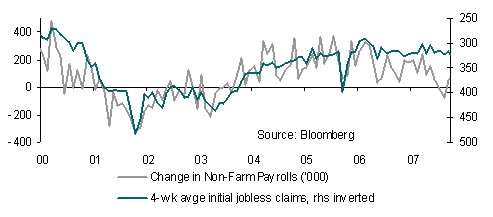
Data and events this week have the potential to change the markets perspective, especially the US November jobs report at the end of the week. There is no doubt that payrolls are on an improving trend (145k consensus) in line with the declining trend in jobless claims but unfortunately the unemployment rate is set to remain stubbornly high at 9.6% and this will be the bigger focus for the Fed and markets as it implies not let up in QE. As usual further clues to the payrolls will be garnered from the ADP jobs report and ISM data on Wednesday.

Euro pressure mounts

The effects of eurozone peripheral bond concerns are cascading through eurozone markets and hitting risk appetite in the process. The EUR is a clear casualty having dropped further against the USD and versus other currencies. EUR/Asian FX remains a sell in the current environment. Contagion outside Greece, Portugal and Ireland had been limited but Italy and Spain have also seen a growing impact on their bond markets. Having broke below support around 1.3734, EUR/USD will target 1.3508 support.

Speculation that Ireland will be forced to follow Greece in seeking international financial support has intensified. Although Ireland has sufficient funds to last until next spring, yields on its debt are already higher than Greek debt before it received funds a few months back. Attention is firmly fixed on the country’s budget on 7 December and the prospects of an agreement between the government and opposition in its austerity plans.

Not helping is the fact that the Irish government has a very slim majority. Even if the budget is passed there is no guarantee that sentiment will improve given the negative impact of even deeper fiscal tightening announced last week will have on economic growth. Moreover, Germany’s insistence that the cost of any Greek style bailout should be borne mostly by private investors has only added to market tension. Even the European Central Bank is unlikely to provide much support, with ECB member Stark suggesting that ECB bond purchases will remain limited.

This leaves eurozone markets in a precarious state and the EUR continues to look heavy as further downside opens up. Moreover, the problems in peripheral Europe are beginning to have a broader impact on risk appetite, with equity markets slipping, although some of this was related to a weaker sales forecast from Cisco in the US. Nonetheless, spreading risk aversion could also dampen sentiment for Asian currencies, which is why selling EUR/Asian FX looks a better bet than selling USD/Asian FX over the short term.

In contrast sentiment for the US is undergoing an improvement. Data releases over recent weeks have generally beaten forecasts and there is even growing speculation that the Fed’s calibrated asset purchases may end up being smaller than planned. Such speculation has boosted the USD but it is premature to suggest that the Fed is on the verge of scaling back asset purchases even as the program of purchases gets going. Although there are clearly some FOMC members who are opposed to significant asset purchases the probability that the Fed remains set to carry out its full $600 billion of planned purchases.

Attention today will focus squarely on day 2 of the G20 meeting and any resolution to disputes over trade imbalances and currencies. Unfortunately none is likely to be forthcoming. Despite a reported 80 minute meeting between US and Chinese leaders little agreement was reached, with plenty of finger pointing remaining in place. It appears that the mantra of moving towards “market-determined exchange rates” and efforts at “reducing excessive imbalances” as agreed at the G20 meeting of finance ministers and central bankers will be as far as any agreement reaches. As a result markets will be left with very little to chew on.