Greek bailout edges closer

A semblance of calm appears to have returned into the weekend following a fit of nervousness about all things Greece.  For currency markets this means that the EUR has recovered some composure after hitting 2010 lows around 1.3115 but direction next week will largely depend on the much anticipated announcement from European officials over coming days on the size and conditionality of a loan package to the country.   In return Greece is reported to be planning a EUR 24 billion package of additional measures to cut its burgeoning fiscal deficit.

Over recent days the consensus on how much funding Greece will need has increased to EUR 120 billion from the initial EUR 45 billion announced just over a couple of weeks ago.   Presumably the jump in size of assistance will be sufficient to convince markets that Greece’s default risk will be minimal, not just in the coming year but over the next few years.   It may also help to prevent further credit ratings downgrades following the decision by S&P ratings agency to downgrade Greece to junk status.  Moody’s left Greece on review for a downgrade but may also cut its ratings to junk if the situation does not improve. 

There are still many obstacles to an improvement in confidence towards Greece, however including the willingness of Germany to contribute to any aid package ahead of regional elections on May 9th and the ability of the Greek government to push through austerity measures in the face of growing social unrest in the country.   Moreover, the task ahead for Greece which aims at cutting the budget deficit down to 2% by 2013 is enormous having never been achieved in modern history.  Given the outlook for much weaker growth in the months and years ahead as well as growing domestic resistance in Greece, it will be all the more difficult. 

The likely announcement of an aid package over coming days will keep market sentiment relatively well supported and as reflected in the narrowing in Greek debt spreads, which seem to be trading more like equities, it is already having a positive impact.  Nonetheless, the bounce to markets will be limited and whilst a EUR 100-120 billion package will help to shore up confidence, there is just too much uncertainty remaining.  This points to continued volatility in the weeks ahead and very limited upside for EUR/USD and more likely a test of technical support around 1.3091 in the short-term then down to 1.2885.
Some Respite For The Euro

Following several days in which confidence in Greece’s ability to weather the storm was deteriorating, news that Greece asked for EU/IMF help helped to boost global markets and the EUR.  Meanwhile strengthening economic and earnings news helped to provide an undercurrent of support for markets, which boosted the end week rally in risk appetite.  

A 27% jump in US new home sales in March, a firm durable goods orders report as well better than expected earnings, with around 80% of companies reporting first quarter earnings beating expectations, highlight that US economic recovery is becoming increasingly well entrenched.  This is likely to be confirmed by the release of US Q1 GDP this week, set to register over 3% annualised quarterly growth.  

In Europe the picture is far more divergent, with exporting countries such as Germany doing well as evidenced from surveys such as the IFO and ZEW surveys, but in contrast the club med countries are not doing so well.  The highlights of the data calendar this week are April confidence indicators and the flash reading of Eurozone CPI.  Confidence indicators are likely to reveal some improvement, but despite Friday’s EUR/USD bounce, the data will be insufficient to prevent EUR/USD continue to move lower, with 1.3150 still a firm target over coming weeks.  

The official request for aid from Greece from the EU/IMF begins a new chapter in the long running saga for the country.  Greece will officially detail the amount of aid needed in a letter to the European Commission and European Central Bank who will then decide whether to approve it.  

A few dates to note are the maturing of EUR 8.5 billion in bonds on May 19, the completion of discussion with the IMF, EU and ECB on May 6 and state elections in Germany on May 9, which could throw a spanner in any financial support from Germany for Greece.   Meanwhile Greek unions are threatening further strikes to protest against austerity measures that Greece needs to carry out to win any aid package.   

Aside from Greece, attention will continue to be focussed on earnings but the main event of the week will be the Fed FOMC meeting on 27/28 April. Whilst a no change outcome is highly likely, with interest rates set to be left at between 0-0.25%, there will be plenty of attention on whether the Fed removes the comment that policy rates will remain low for an “extended period”. If the comment is removed the statement will be taken in somewhat of a hawkish context, which would boost the USD.

Shaking Off The Bad News

Markets managed to shake off the initial shock of the SEC’s fraud case against Goldman Sachs following news that the charge was not approved unanimously, but with a 3-2 vote. This was interpreted by some to imply that there was more of a political rather than economic bias behind the charge, with two Democrats voting for and two Republicans voting against and SEC Chairman Schapiro siding with the Democrats.

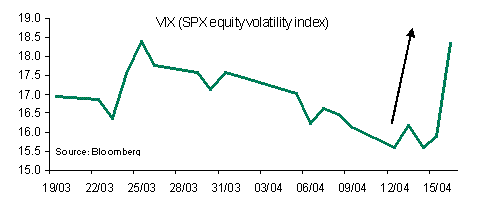
Stronger than forecast earnings from Citigroup and a bigger than expected 1.4% jump in US March leading indicators also helped to calm market nerves, with US equities closing higher and the VIX volatility index reversing some of its spike higher. Attention is still firmly fixed on earnings and with 121 S&P 500 companies due to release earnings this week including Apple, Goldman Sachs, Johnson & Johnson and Yahoo today.

Nonetheless, it is difficult to see sentiment improve too much against the background of ongoing worries about Greece as reflected in the renewed widening in Greek debt spreads yesterday. Moreover, the negative economic impact of the spread of volcanic ash from Iceland, and potential for more lawsuits related to CDOs from regulators as well as investors, against banks, will continue to act as a drag on market risk appetite.

Earnings have been positive so far into the season and as seen overnight, this is helping to counter market negatives, giving risk appetite some support. In turn, this will give risk currencies some relief but given the gyrations between positive and negative news it is difficult to see most currencies breaking out of recent ranges.

My overall bias is for positive earnings and data to overcome the negatives this week, leaving the likes of the AUD, NZD and CAD as well Asian currencies firmer. The EUR and GBP are likely to remain the weakest links, with both currencies set to retrace lower and EUR/USD finding plenty of sellers above 1.3500.

What To Watch This Week

Well so much for a “risk on” week. Market sentiment soured at the end of last week following The US Securities and Exchange Commission (SEC) civil action against Goldman Sachs, in which they accused the bank of fraud. The impact reverberated across markets and risk trades were pulled back as a consequence. Bulls shouldn’t be too downhearted though as the drop in risk trades followed several days of gains and part of the pullback could be attributed to profit taking.

Speculation of similar probes in Europe by financial regulators will cast a shadow over markets early this week. Nonetheless, direction will at least in part come from earnings. So far the run of earnings looks upbeat, with around 83% of the 48 S&P 500 companies reporting, beating analysts’ estimates. Overall profits are forecast to increase by around 30% from a year ago but are on track to easily beat this estimate. Bellwether names including IBM, Apple, Coca-Cola, Boeing, Microsoft, and AT&T report this week.

The meeting between Greek officials, ECB, IMF and EU has been delayed until Wednesday. There is little likelihood of Greece seeing any loan money soon as the need for parliamentary approval in some EU countries and upcoming regional elections in Germany on 9 May will put a spanner in the works. An issue of EUR 1.5bn of 3-month Greek debt tomorrow will act another test of market confidence but the recent widening in Greek debt spreads suggests a less positive reception than the previous sale.

There are also a few central bank meetings to contend with this week including Canada, Sweden, India, Philippines and Thailand. The only Bank likely to hike interest rates out of this bunch is the RBI in India with another hike expected, following closely on the heels of the March move. Canada and Sweden are unlikely to shift policy until at last after the end of Q2 whilst protests in Bangkok, Thailand, and the knock on impact on consumer confidence, have effectively sealed the case for no rate move there.

On the data front, attention will turn to US housing market activity. Markets will be able to gauge further clues to whether recovery in the housing market has stalled. An increase in both existing (Thu) and new home sales (Fri) in March is expected, which may allay some concerns although any improvement is likely to continue to fragile against the background of tight credit and high foreclosure levels.

In Europe, aside from the ongoing Greek sage, sentiment surveys will garner most attention, with the release of the German ZEW (Tue) and IFO (Fri) surveys as well as manufacturing and service sector purchasing managers indices (PMIs) across Europe. On the whole the surveys are likely to reveal some improvement as confidence.

Risk aversion will be slightly elevated at the beginning of this week but strong earnings and improving data will help to prevent too much damage. Consequently Risk currencies will start the week under pressure but any pullback will be limited. Given that speculative positioning in risk currencies such as the AUD, NZD and CAD is well above their three-month average according to the latest Commitment of Traders’ IMM data there will be some scope for profit taking. EUR speculative sentiment has seen some improvement but EUR/USD remains vulnerable to a further pull back to technical support around 1.3302 this week.

Shaping up to be a “risk on” week

It’s most definitely turning into a “risk on” week. On the earnings front both JP Morgan Chase and Intel beat forecasts whilst data releases did not disappoint either. In particular, US retail sales came in much stronger than expected. The Fed’s Beige Book also gave markets some good news to chew on. The reports from the twelve Federal Reserve Districts noted that economic activity “increased somewhat” since the March 3rd report.

The positive tone will continue today with the release of the March industrial production data, expected to show a strong gain over the month (consensus 0.7%), whilst both the Empire State and Philly Fed manufacturing surveys are set to post small gains in April, consistent with strengthening manufacturing activity in the months ahead.

Fed speakers have also been helpful for market sentiment. Fed Chairman Bernanke sounded a little more upbeat on the economy but highlighted the “significant restraints” remaining in the US economy. Bernanke maintained the “extended period” of low rates statement despite some speculation that the Fed was verging on removing this. The net impact of the testimony, improved data and earnings and firmer risk appetite is to keep the USD on pressure. In contrast, commodity currencies including AUD, NZD and CAD, will benefit, both from firmer risk appetite and an upturn in commodity prices.

Despite the positive reception to Greece’s debt auction there is not a lot of faith in the ability of Greece to weather the storm. Reports that Greece will need far more funding than has been initially promised by the EU/IMF – potentially as high as EUR 90 billion over coming years – together with worries about selling the loan package to the public in Germany and other eurozone countries, as well EU comments that Portugal will need further fiscal consolidation, have not done much good for confidence. Technically EUR/USD will see plenty of resistance around 1.3692.

After Singapore’s move to tighten monetary policy via the SGD revaluation, and following close on the heels of India, Malaysia and Vietnam, attention has turned to who’s next in line. South Korea must be a prime candidate, especially following data yesterday revealing a drop in the unemployment rate. Of course, China is very much in the spotlight and is set to embark on monetary tightening measures as well as CNY revaluation soon.

India is set to move again as early as next week, with inflation data today likely to seal the case for another hike (consensus 10.37% in March). The risk remains however, that many Asian central banks are moving too slowly to curb building inflation pressures and may find that they ultimately need to tighten more than they otherwise would have done.

China’s heavy slate of data released will if anything fuel greater expectations of an imminent CNY revaluation as well as monetary tightening. China’s economy grew a very strong 11.9% in Q1, above already strong consensus expectations, whilst CPI rose 2.4% YoY in March.

The growth data alongside further evidence of accelerating real estate prices highlight the risks of overheating in the economy and the need to act quickly to curb inflation threats. Given this expectation, firm risk appetite, and more follow through from Singapore’s FX move, the outlook for other Asian currencies remains positive.