Euro decline limited, AUD under pressure

EUR looks like it’s going nowhere fast, with the currency failing to break above 1.33 versus the USD. Nonetheless any drop will be limited as there will be plenty of support for EUR/USD around the 1.30 level. Such support may be required following the disappointing reading for the Eurozone March flash purchasing managers index (PMI) and renewed growth worries even in Germany.

Moreover, there have been plenty of scare stories about ongoing problems in the Eurozone, centring on Portugal and Spain and even speculation of a third Greek bailout being needed at some point.

However, the reality is that the market has reduced its attention on Eurozone debt issues for the time being. Once the latest bout of risk aversion passes, this ought to allowing the EUR some room to push higher, with my short term models highlighting the scope for EUR/USD to edge back towards 1.35 over coming weeks.

AUD has been pummelled this week, alongside its neighbour NZD. Growth worries in China compounded by a weaker than expected March China PMI has piled on the pressure, especially on AUD where economic conditions are increasingly linked with China. My quantitative models highlight ongoing short term downside risks to both AUD and NZD.

However, declines in these currencies will provide better levels to eventually buy as I remain bullish in the medium term even though my valuation metrics reveal that both currencies remain overvalued. My view is built on the prediction that risk appetite will improve further this year, a boon to high beta currencies such as AUD and NZD. Additionally as yield gains importance and carry trades gain attraction AUD will look particularly attractive.
Euro pain, Australian and New Zealand dollars vulnerable

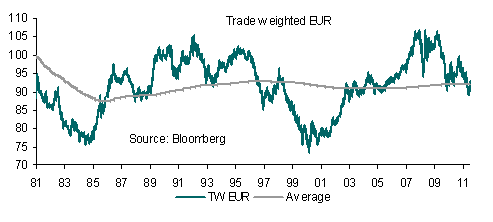
EUR appreciation has been painful for many, especially those looking for a turn in the currency over recent days. Unfortunately, for these investors, the EUR may yet strengthen further in the short term before any reversal is seen. Indeed, using valuations to justify a bearish view may not be a particularly strong argument at present given that the EUR trade weighted index is trading close to its historical average level while IMM data reveals that the speculative market remains significantly short EUR.

Additionally, my quantitative models reveal that the short term ‘fair value’ for EUR/USD is close to 1.40. While longer term fair value is undoubtedly much lower, it could take some time before the EUR declines to such levels. This is not encouraging news for EUR bears but there are some signs that the upmove in EUR/USD may not persist. Currently EUR/USD is trading above its 100-day moving average but since July last year, it has failed to remain above its 100 day moving average level for more than a few days.

There are definite signs that commodity currencies are topping out. Both the AUD and NZD have failed to extend gains over recent weeks. Perhaps valuation concerns are finally begging to catch up with these currencies (both are close to 2 standard deviations from average purchasing power parity while my quantitative models reveals a divergence with short term fair value) while speculative positioning according to IMM data remains at high levels. AUD and NZD even look stretched relative to interest rate differentials.

A wider than forecast January trade deficit in New Zealand did not bode well for the NZD but near term direction for both currencies will still depend on the gyrations in risk appetite given the strong correlation that both AUD and NZD have with risk aversion. Notably the the improvement in risk appetite has stalled in February, leaving AUD and NZD exposed to lofty valuations.

FX outlook this week

Direction in FX markets will largely hinge on developments at the beginning of the week in Europe but a US holiday (Presidents’ Day) will mean a subdued start. US data has continued to beat expectations as revealed by the recent gains in core retail sales, manufacturing surveys, jobless claims and industrial production. US recovery is taking shape and the USD is finally showing some signs of perking up on the news.

Rising US bond yields have provided the USD with some support although the impact has been muted by higher bond yields elsewhere. Nonetheless, despite ongoing speculation of more Fed quantitative easing the USD looks set to be on a slightly firmer footing over coming days. In a relatively light week of data releases housing data will be the major focus of attention.

Assuming approval for a second Greek bailout goes ahead (after much procrastination) the week will at least begin on a positive note for the EUR. Whether the EUR will extend gains will partly be determined by the release of flash February purchasing managers’ indices (PMI) and the German IFO business confidence survey. Our forecasts of weak service sector readings but firm manufacturing indices will be a mixed blessing for the EUR but overall data will remain consistent with mild recession.

Failure of EUR/USD to sustain a move below the psychologically important 1.30 level suggests a bit more resilience over coming days. Nonetheless, speculation of a Greek euro exit will not fade quickly and markets will likely gyrate between ‘risk on’ and ‘risk off’ depending on the latest comments from Greek or European officials. All in all, the EUR will continue to struggle to move higher.

For a change one of the bigger movers in currency markets over recent days has been the JPY. Its decline following more aggressive monetary policy action by the Bank of Japan has extended further. The move by the BoJ helped to suppress Japanese government bond yields (JGBs) allowing USD/JPY to move higher in line with relatively higher US yields. This week’s release of January trade data will support the case for more JPY weakness given the deteriorating trend.

The data will also strengthen the resolve of the Japanese authorities to intervene in FX markets should the JPY strengthen anew. Immediate focus will be whether USD/JPY can break through the psychologically important 80 level where JPY weakness will be met by plenty of exporters offloading USDs. I suspect the upside momentum in USD/JPY will fade over coming days unless US bond yields continue their ascent.

Euro pricing in a lot of good news

Markets remain in limbo ahead of a potential Greek debt deal although US equities managed to eek out small gains overnight. Stocks in the US have entered a bull market helped by the dovish stance of major central banks.

The Federal Reserve’s commitment to maintain accommodative policy until the end of 2014 and the European Central Bank’s (ECB)3 year LTRO have been drivers of the rally in risk assets. The BoE will contribute to the easy stance of central banks, with an increase in UK quantitative easing set to be announced today. The ECB in contrast is set to remain in status quo.

Will it be a buy on rumour, sell on fact reaction for the EUR to a Greek debt deal? Over recent days anticipation has grown that a deal on debt writedowns and in turn a second bailout package will emerge soon. This has helped to propel EUR/USD higher, with the currency hitting a high of 1.3289 overnight.

So far a deal has been lacking but leaders are expected to approve a draft agreement on fresh austerity measures between the main Greek political parties today. This should pave the way a deal on debt restructuring and a new loan package for the country due to be discussed today between Eurozone finance officials.

However, the EUR has already priced in a lot of good news on this front and even agreements on the issues above may not see the currency push much higher, with strong resistance around EUR/USD 1.3388. Separately today’s ECB meeting is unlikely to provide much direction for the EUR, with the Bank set to maintain current policy settings.

USD/JPY has managed a recovery of sorts but still remains in the middle of multi month 75.5-78.5 range. Nonetheless, the momentum over the short term will continue to be for USD/JPY upside, with resistance around 77.49 targeted. News that the Japanese authorities conducted ‘stealth intervention’ to weaken the JPY in late October/early November will have emboldened JPY bears.

However, at the same time they should also be worried as it is clear that even after all the intervention the JPY remains overly strong. Reflecting this is the fact that speculative and margin trading JPY positioning is at a very high level.

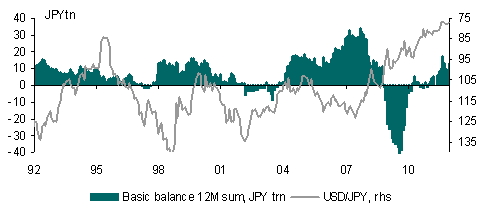
Moreover, while much has been made of the deterioration in Japan’s current account balance over recent months and the potentially negative impact on the JPY it should be noted that Japan’s basic balance (sum of direct investment + current account + portfolio flows) position remains healthy (for now) and is acting as an obstacle to JPY weakness.

Super Failure By Supercommittee

The USD remains a clear beneficiary in the ‘risk off’ environment enveloping markets at present. Indeed as reflected in the latest jump in USD (IMM) speculative positioning the market is turning increasingly to the USD at a time of intense stress. Moreover, the run of better economic data over recent weeks including October existing home sales yesterday points to less need for further Fed quantitative easing, which comes as further relief to the USD.

Further information on this front will be revealed in the Federal Reserve FOMC minutes on Wednesday, with the Fed set to keep the option open. Even the lack of agreement by the US Congressional Supercommittee on a deal to cut the US budget deficit by $1.2 trillion has failed to dent the USD’s progress as the failure of deficit talks was largely expected. Further USD gains are likely but the pace of its upside move will slow.

Although sentiment towards the Eurozone has deteriorated further EUR/USD is just about clinging onto the 1.3500 level despite several forays lower. More active European Central Bank (ECB) bond buying likely helped dampen some bearishness on the currency although reports suggest that the central bank has imposed a limit of EUR 20 billion on such purchases.

The EUR is not being helped however, by ongoing rumblings of a EUR break up despite Greek Prime Minister Papademos attempting to downplay talk of a Greek EUR exit. A meeting today between Italian Prime Minister Monti and EU officials will be in focus, with markets looking to see further signs of commitment to reforms. We expect no let up in pressure on the EUR, though further declines are likely to be slower, with last week’s low around 1.3420 providing short term support.

GPB has been an underperformer, with the currency on the path for a re-test of the 6 October low around 1.5272. News this week will not be helpful for the currency, with potentially dovish Bank of England monetary policy committee (MPC) minutes likely to inflict further damage, with support from the MPC for more QE set to be revealed.

Ahead of the minutes, UK public finances data today will not make for attractive reading just over a week away from UK Chancellor Osborne’s Autumn statement, which will likely reveal a downward revision to growth forecasts and an upward revision to deficit forecasts. GBP has even lost ground against the beleaguered EUR although we continue to believe that the overall trend will continue to be lower for EUR/GBP over coming weeks.