Data and earnings focus

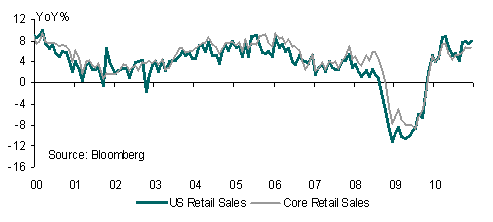
Friday’s round of US data were generally upbeat, highlighting that consumer spending is coming back to life. Inflation pressures however, remain benign at least on the core reading highlighting the Fed’s concern that inflation is running below the level consistent with its mandate. In other words it will be a long time, probably late into 2012 before policy rates increase.
While the Fed is no hurry to raise rates despite a few hawkish rumblings within the FOMC the European Central Bank (ECB) in contrast appears to have become more eager to pull the trigger for higher rates. ECB President Trichet’s hawkish press conference last week set the cat amongst the pigeons and marked a clear shift in ECB rhetoric towards a more hawkish stance.

A very big problem for the ECB is that the eurozone economy is not performing along the lines that its hawkish rhetoric would suggest, especially in the periphery. Growth momentum in the core in contrast, as likely reflected in the January ZEW investor confidence and IFO business confidence survey data this week in Germany, remains positive. Both surveys are likely to stabilize at healthy levels but how long can the likes of Germany drag along the eurozone periphery?

There will be relatively more attention on the meeting of Eurogroup/Ecofin officials, with focus on issues such as enlarging the size of the European Financial Stability Facility (EFSF) bailout fund and development of a “comprehensive plan” to contain the eurozone crisis. Don’t look for any conclusive agreements as this may have to wait until the European Union (EU) Council meeting on 4 February assuming (optimistically given ongoing German resistance) some agreement can even be reached.

Following the success (albeit at relatively high yields) of the eurozone debt auctions last week, sentiment for peripheral debt will face further tests this week in the form of debt sales in Spain, Belgium and Portugal.

The US Martin Luther King Jr. holiday will result in a quiet start to the week for markets but there will be plenty to chew on. This week’s key earnings reports include several banks scheduled to release Q4 earnings. Financials are a leading sector in the rally in equities at present and these earnings will be critical to determine whether the rally has legs.

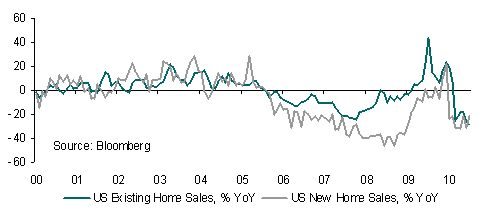
The US data slate includes January manufacturing surveys in the form of the Empire and Philly Fed, both of which are likely to post healthy gains whilst existing home sales are also likely to rise. This will not change the generally weak picture of the US housing market, with high inventories and elevated foreclosures characterizing conditions. As if to prove this, housing starts are set to drop in December. On the rates front, the Bank of Canada is likely to keep its policy rates on hold this week.
After coming under pressure last week much for the USD will depend on the eurozone’s travails to determine further direction. Concrete evidence of progress at the Ecofin may bolster the EUR further, with resistance seen around 1.3500 but don’t bank on it. The ability of eurozone officials to let down often lofty expectations should not be ignored. In any case following sharp gains last week progress over coming days for the EUR will be harder to achieve.

Risk on mood prevails

The end of the year looks as though it will finish in a firmly risk on mood. Equity volatility in the form of the VIX index at its lowest since July 2007. FX volatility remains relatively low. A lack of market participants and thinning volumes may explain this but perhaps after a tumultuous year, there is a certain degree of lethargy into year end.

Whether 2011 kicks off in similar mood is debatable given the many and varied worries remaining unresolved, not the least of which is the peripheral sovereign debt concerns in the eurozone. It is no surprise that the one currency still under pressure is the EUR and even talk that China offered to buy Portuguese sovereign bonds has done little to arrest its decline.

Reports of officials bids may give some support to EUR/USD just below 1.31 but the various downgrades to ratings and outlooks from ratings agencies over the past week has soured sentiment for the currency. The latest move came from Fitch ratings agency which placed Greece’s major banks on negative ratings watch following the move to place the country’s ratings on review for a possible downgrade.

The USD proved resilient to weaker than forecast data including a smaller than forecast 5.6% gain in existing home sales in November. The FHFA house price index recorded a surprise gain of 0.7% in October, which mitigated some of the damage. The revised estimate of US Q3 GDP revealed a smaller than expected revision higher to 2.6% QoQ annualized from a previous reading of 2.5%. Moreover, the core PCE was very soft at 0.5% QoQ, supporting the view that the Fed has plenty of room to keep policy very accommodative.

Despite the soft core PCE reading Philadelphia Fed President Plosser who will vote on the FOMC next year indicated that if the economy continues to strengthen he will look for the Fed to cut back on completing the $600 billion quantitative easing (QE) program. Although the tax deal passed by Congress will likely reduce the need for QE3, persistently high unemployment and soft core inflation will likely see the full $600 billion program completed. Today marks the heaviest day for US data this week, with attention turning to November durable goods orders, personal income and spending, jobless claims, final reading of Michigan confidence and November new home sales.

Overall the busy US data slate will likely maintain an encouraging pattern, with healthy gains in income and spending, a rebound in new home sales and the final reading of Michigan confidence likely to hold its gains in December. Meanwhile jobless claims are forecast to match the 420k reading last week, which should see the 4-week average around the 425k mark. This will be around the lowest since August 2008, signifying ongoing improvement in payrolls. The data should maintain the upward pressure on US bond yields, which in turn will keep the USD supported.

Please note that this will be the last post on Econometer.org this year. Seasons greatings and best wishes for the new year to all Econometer readers.

The loss of a great forecaster

Forecasters around the world will mourn the loss of one of their finest following the death of Paul the Octopus at the age of 2 ½ (apparently an average age for Octopi). Although Paul had various threats to his life and insults to his mother’s honour he passed away from natural causes. Many forecasters envious of Paul’s record will look now a successor being groomed to take his place. Markets could do with Paul’s abilities in trying to ascertain the magnitude of Fed quantitative easing (QE) to be announced on 3 November. Conflicting comments from the Fed’s Hoenig (hawkish) and Dudley (dovish) yesterday will keep the market’s guessing.

Interestingly US bond yields are backing up and although yields elsewhere are also rising US yields are beginning to move relatively higher. The FX impact is evident in the growing resilience of the USD. Major Currencies with the highest correlations with bond yield differentials are EUR/USD, AUD/USD, EUR/CAD and USD/CHF although USD/JPY correlations have also been pushing higher. These currencies will ultimately suffer the most if US yields back up further.

Part of the reason for the shift higher in US bond yields is growing speculation that the Fed will take a more measured approach to asset purchases whilst recent data, particularly in the US housing market is showing some stabilisation as revealed in existing home sales data on Monday and a surprise gain in the August US FHFA home price index overnight. September new homes sales will be closely watched today to determine whether this stability is becoming broader based.

US consumer confidence continued this pattern, with the Conference Board index rising to 50.2 in October. Perhaps more interesting was the outcome of the US 5-year TIPS auction at a negative yield (-0.55%). The increased demand for inflation protection hints at QE2 working even before it has been carried out but there is a long way to go on this road and it would be premature to read too much into the auction outcome.

It’s worth noting that UK bond yields bucked the trend versus US bond yields following the release of stronger than expected UK GDP. The data alongside persistently above target inflation will likely dampen expectations that the Bank of England (BoE) will follow the path of the Fed into more QE. Consequently GBP has been a key outperformer. EUR/GBP in particular underwent a sharp reversal and technically the currency pair is showing a negative divergence from the 9-day RSI and the MACD is turning lower from overbought levels. The cross needs to drop below 0.8696 to confirm the technical signals.

Closer to home Australian CPI data this morning played into the hands of those looking for the Reserve Bank of Australia (RBA) to remain on hold next week. Although CPI was slightly softer than expected at 0.6% QoQ in Q3, the AUD took the news badly. The RBA has kept the cash rate on hold at 4.5% since May and at the last meeting there was little indication of an urgency to hike. Nonetheless, recent data plays towards a rate hike next week though the outcome is now a much closer call

Split personality

Markets are exhibiting a Strange Case of Dr Jekyll and Mr Hyde, with a clear case of split personality. Intensifying risk aversion initially provoked USD and JPY strength, with most crosses against these currencies under pressure. Both USD/JPY and EUR/JPY breezed through psychological and technical barriers, with the latter hitting a nine-year low. However, this reversed abruptly in the wake of extremely poor US existing home sales, which plunged 27.2% in July, alongside downward revisions to prior months, a much bigger drop than forecast.

Obviously double-dip fears have increased but how realistic are such fears? Whilst much of the drop in home sales can be attributed to the expiry of tax credits, investors can be forgiven for thinking that renewed housing market weakness may lead the way in fuelling a more generalized US economic downdraft. The slow pace of jobs market improvement highlights that the risks to the consumer are still significant, whilst tight credit and weaker equities, suggests that wealth and income effects remain unsupportive.

FX markets will need to determine whether to buy USDs on higher risk aversion or sell USDs on signs of weaker growth and potential quantitative easing. I suspect the former, with the USD likely to remain firm against most risk currencies. The only positive thing to note in relation to the rise in risk aversion is that it is taking place in an orderly manner, with markets not panicking (yet).

European data in the form of June industrial new orders delivered a pleasant surprise, up 2.5%, but sentiment for European markets was delivered a blow from the downgrade of Ireland’s credit rating to AA- from AA which took place after the close. The data suggests that the momentum of European growth in Q3 may not be as soft as initially feared following the robust Q2 GDP outcome.

Japan has rather more to worry about on the growth front, especially given the weaker starting point as revealed in recently soft Q2 GDP data. Japan revealed a wider than expected trade surplus in July but this was caused by a bigger drop in exports than imports, adding to signs of softening domestic activity. The strength of the JPY is clearly making the job of officials harder but so far there has been no sign of imminent official FX action.

Japan’s finance minister Noda highlighted that recent FX moves have been “one sided” and that “appropriate action will be taken when necessary”. The sharp move in JPY crosses resulted in a jump in JPY volatility, a factor that will result in a greater probability of actual FX intervention but the prospects of intervention are likely to remain limited unless the move in the JPY accelerates. USD/JPY hit a low of 83.60 overnight but has recovered some lost ground, with 83.50 seen as the next key support level. JPY crosses may see some support from market wariness on possible BoJ JPY action, but the overall bias remains downwards versus JPY.

Risk trade rally fizzles out

The risk trade rally spurred by China’s decision to de-peg the CNY fizzled out. The realization that China will only move very gradually on the CNY brought a dose of reality back to markets after the initial euphoria. The fact that unlike in July 2005 China ruled out a one off revaluation adds support to the view that China will move cautiously ahead with CNY reform. In addition, renewed economic worries have crept back in, with particular attention on a potential double dip in the US housing market following a surprise 2% drop in existing home sales in May.

European banking sector woes have not disappeared either with S&P raising the estimate of writedowns on Spanish bank losses, whilst Fitch ratings agency noted that there is an increased chance of the eurozone suffering a double-dip recession. The net impact of all of these factors is to dampen risk appetite and the EUR in particular.

The UK’s announcement of strong belt tightening measures in its emergency budget did not fall far outside of market expectations. The budget outlined a 5-year plan of deficit reduction, from 11% of GDP in 2009-10 to 2.1% of GDP in 2014-15. The main imponderable was the response of ratings agency and so far it appears to have been sufficient not to warrant a downgrade of the UK’s credit ratings. Fitch noted that the “ambitious” plan ensured that the UK would keep its AAA credit rating. The emergency budget and reaction to it has been mildly positive for GBP, which has shown some resilience despite the pull back in risk currencies.

The recent rally in Asian currencies is looking somewhat overdone but direction will come from gyrations in risk appetite and the CNY rather than domestic data or events. Encouragingly equity capital flows into Asia have picked up again over recent weeks, with most countries with the exception of the Philippines registering capital inflows so far this month, led by India and South Korea.

China’s CNY move may attract more capital inflows into the region, suggesting that equity capital flows will continue to strengthen unless there is a relapse in terms of sovereign debt/fiscal concerns in Europe. Nonetheless, central banks in the region will continue to resist strong FX gains via FX interventions, preventing a rapid strengthening in local currencies.

Although India and Korea have registered the most equity inflows this month, both the INR and KRW have had a low correlation with local equity market performance over recent weeks. In fact the most highly sensitive currencies to their respective equity market performance have been the MYR and IDR both of which have reversed some of their gains from yesterday. USD/MYR will likely struggle to break below its 26th April low around 3.1825 whilst USD/IDR will find a break below 9000 a tough nut to crack.