Speculators bail out of USDs

Risk appetite held up reasonably well last week, with markets failing to be derailed by concerns over Ireland’s banking sector and growing opposition to austerity measures across Europe. The main loser remained the USD, with the USD index hitting a low marginally above 78.00 and speculative positioning as reflected in the CFTC IMM data revealing a further sharp drop in sentiment to its lowest since Dec 2007.

This week is an important one for central bank meetings, with four major central banks deliberating on monetary policy including Bank of Japan (BoJ), Reserve Bank of Australia (RBA), European Central Bank (ECB) and Bank of England (BoE). The major event of the week however, is Friday’s release of the September US employment report. The RBA is set to hike its cash rate by 25bps, the BoJ may announced more easing measures whilst in contrast both the ECB and BoE are unlikely to alter their policy settings.

Whilst the BoJ is widely expected to leave its policy rate unchanged at 0.1%, it may announce further measures against the background of persistent JPY strength, a worsening economic outlook as reflected in last week’s Tankan survey and decline in exports. Japanese press indicate that the BoJ may increase lending of fixed rate 3 to 6 month loans to financial institutions as well as buy more short-term government debt.

The measures alongside risks of further JPY intervention may prevent USD/JPY slipping further but as reflected in the increase in speculative net long JPY positions last week, the market is increasingly testing the resolve of the Japanese authorities. Strong support is seen around USD/JPY 82.80, with the authorities unlikely to allow a break below this technical level in the short-term.

Although we will only see details of the voting in two weeks in the release of the UK BoE Monetary Policy Commitee (MPC) minutes it is likely that there was a three-way split within the MPC as reflected in recent comments, with MPC member Posen appearing to favour more quantitative easing whilst the MPC’s Sentance is set to retain his preference for higher rates. As has been the case over recent months the majority of the MPC are likely to have opted for the status quo.

GBP was a laggard over September as markets continued to fret over potential QE from the BoE. This uncertainty is unlikely to fade quickly suggesting limited gains against the USD and potentially more downside against the EUR. GBP speculative sentiment has improved but notably positioning remains short. EUR/GBP will likely target resistance around 0.8810.

In contrast to GBP the EUR has taken full advantage of USD weakness and looks set to extend its gains. Although there is a risk that speculative positioning will soon become overly stretched it is worth noting that positioning is well below its past highs according to the IMM data. EUR may have received some support from Chinese Premier Wen’s pledge to support Greece, and a stable EUR. Whilst there continues to be risks to the EUR from ongoing peripheral debt concerns such comments likely to be repeated at the EU-Asia summit today and tomorrow, will keep the EUR underpinned for a test of 1.3840.
Split personality

Markets are exhibiting a Strange Case of Dr Jekyll and Mr Hyde, with a clear case of split personality. Intensifying risk aversion initially provoked USD and JPY strength, with most crosses against these currencies under pressure. Both USD/JPY and EUR/JPY breezed through psychological and technical barriers, with the latter hitting a nine-year low. However, this reversed abruptly in the wake of extremely poor US existing home sales, which plunged 27.2% in July, alongside downward revisions to prior months, a much bigger drop than forecast.

Obviously double-dip fears have increased but how realistic are such fears? Whilst much of the drop in home sales can be attributed to the expiry of tax credits, investors can be forgiven for thinking that renewed housing market weakness may lead the way in fuelling a more generalized US economic downdraft. The slow pace of jobs market improvement highlights that the risks to the consumer are still significant, whilst tight credit and weaker equities, suggests that wealth and income effects remain unsupportive.

FX markets will need to determine whether to buy USDs on higher risk aversion or sell USDs on signs of weaker growth and potential quantitative easing. I suspect the former, with the USD likely to remain firm against most risk currencies. The only positive thing to note in relation to the rise in risk aversion is that it is taking place in an orderly manner, with markets not panicking (yet).

European data in the form of June industrial new orders delivered a pleasant surprise, up 2.5%, but sentiment for European markets was delivered a blow from the downgrade of Ireland’s credit rating to AA- from AA which took place after the close. The data suggests that the momentum of European growth in Q3 may not be as soft as initially feared following the robust Q2 GDP outcome.

Japan has rather more to worry about on the growth front, especially given the weaker starting point as revealed in recently soft Q2 GDP data. Japan revealed a wider than expected trade surplus in July but this was caused by a bigger drop in exports than imports, adding to signs of softening domestic activity. The strength of the JPY is clearly making the job of officials harder but so far there has been no sign of imminent official FX action.

Japan’s finance minister Noda highlighted that recent FX moves have been “one sided” and that “appropriate action will be taken when necessary”. The sharp move in JPY crosses resulted in a jump in JPY volatility, a factor that will result in a greater probability of actual FX intervention but the prospects of intervention are likely to remain limited unless the move in the JPY accelerates. USD/JPY hit a low of 83.60 overnight but has recovered some lost ground, with 83.50 seen as the next key support level. JPY crosses may see some support from market wariness on possible BoJ JPY action, but the overall bias remains downwards versus JPY.

US/China Tensions Ratchet Higher

FX policy tension is a theme that looks to be making a come back. The potential for CNY revaluation continues to be hotly debated, with international pressure on China intensifying. For its part China continues to resist such calls, but growing speculation that the US will label China a “currency manipulator” in the semi-annual US Treasury report on 15 April suggests that the issue will remain very much on the radar screen.

Tensions have ratcheted higher in the wake of a proposed bill by US senators targeting countries with “fundamentally misaligned currencies” and those needing “priority action”. Any country that is targeted would then have a year to correct its currency or face a case at the World Trade Organisation. If China is labelled as a currency manipulator it could also result in anti dumping regulations.

Much of the increase in tension may be attributable to politicking ahead of the November mid-term Congressional elections but it is clear that the issue is not going away quickly. Chinese Premier Wen’s strong comments over the past weekend denying any need for revaluation of the CNY suggests that the stakes will get even higher over coming months.

It is looking increasingly difficult for the US administration to ignore Congress’ calls for stronger action on FX. Moreover, US President Obama’s pledge to double US exports within 5-years will require some USD weakness, but the USD will need to weaken against Asian currencies led by China and not just against the usual culprits such as the EUR.

There is little sign of this happening anytime soon as Asian central banks continue to intervene to prevent their currencies from strengthening. Nonetheless despite China’s insistence that it does not believe the CNY is undervalued China is likely to be edging closer to an eventual revaluation in the CNY sometime in Q2 2010 as it combined a stronger currency with higher interest rates and tighter lending to curb inflation. A stronger CNY will also spur other Asian central banks to allow stronger currencies.

A deterioration in the China/US relationship could have potentially significant FX implications. The latest US Treasury TIC report this week showed that China reduced its holdings of US Treasuries for the third straight month in January. Should China feel that it needs to retaliate against a more aggressive US trade or FX stance it could reduce its holdings of US Treasuries further.

Risk Appetite Puts Dollar On The Back Foot

Markets look somewhat calmer going into this week helped by comments by Fed members who noted that the discount rate hike did not signal a shift in monetary policy, something which is likely to be repeated by Fed Chairman Bernanke in his testimony to Congress on Wednesday and Thursday.  A tame US January CPI report last Friday helped too, giving further support to the view that the Fed will not hike the Fed Funds rate for some time yet; a rate hike this year seems highly unlikely in my view.  

Data this week will be conducive to a further improvement in risk appetite and despite the lingering concerns about Greece the EUR may find itself in a position to extend gains.  In Europe all eyes will be on the February German IFO survey and eurozone sentiment indicators, which following the surprising strength in the manufacturing Purchasing Managers Indices (PMIs), are likely to reveal solid gains. 

The main highlights in Japan this week includes January trade data and industrial production. The trade numbers will be particularly important to determine whether the rebound in exports due in large part to robust Asian demand, has continued whilst the bounce back in exports will be a key factor in fuelling a further gain in industrial output. 

In the US aside from the testimonies by Fed Chairman Bernanke there are plenty of releases on tap including consumer confidence, new and existing home sales, durable goods orders and a likely upward revision to Q4 GDP.  For the most part the data will show improvement and play for a further improvement in risk appetite. 

FX direction will depend on whether markets focus on the potentially positive USD impact of a reduction in USD liquidity or on the likely firmer tone to risk appetite this week.  Given expectations of firmer data and the soothing tone of the Fed, risk currencies will likely perform better, with crosses such as AUD/JPY favoured.  The USD will likely be placed on the back foot, especially given the very long market positioning in the currency.

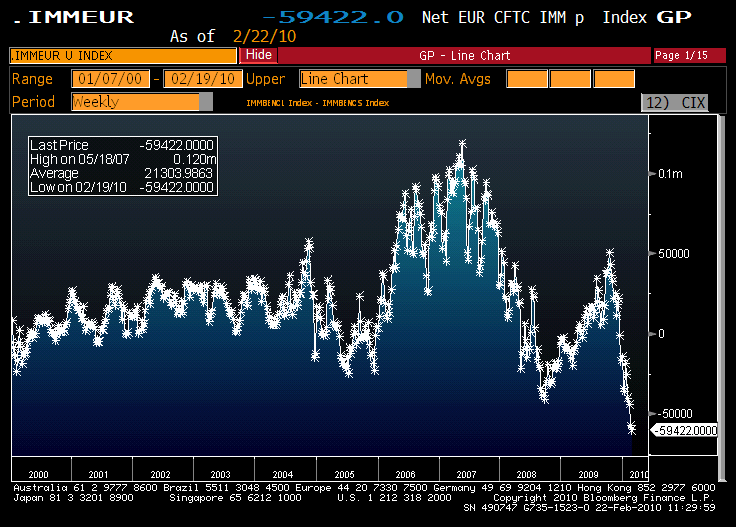
The EUR will be helped by the fact that speculative market, according to the CFTC IMM data, holds record short positions in the EUR (as of the week ended 16 February) giving plenty of potential for short-covering.   The more timely Tokyo Financial Exchange (TFX) data also reveals that positioning in EUR/JPY has continued to be scaled back.  

CFTC Commitment of Traders (IMM) data – Net EUR speculative positioning

EUR/USD bounced smartly from its lows around 1.3444 on Friday, partly reflecting some short covering and the drop in FX volatility suggests the market is more comfortable with EUR/USD around these levels.  A positive IFO survey and improved risk appetite could see EUR/USD test resistance around 1.3774, its 20 day moving average, over coming days.  Ongoing Greek concerns suggest that any EUR bounce will be limited, however. 

USD/JPY looks well supported and although data this week will suggest that exports are improving despite JPY strength, the relatively more aggressive stance of the Fed compared to the BoJ, long JPY positioning, and improved risk appetite, give plenty of scope for the JPY to extend losses, with technical USD/JPY support seen around 91.28.

What to watch this week

The 85k drop in US non-farm payrolls in December was obviously disappointing given hopes/expectations/rumours of a positive reading over the month.  There was a small silver lining however, as November payrolls were revised to show a positive reading of +4k, the first monthly gain in jobs since December 2007.  Overall, the US labour market is still gradually improving as the trend in jobless claims and other indicators show. 

The fact that the market took the drop in US payrolls in its stride highlights the fact that recovery is becoming more entrenched despite the occasional set back.  More significantly weaker US jobs disappointment has been countered by strong Chinese trade data, which showed both strong imports and exports growth in December.  Whilst the data, especially the strength in exports, will support calls for a stronger CNY, it also highlights China’s growing influence on world trade and the important role that the country is providing for global economic recovery.

Market resilience in the wake of the drop in US payrolls and positive reaction to Chinese trade data will maintain a “risk on” tone to markets this week.  In particular, the USD is set to start the week on the back foot and despite data last week showing that Eurozone unemployment reached an 11-year high of 10% and growing evidence that the Eurozone economy is falling behind the pace of recovery seen elsewhere, EUR/USD held above technical support (200 day moving average) around 1.4257, and is setting its sights on the 16 December 2009 high of 1.4591 helped by renewed Asian sovereign interest.  

The main event in the Eurozone is the ECB meeting on Thursday no surprises are expected, with the Bank set to keep policy unchanged whilst maintaining current liquidity settings.  The bigger concern for European markets is ongoing fiscal woes in the region, with press reports warning of a ratings downgrade for Portugal and still plenty of attention on Greece and its attempts at deficit reduction.  Fiscal concerns are not going to go away quickly and will clearly act as a restraint on market sentiment for European assets. 

In a holiday shortened week in the US as markets close early on Friday ahead of the 3-day MLK holiday, there are a number of data this week that will shed further light on the shape of US recovery. The main event is the December advance retail sales report on Thursday, which is expected to record a reasonable gain, helped by firm autos sales. 

Preceding this, tomorrow there is expected to be a renewed widening in the US trade deficit in November whilst on Wednesday the Fed’s Beige Book as well as various Fed speakers this week including Bullard, Lockhart, Fisher, Plosser, Evans and Lacker, will give important clues ahead of the January 27 Fed FOMC meeting.  Bullard sounded dovish in his comments in Shanghai, as he highlighted that US interest rates will remain low for some time. 

At the end of the week there will be a heavy slate of releases including December CPI, industrial production, capacity utilization, January Empire manufacturing and Michigan confidence. The outlook for these data is generally positive, with gains expected in both manufacturing and consumer confidence, whilst hard data in the form of industrial production is likely to record a healthy increase and CPI is set to reveal another benign reading.