Australian Dollar Looking Stretched

Central bank decisions in Japan, Europe and UK will dictate FX market direction today. No surprises are expected by the Bank of Japan (BoJ) and Bank of England (BoE) leaving the European Central Bank (ECB) decision and press conference to provide the main market impetus. Although a hawkish message from ECB President Trichet is likely the market has already priced in a total of 75 basis points of tightening this year. We retain some caution about whether the EUR will be able to make further headway following the ECB meeting unless the central bank is even more hawkish than already priced in.

EUR/USD easily breached the 1.4250 resistance level and will now eye resistance around 1.4500. News that Portugal formally requested European Union (EU) aid came as no surprise whilst strong German factory orders provided further support to the EUR. The data highlights upside risks to today’s February German industrial production data. The EUR will find further support versus the USD from comments by Atlanta Fed’s Lockhart who noted that he doesn’t expect the Fed to hike interest rates by year end.

USD/JPY is now around 7.5% higher than its post earthquake lows. Japanese authorities will undoubtedly see a measure of success from their joint FX intervention. To a large degree they have been helped by a shift in relative bond yields (2-year US / Japan yield differentials have widened by close to 30 basis points since mid March, and are finally having some impact on USD/JPY as reflected in the strengthening in short-term correlations. Whilst the BoJ is unlikely to alter its policy settings today the fact that it is providing plenty of liquidity to money markets, having injected around JPY 23 trillion or about 5% of nominal GDP since the earthquake, is likely playing a role in dampening JPY demand.

AUD/USD has appreciated by close to 6% since mid March and whilst I would not recommend selling as yet I would be cautious about adding to long positions. My quantitative model based on interest rate / yield differentials, commodity prices and risk aversion reveals a major divergence between AUD/USD and its regression estimate. Clearly the AUD has benefitted from diversification flows as Asian central banks intervene and recycle intervention USDs. However, at current levels I question the value of such diversification into AUD.
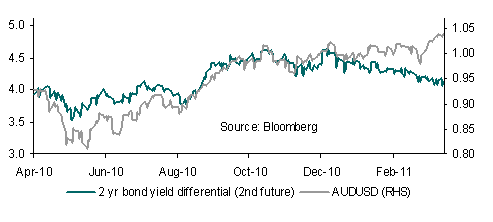
Speculative AUD/USD positioning as indicated by the CFTC IMM data reveals that net long positions are verging on all time highs, suggesting plenty of scope for profit taking / position squaring in the event of a turn in sentiment. Moreover, AUD gains do not match the performance of economic data, which have been coming in worse than expected over recent weeks. Consequently the risks of a correction have increased.
Positive Data Run Continues

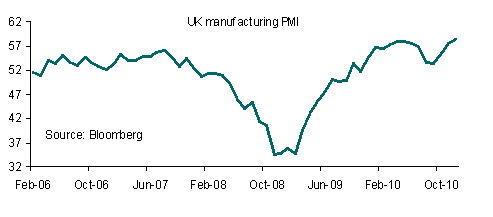
The batch of data releases in Tuesday’s trading session was generally positive. Leading the way was a stronger than expected increase in the UK manufacturing purchasing managers index (PMI) for December at 58.3 which coming in at a 16-year high. The data gave a boost to GBP though GBP/USD is unlikely to gain much of a foothold above 1.5600.

In the US, factory orders surprisingly jumped 0.7% in November and whilst the data is second tier it does maintain the run of generally upbeat US data. Meanwhile eurozone inflation came in higher than forecast at 2.2% YoY, above the European Central Bank (ECB) target level for the first time in two years. The outcome is unlikely to trigger a response from the ECB especially given that core inflation remains well behaved. After hitting a post CPI release high of 1.3433 EUR/USD is likely to drift lower in the short term.

Separately the Fed FOMC minutes of the December 14 meeting revealed little to surprise. Of note, FOMC members highlighted that the improvement in economic conditions was insufficient to warrant any change to the asset purchase program. The bottom line for the Fed is that the dual mandate of maximum employment and price stability is still not in reach and therefore they will keep the pedal to the floor in terms of policy stimulus. Although a further round of quantitative easing seems unlikely the Fed is likely to stick it out in terms of the $600 billion in planned asset purchases whilst an actual rate hike is unlikely until well into 2012.

Commodity prices dropped sharply overnight with soft commodities and energy prices in particular leading the declines. Commodity currencies fell as a result, with the AUD also impacted by growing worries about the impact of the Queensland floods. Initial estimates suggest that total damage from the flooding could reach AUD 6 billion and as Queensland represents around 19% of Australian GDP, the impact on growth could be significant. Growth could drop by a sharp -0.8% YoY in Q1 GDP. This is based on the assumptions that 40% of all exports will experience a 30% reduction

Today’s data slate in the US will be crucial to provide the final clues to Friday’s December payrolls report. The ADP jobs report, ISM non-manufacturing survey and Challenger job cuts data are all scheduled for release. The run of positive US data will help the USD to trade on a firm footing over the short term but clearer direction will await the outcome of the December jobs report whilst the beginning of the Q4 earnings season next week will also be influential. The exception to USD strength will continue to be Asian currencies where more upside is likely, but I prefer to play this via short EUR/Asian FX than the USD.

What goes down must go up

What goes down must go up! A day that began with a stronger than forecast increase in China’s purchasing managers index (PMI) and firm Australian Q2 GDP continued with a surprise jump in the August ISM manufacturing index. The ISM rose to 56.3 from 55.5 in July an outcome that contradicted most of the regional US manufacturing surveys. It was not all positive in terms of data, yesterday however, with a weaker UK manufacturing PMI and unexpected drop in the August US ADP employment report casting a shadow over markets.

Nonetheless, for a change the market decided to act on the good news, with risk assets surging. Despite the improvement in risk appetite it still feels as though the market is grasping for direction. The jump in equities is unlikely to prove durable in an environment characterized by various uncertainties about growth and policy, especially the US.

The next hurdle for markets is the US payrolls data tomorrow. Although the ADP jobs report revealed a surprise 10k decline the employment component of the ISM manufacturing survey strengthened to 60.4, suggesting an improvement in August manufacturing payrolls. Ahead of the payrolls release the US data slate today largely consists of second tier releases including July pending home sales, August chain store sales, weekly jobless claims, and factory orders. It is worth paying particular interest to jobless claims given that the four week moving average has been edging higher, suggesting renewed job market deterioration. The consensus is for a 475k increase in claims, which will still leave the 4-week average at an elevated level.

Given that one of the biggest debates raging through markets at present is whether the Fed will embark on further quantitative easing comments by Fed officials overnight were closely scrutinized for further clues. In the event, Fed Governor Kohn highlighted that the Fed’s reinvestment of the proceeds from mortgage-backed securities will not automatically lead to further QE, suggesting some hesitancy on his part. Meanwhile, Dallas Fed President Fisher noted his reluctance to expand the Fed’s balance sheet until fiscal and regulatory uncertainties are cleared up.

Both sets of comments highlight the difficulty in gaining a consensus within the FOMC for a further increase in QE, suggesting that the hurdle for further balance sheet expansion will be set quite high. Moreover, such comments put the onus on Congress to move quickly in clearing up fiscal policy uncertainties.

As markets flip from risk on to risk off almost on a daily basis the question for today is how sustainable the rally in risk trades will prove to be against the background of so much policy and growth uncertainty. Unfortunately today’s data will provide few clues and markets will turn their attention to tomorrow’s US non-farm payrolls report for further direction. To an extent this suggests that it may be a case of treading water until then. Nonetheless, I still maintain that risk trades remain a sell on rallies over coming weeks

Post US Jobs Data FX Outlook

The massive upside surprise to US payrolls could prove to be a significant indicator for the USDs fortunes in the months ahead.  To summarize, payrolls dropped by 11k, much less than expected. Net revisions totaled +148k, the workweek rose and the unemployment rate fell to 10%, also better than forecast and likely a surprise to the US administration who hinted at a rise in the unemployment rate.

Equity and bond market reaction was as would be expected; equities rallied and bonds sold off.  Gold prices dropped sharply too.  However, and this is what was most interesting, the dollar strengthened. Why is this odd? Well, over the past 9 months any news that would have been perceived as positive for risk appetite was associated with dollar weakness.  This reaction clearly did not take place following the jobs data. 

It’s worth noting that going into the payrolls data markets were very short USDs as reflected in the CFTC Commitment of Traders IMM data which revealed the biggest aggregate net short USD position since 25 March 2008. The bounce in the USD could have reflected a strong degree of short covering especially against the JPY where net long JPY positions had jumped to close to its all time high.  Going into year end expect to see more position adjustment, perhaps indicating a return of the JPY funded carry trade is back on the cards.

The dollar’s reaction to the payrolls data was reminiscent of its pre-crisis relationship of buying dollars in anticipation of a more aggressive path for US interest rates and indeed markets brought forward expectations of higher rates following the data.  It is probably too early to believe that the dollar’s movements are once again a function of interest rate differentials but it is a taste of things to come. In any case, markets will be able to garner further clues from a speech by Fed Chairman Bernanke today.

The post payrolls dollar reaction could have also reflected the fact that EUR/USD failed to break above the 1.5145 high over the week resulting in a capitulation of stale long positions, especially as the move towards reducing liquidity provision by the ECB also failed to push the EUR higher. If the S&P 500 stays above 1100 EUR/USD could retrace higher for the most part a broad 1.48-1.51 range is likely to dominate over the week.  Nonetheless, a break below 1.4820 could provoke an accelerated stop loss fuelled drop in EUR/USD.  ECB President Trichet speaks today and may reiterate that the ECB’s measures to begin scaling back its liquidity provision should not be taken as a step towards monetary tightening.

USD/JPY proved interesting last week pushing higher in the wake of strong rhetoric by the Japanese authorities threatening intervention to prevent JPY strength. The BoJ’s attempt to provide more liquidity to banks also helped on the margin to weaker the JPY but the impact of the move is likely to prove limited. Nonetheless, exporters and Japanese officials may be more relaxed this week, if USD/JPY can hold above 90.00.  However, a likely sharp revision lower to Japanese Q3 GDP tomorrow will help maintain calls for a weaker JPY.