Risk assets to slip ahead of ECB and US payrolls

Although Federal Reserve Chairman Bernanke did not categorically state that a third round of quantitative easing or QE3 is on the cards his stoic defence of past QE while playing down of the risks emanating from such actions, highlight that the prospects are more likely than not for more Fed balance sheet expansion.

Markets clearly liked what they heard, with risk assets finishing off the week on a positive note. Notably commodities continue to outperform and the prospects of more currency debasing by the Fed and European Central Bank suggest that gold in particular, will continue to look attractive. However, the weaker than expected Chinese manufacturing purchasing managers index (PMI) in August, with the index dropping below the 50 boom/bust level, will put a dampener on markets.

The main impediment to QE3 would be a major improvement in job market conditions and in this respect markets will have the August jobs report to digest at the end of this week. Preliminary estimates of an 125k increase in payrolls and an unemployment rate stuck at 8.3% suggests that it should be no hindrance to more QE.

The other key event of the week is the European Central Bank meeting although markets will eye events in Greece ahead of this, with the Troika set to revisit the country mid week. The ECB continues to play its game of brinkmanship with governments, and while they Bank will likely commit to a bond buying programme it is unlikely to announce the onset of a new round of bond purchases until governments in particular Spain formally request aid from the EFSF / ESM bailout funds. Although there is some scope for disappointment expectations of major ECB action have already been pared back.

Other central banks in the frame include the Reserve Bank of Australia and Bank of Canada but unlike the ECB policy easing is unlikely from either of these central banks. Overall, risk assets to trade with a heavy tone and the USD will recoup some of its losses over coming days, especially against the EUR.
Japan FX Measures Underwhelm

Currencies continue to show remarkable stability in the face of elevated risk aversion which has prompted huge volatility in other asset markets. Although FX volatility has risen over recent weeks its rise is nothing compared to the jump in the VIX ‘fear gauge’ equity volatility measure. FX markets are in some form of limbo where there are conflicting forces at play and where there is no obvious currency to play. The lack of clarity in markets suggests that this situation will not change quickly.

The USD (index) is trading at the lower end of its recent ranges and verging on a retest of its July 27 low around 73.421, with the currency perhaps suffering from expectations that Fed Chairman Bernanke will announce a desire to embark on more quantitative easing at Friday’s Jackson Hole symposium. Its losses could quickly reverse as such expectations are quickly dashed.

Indeed, while Bernanke will likely keep all options open any hint at QE3 is unlikely as the Fed maintains a high hurdle before any prospect of further quantitative easing is entertained. One option on the table is ‘sterilised’ large scale asset purchases which would not result in an increase in the size of the Fed’s balance sheet. This would be far less negative for the USD than a fresh round of QE and may even prompt a rally in the currency as markets shift away from the idea of QE3.

The USD will benefit from high risk aversion except against safe havens such as the CHF and JPY. In this respect the USD remains a better bet than the EUR which has failed to garner much benefit from renewed ECB peripheral bond buying. Nonetheless, data yesterday failed to feed into negative EUR sentiment despite mixed manufacturing surveys and a sharp drop in the German ZEW investor confidence survey. EUR/USD remains trapped in a broad 1.42-1.45 range.

News that Moody’s ratings agency has downgraded Japan’s sovereign ratings by one notch to Aa3 is unlikely to have much impact on the JPY. Moody’s left the outlook stable while unlike the US and Europe around 95% of Japanese debt is held domestically, suggesting little FX and JGB impact. USD/JPY continues to garner some influence from yield differentials and given that the US bond yield advantage versus Japan has continued to narrow, USD/JPY continues to face downward pressure.

Japan announced measures to deal with JPY strength including the creation of a $100 billion emergency credit facility. However, the main impact on the JPY could come from increased monitoring of FX transactions with firms having to report on FX positions held by dealers. The statement made no comment on FX intervention and this is where there will be most disappointment for JPY bears. Overall, the actions are somewhat underwhelming and are unlikely to have much impact on the JPY. If anything, the JPY may actually strengthen given the lack of comment on FX intervention. USD/JPY downside could face strong technical support around 75.93, however.

ECB to Hike, BoJ, BoE & RBA on Hold

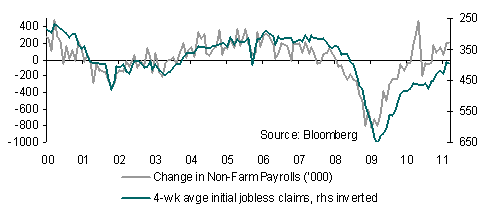
The better than expected March US jobs report will likely help to shift the debate further towards the hawkish camp in the Fed. There is little this week to match the potency of payrolls in terms of market moving data this week. Instead attention will focus on a raft of Fed speakers over coming days as well as the minutes of the March 15 FOMC meeting.

This week’s Fed speakers include Lockhart, Evans, Bernanke, Kocherlakota, Plosser and Lacker. Of these only Lockhart and Lacker are non voters. Given the intense focus on recent Fed comments FX markets will be on the lookout for anything that hints a broader Fed support for a quicker hike to interest rates and/or reduction in the Fed’s balance sheet.

In any case the USD may struggle to make much headway ahead of an anticipated European Central Bank (ECB) rate hike of 25 basis point on Thursday. Much will depend on the press statement, however. If the ECB merely validates market expectations of around 75bps of policy rate hikes this year the EUR will struggle to rally.

It may also be possible that once the ECB meeting is out of the way the EUR may finally be susceptible to pressure related to ongoing peripheral tensions. Last week the outcome of the Irish bank stress tests, and political vacuum in Portugal ahead of elections set for June 5 were well absorbed by the EUR but it is questionable whether the dichotomy between widening peripheral bond spreads and the EUR can continue.

The Tankan survey in Japan released today unsurprisingly revealed a deterioration in sentiment. The survey will provide important clues for the Bank of Japan (BoJ) at its meeting on April 6 & 7th. Although a shift in Japan’s ultra easy monetary policy is unlikely whilst strong liquidity provision is set to continue, pressure to do more will likely grow. This will be accentuated by a likely downward revision in the economic outlook by the BoJ.

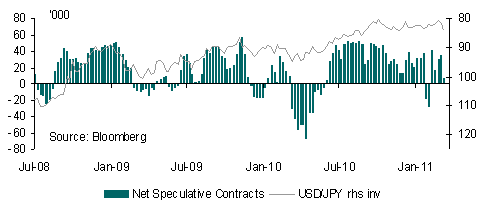
The JPY will not take much direction from this meeting. Nonetheless, its soft tone may continue helped by foreign securities outflows (particularly out of bonds), with USD/JPY eyeing the 16 December high around 84.51. Speculative positioning as reflected in the CFTC IMM data reveals a sharp deterioration in JPY sentiment as the currency evidence that finally the currency maybe regaining its mantle of funding currency.

It is still too early for the Bank of England to hike rates despite elevated inflation readings and MPC members are likely to wait for the May Quarterly Inflation Report before there is decisive shift in favour of raising policy rates. Even then, members will have to grapple with the fact that economic data remains relatively downbeat as reflected in the weaker than expected March manufacturing purchasing managers index (PMI) data.

Today’s PMI construction data will likely paint a similar picture. The fact that a rate hike is not expected by the market will mean GBP should not suffer in the event of a no change decision by the BoE this week but instead will find more direction from a host of data releases including industrial production. GBP has come under growing pressure against the EUR since mid February and a test of the 25 October high of 0.89415 is on the cards this week.

Finally, congratulations to the Indian cricket team who won a well deserved victory in the Cricket World Cup final over the weekend. The celebrations by Indians around the world will go on for a long while yet.