USD weaker, EUR resilient, JPY supported, CHF pressure

Why has the USD come under pressure even after Fed Chairman Bernanke failed to signal more QE? The answer is that Bernanke offered hope of more stimulus and gave a shot in the arm to risk trades even if QE3 was not on the cards. Consequently the USD has looked vulnerable at the turn of this week but we suspect that a likely batch of soft US data releases over coming days including the August jobs report at the end of the week, ISM manufacturing survey on Thursday and consumer confidence today, will erase some of the market’s optimism and leave the USD in better position. The FOMC minutes today may also give some further guidance to the USD as more details emerge on the potential tools the Fed has up its sleeve.

The EUR’s ability to retain a firm tone despite the intensification of bad news in the eurozone has been impressive. Uncertainty on various fronts in Germany including but not limited to concerns about the outcome of the German Bundestag vote on the revamped EFSF on September 30, German commitment to Greece’s bailout plan and German opposition party proposals for changes to bailout terms including the possibility of exiting the eurozone, have so far gone unnoticed by EUR/USD as it easily broke above 1.4500. EUR was given some support from news of a merger between Greece’s second and third largest banks. Likely weak economic data today in the form of August eurozone sentiment surveys may bring a dose of reality back to FX markets, however.

The lack of reaction of the JPY to the news that Japan’s former Finance Minister Noda won the DPJ leadership and will become the country’s new Prime Minister came as no surprise. The JPY has become somewhat used to Japan’s many political gyrations over recent years and while Noda is seen as somewhat of a fiscal hawk his victory is unlikely to have any implications for JPY policy. Instead the JPY‘s direction against both the USD and EUR continues to be driven by relative yield and in this respect the JPY is likely to remain firmly supported. Both US and European 2-year differentials versus Japan are at historic lows, with the US yield advantage close to disappearing completely. Until this picture changes USD/JPY is set to languish around current levels below 77.00.

EUR/CHF has rebounded smartly over recent weeks, the latest bounce following speculation of a fee on CHF cash balances, with the currency pair reaching a high of 1.1972 overnight. The pressure to weaken the CHF has become all the more acute following the much bigger than anticipated drop in the August KOF Swiss leading indicator last week and its implications for weaker Swiss growth ahead. The ‘risk on’ tone to markets following Bernanke’s speech has provided a helping hand to the Swiss authorities as safe haven demand for CHF lessens but given the likely weak slate of economic releases this week his speech may be soon forgotten. Nonetheless, the momentum remains for more EUR/CHF upside in the short term, at least until risk aversion rears its head again.
US payrolls clues

Most investors will be glad to see the back of August, a month that marked the biggest monthly decline in US stocks in nine years. The main imponderable is whether September will be any better. A series of manufacturing surveys globally today will do little to restore confidence although there was some good news in a slight increase in China’s official August purchasing managers index (PMI) as well a stronger than forecast increase in Australian Q2 GDP, which will likely provide some short-term relief for risk trades.

There was also some slight solace for markets in terms of US data at least from the point of view that the data was not as disappointing as many recent releases. Although the August Chicago PMI slipped (to 56.7) consumer confidence increased (to 53.5) though admittedly confidence remains at a relatively low level. The job market situation detailed within the consumer confidence report was more pessimistic in August than the previous month, however, with those reporting jobs hard to get moving higher. This sends a negative signal for Friday’s payrolls data.

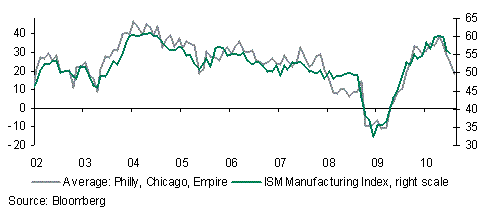
There will be more clues to Friday’s US jobs report today which will enable any fine tuning of forecasts to take place in the wake of the August ADP employment report and ISM manufacturing survey. Consensus forecasts centre on a 15k increase in private jobs. Despite the slight increase in the Empire manufacturing survey in August, the falls in other manufacturing surveys point to some downside risks to the ISM today, with a simple average of the three pointing to the ISM closer to the 50 mark, which will highlight a loss in US manufacturing momentum.

Manufacturing surveys elsewhere will also be in focus, with the final PMI readings scheduled to be released for the eurozone and UK. There is likely to be confirmation of the slight drop in the eurozone PMI to 55.0 in August while the UK PMI is likely to drop to around 57.0 over the month. Both surveys remain at a relatively high level but it is clear that activity is moderating in H2 2010 from a healthy level in H2. The data will give little support to the EUR but the currency has found a degree of stability over the last couple of days. Nonetheless, a further downward move is in prospect.

The Fed FOMC minutes provided little for markets to get excited about. The minutes noted concerns about large scale asset purchases from some Fed officials, indicating resilience to increasing quantitative easing despite acknowledging increased downside risks to the growth and inflation outlook. It is unclear exactly what will be the trigger for further QE as acknowledged by Fed Chairman Bernanke last week.

The minutes will do little to help market confidence given the hesitancy to pursue further QE and provide further stimulus to the economy but the USD is likely to benefit from the fact that the Fed may not be as eager to expand its balance sheet further. Other currencies that remain beneficiaries in the current risk averse environment are the JPY and CHF. The JPY may find further upside more difficult given ongoing intervention fears but the trend remains for a lower USD/JPY in the coming weeks.

Risk Appetite Puts Dollar On The Back Foot

Markets look somewhat calmer going into this week helped by comments by Fed members who noted that the discount rate hike did not signal a shift in monetary policy, something which is likely to be repeated by Fed Chairman Bernanke in his testimony to Congress on Wednesday and Thursday.  A tame US January CPI report last Friday helped too, giving further support to the view that the Fed will not hike the Fed Funds rate for some time yet; a rate hike this year seems highly unlikely in my view.  

Data this week will be conducive to a further improvement in risk appetite and despite the lingering concerns about Greece the EUR may find itself in a position to extend gains.  In Europe all eyes will be on the February German IFO survey and eurozone sentiment indicators, which following the surprising strength in the manufacturing Purchasing Managers Indices (PMIs), are likely to reveal solid gains. 

The main highlights in Japan this week includes January trade data and industrial production. The trade numbers will be particularly important to determine whether the rebound in exports due in large part to robust Asian demand, has continued whilst the bounce back in exports will be a key factor in fuelling a further gain in industrial output. 

In the US aside from the testimonies by Fed Chairman Bernanke there are plenty of releases on tap including consumer confidence, new and existing home sales, durable goods orders and a likely upward revision to Q4 GDP.  For the most part the data will show improvement and play for a further improvement in risk appetite. 

FX direction will depend on whether markets focus on the potentially positive USD impact of a reduction in USD liquidity or on the likely firmer tone to risk appetite this week.  Given expectations of firmer data and the soothing tone of the Fed, risk currencies will likely perform better, with crosses such as AUD/JPY favoured.  The USD will likely be placed on the back foot, especially given the very long market positioning in the currency.

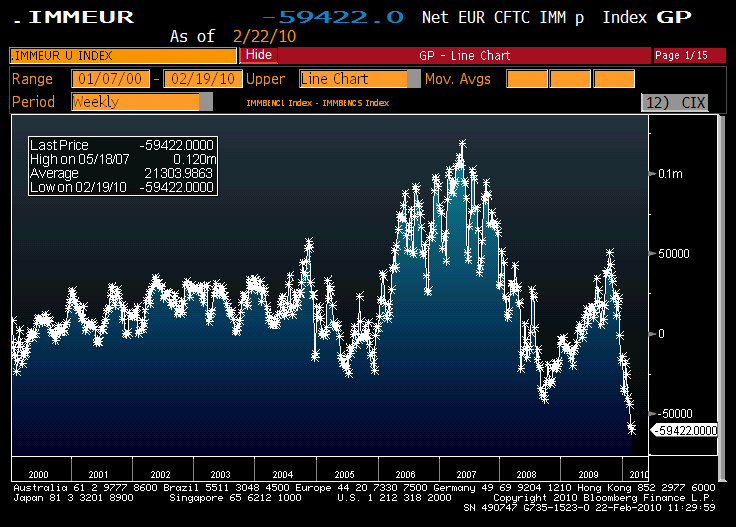
The EUR will be helped by the fact that speculative market, according to the CFTC IMM data, holds record short positions in the EUR (as of the week ended 16 February) giving plenty of potential for short-covering.   The more timely Tokyo Financial Exchange (TFX) data also reveals that positioning in EUR/JPY has continued to be scaled back.  

CFTC Commitment of Traders (IMM) data – Net EUR speculative positioning

EUR/USD bounced smartly from its lows around 1.3444 on Friday, partly reflecting some short covering and the drop in FX volatility suggests the market is more comfortable with EUR/USD around these levels.  A positive IFO survey and improved risk appetite could see EUR/USD test resistance around 1.3774, its 20 day moving average, over coming days.  Ongoing Greek concerns suggest that any EUR bounce will be limited, however. 

USD/JPY looks well supported and although data this week will suggest that exports are improving despite JPY strength, the relatively more aggressive stance of the Fed compared to the BoJ, long JPY positioning, and improved risk appetite, give plenty of scope for the JPY to extend losses, with technical USD/JPY support seen around 91.28.