ECB to Hike, BoJ, BoE & RBA on Hold

The better than expected March US jobs report will likely help to shift the debate further towards the hawkish camp in the Fed. There is little this week to match the potency of payrolls in terms of market moving data this week. Instead attention will focus on a raft of Fed speakers over coming days as well as the minutes of the March 15 FOMC meeting.
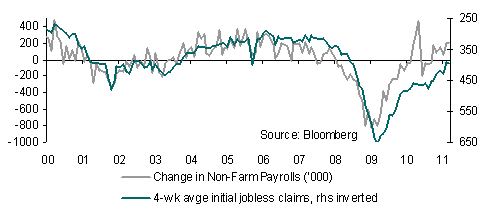
This week’s Fed speakers include Lockhart, Evans, Bernanke, Kocherlakota, Plosser and Lacker. Of these only Lockhart and Lacker are non voters. Given the intense focus on recent Fed comments FX markets will be on the lookout for anything that hints a broader Fed support for a quicker hike to interest rates and/or reduction in the Fed’s balance sheet.

In any case the USD may struggle to make much headway ahead of an anticipated European Central Bank (ECB) rate hike of 25 basis point on Thursday. Much will depend on the press statement, however. If the ECB merely validates market expectations of around 75bps of policy rate hikes this year the EUR will struggle to rally.

It may also be possible that once the ECB meeting is out of the way the EUR may finally be susceptible to pressure related to ongoing peripheral tensions. Last week the outcome of the Irish bank stress tests, and political vacuum in Portugal ahead of elections set for June 5 were well absorbed by the EUR but it is questionable whether the dichotomy between widening peripheral bond spreads and the EUR can continue.

The Tankan survey in Japan released today unsurprisingly revealed a deterioration in sentiment. The survey will provide important clues for the Bank of Japan (BoJ) at its meeting on April 6 & 7th. Although a shift in Japan’s ultra easy monetary policy is unlikely whilst strong liquidity provision is set to continue, pressure to do more will likely grow. This will be accentuated by a likely downward revision in the economic outlook by the BoJ.

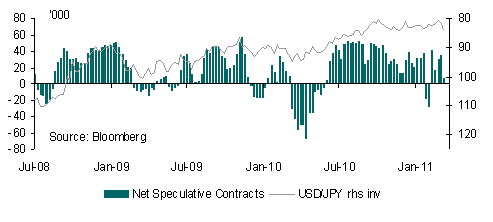
The JPY will not take much direction from this meeting. Nonetheless, its soft tone may continue helped by foreign securities outflows (particularly out of bonds), with USD/JPY eyeing the 16 December high around 84.51. Speculative positioning as reflected in the CFTC IMM data reveals a sharp deterioration in JPY sentiment as the currency evidence that finally the currency maybe regaining its mantle of funding currency.
It is still too early for the Bank of England to hike rates despite elevated inflation readings and MPC members are likely to wait for the May Quarterly Inflation Report before there is decisive shift in favour of raising policy rates. Even then, members will have to grapple with the fact that economic data remains relatively downbeat as reflected in the weaker than expected March manufacturing purchasing managers index (PMI) data.

Today’s PMI construction data will likely paint a similar picture. The fact that a rate hike is not expected by the market will mean GBP should not suffer in the event of a no change decision by the BoE this week but instead will find more direction from a host of data releases including industrial production. GBP has come under growing pressure against the EUR since mid February and a test of the 25 October high of 0.89415 is on the cards this week.

Finally, congratulations to the Indian cricket team who won a well deserved victory in the Cricket World Cup final over the weekend. The celebrations by Indians around the world will go on for a long while yet.
The Week Ahead

As markets make the last strides towards year end it appears that currencies at least are becoming increasingly resigned to trading in ranges. Even the beleaguered EUR has not traded far from the 1.3200 level despite significant bond market gyrations. Even news that inflation in China came in well above expectations in November (5.1% YoY) and increased prospects of a rate hike is likely to prompt a limited reaction from a lethargic market.

At the tail end of last week US data provided further support to the growing pool of evidence indicating strengthening US economic conditions, with the trade deficit surprisingly narrowing in October, a fact that will add to Q4 GDP growth, whilst the Michigan measure of consumer confidence registered a bigger than expected increase in November to its highest level since June.

The jump in consumer confidence bodes well for retail spending and highlights the prospects that US November retail sales tomorrow are set to reveal solid gains both headline and ex-autos sales driven by sales and promotions over the holiday season. Other data too, will paint an encouraging picture, with November industrial production (Wed) set to reveal a healthy gain helped by a bounce in utility output. Manufacturing surveys will be mixed with a rebound in the Empire manufacturing survey in December likely but in contrast a drop in the Philly Fed expected.

The main event this week is the FOMC decision tomorrow the Fed is expected to deliver few surprises. The Fed funds rate is expected to remain “exceptionally low for an extended period”. Despite some recent encouraging data recovery remains slow and the fact that core inflation continues to decelerate (CPI inflation data on Wednesday is set to reveal a benign outcome with core CPI at 0.6%) whilst the unemployment rate has moved higher means that the Fed is no rush to alter policy including its commitment to buy $600 billion in Treasuries including $105 billion between now and January 11.

In Europe there are also some key releases that will garner plenty of attention including the December German ZEW and IFO investor and manufacturing confidence surveys and flash purchasing managers indices (PMI) readings. The data are set to remain reasonably healthy and may keep market attention from straying to ongoing problems in the eurozone periphery but this will prove temporary at least until the markets are convinced that European Union leaders are shifting away from “piecemeal” solutions to ending the crisis. The EU leaders’ summit at the end of the week will be important in this respect. A Spanish debt auction on Thursday will also be in focus.

Assuming the forecasts for US data prove correct it is likely that US bond markets will remain under pressure unless the Fed says something that fuels a further decline in yield such as highlighting prospects for more quantitative easing (QE). However, following the tax compromise agreement last week this seems unlikely. Higher relative US bond yields will keep the USD supported, and as I have previously noted, the most sensitive currencies will be the AUD, EUR and JPY, all of which are likely to remain under varying degrees of downward pressure in the short term. The AUD will also be particularly sensitive to prospects of further Chinese monetary tightening.

Risk Appetite Puts Dollar On The Back Foot

Markets look somewhat calmer going into this week helped by comments by Fed members who noted that the discount rate hike did not signal a shift in monetary policy, something which is likely to be repeated by Fed Chairman Bernanke in his testimony to Congress on Wednesday and Thursday.  A tame US January CPI report last Friday helped too, giving further support to the view that the Fed will not hike the Fed Funds rate for some time yet; a rate hike this year seems highly unlikely in my view.  

Data this week will be conducive to a further improvement in risk appetite and despite the lingering concerns about Greece the EUR may find itself in a position to extend gains.  In Europe all eyes will be on the February German IFO survey and eurozone sentiment indicators, which following the surprising strength in the manufacturing Purchasing Managers Indices (PMIs), are likely to reveal solid gains. 

The main highlights in Japan this week includes January trade data and industrial production. The trade numbers will be particularly important to determine whether the rebound in exports due in large part to robust Asian demand, has continued whilst the bounce back in exports will be a key factor in fuelling a further gain in industrial output. 

In the US aside from the testimonies by Fed Chairman Bernanke there are plenty of releases on tap including consumer confidence, new and existing home sales, durable goods orders and a likely upward revision to Q4 GDP.  For the most part the data will show improvement and play for a further improvement in risk appetite. 

FX direction will depend on whether markets focus on the potentially positive USD impact of a reduction in USD liquidity or on the likely firmer tone to risk appetite this week.  Given expectations of firmer data and the soothing tone of the Fed, risk currencies will likely perform better, with crosses such as AUD/JPY favoured.  The USD will likely be placed on the back foot, especially given the very long market positioning in the currency.

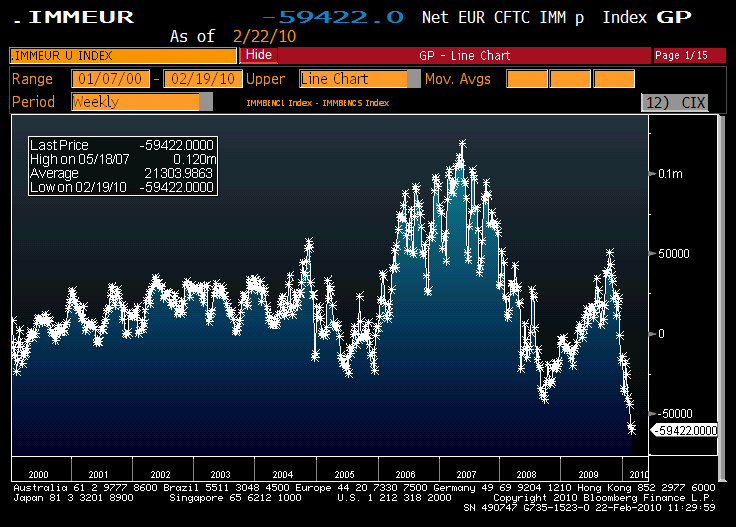
The EUR will be helped by the fact that speculative market, according to the CFTC IMM data, holds record short positions in the EUR (as of the week ended 16 February) giving plenty of potential for short-covering.   The more timely Tokyo Financial Exchange (TFX) data also reveals that positioning in EUR/JPY has continued to be scaled back.  

CFTC Commitment of Traders (IMM) data – Net EUR speculative positioning

EUR/USD bounced smartly from its lows around 1.3444 on Friday, partly reflecting some short covering and the drop in FX volatility suggests the market is more comfortable with EUR/USD around these levels.  A positive IFO survey and improved risk appetite could see EUR/USD test resistance around 1.3774, its 20 day moving average, over coming days.  Ongoing Greek concerns suggest that any EUR bounce will be limited, however. 

USD/JPY looks well supported and although data this week will suggest that exports are improving despite JPY strength, the relatively more aggressive stance of the Fed compared to the BoJ, long JPY positioning, and improved risk appetite, give plenty of scope for the JPY to extend losses, with technical USD/JPY support seen around 91.28.