Fed discount rate move boosts dollar

The Fed’s move to hike the discount rate by 25bps has set the cat amongst the pigeons.   Although the move was signalled in the FOMC minutes yesterday a hike in the discount rate was not expected to happen so soon.  The Fed sees the modifications which also include reducing the typical maximum maturity for primary credit loans to overnight, as technical adjustments, rather than a signal of any change in monetary policy. 

Nonetheless, the market reaction has been sharp, with the USD strengthening across the board and short term interest rate and stock futures falling.  Although the reaction looks overdone and will likely be followed by some consolidation over the short term, the move will be interpreted as the beginning of a move towards monetary policy normalisation despite the Fed’s insistence that this is not the case.  The firm USD tone is set to remain in place for now but the bulk of the strengthening has likely already occurred following the announcement.  

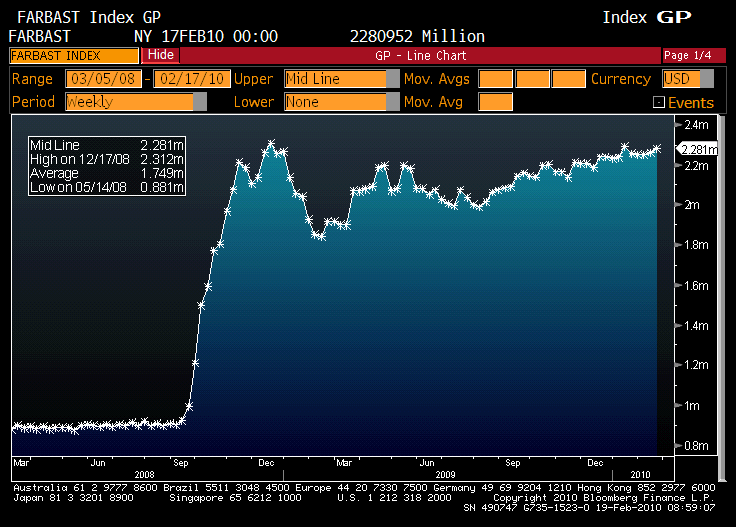
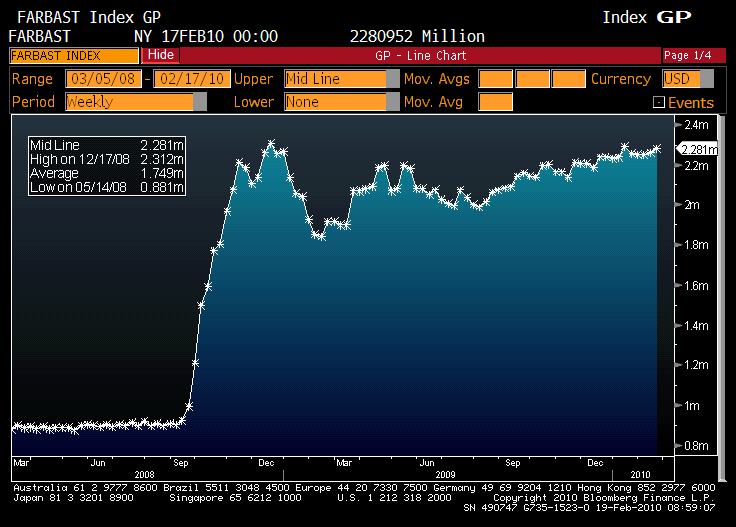
The Fed’s desire to reduce the size of its burgeoning balance sheet, which at $2.3 trillion is roughly around three times its size before the financial crisis began, will imply further measures to reduce USD liquidity over the coming months.   A withdrawal of liquidity could have positive implications for the USD but given that the Fed is still some months away from hiking the Fed Funds rate, interest rate differentials will not turn positive for the USD for a while yet. 

The move has however, changed the complexity of the FX market and likely shifted currencies into new lower ranges against the USD.  There were plenty of reasons to sell EUR even before the Fed move and the discount rate hike inflicted further damage on EUR/USD which dropped below the key psychological level of 1.35.  GBP and commodity currencies were also big losers, with GBP/USD below 1.55.  Key technical support levels to watch will be EUR/USD 1.3422, GBP/USD 1.5374 and AUD/USD 0.884.

US Federal Reserve Balance Sheet ($trillion)
Euro Still Vulnerable

Markets have become rather skittish, with attention gyrating between sovereign deficit/debt concerns on the one hand and better news on the corporate and economic front on the other.  This week the latter appears to be gaining the upper hand helped by an easing of concerns about Greece. Although the Greek saga is by no means close to an end, especially given the new deadlines set by the EU Commission on adherence to budget cuts, the chances of the worst case scenario of default or pull out from the EU looks to have diminished. 

Renewed attention on other EU members, especially in light of the derivatives transactions carried out by Greece and potentially by other European countries to disguise the extent of their budget problems suggests that there is still more pain ahead. Nonetheless, it is increasingly clear that investors are differentiating between Europe and the rest of the world much to the chagrin of the EUR.  

Differentiation between the eurozone and the US was particularly apparent in the wake of stronger than forecast earnings and data in the US. Two more companies joined the three-quarters of S&P 500 companies beating earnings forecasts whilst economic reports including US January industrial production and housing starts came in ahead of forecasts.  This pattern is set to continue today, with the US Philly Fed manufacturing index set to increase to around 17 in February from 15.2 in January. 

In contrast, data in Europe has been much less impressive, with for example, the February ZEW survey of investor confidence recording its 5th consecutive decline in February.  The eurozone economic news may look a little better in the form of likely increases in manufacturing Purchasing Managers Indices (PMIs) but unless the data reveals particularly strong readings the growing perception that Europe is falling behind in the recovery process will remain in place.

Despite the improvement in risk appetite the USD has taken a firmer tone, appearing to react more to positive data and implications for a reduction in policy accommodation by the Fed.  In particular, the USD was spurred by the FOMC minutes of the January 26-27 meeting, in which the Fed debated its exit strategy from quantitative easing.  Some officials even went as far as pushing for asset sales in the “near future” to reduce the size of the Fed’s balance sheet.

Even though the USD has taken a firmer tone it will continue to be buffeted by the conflicting forces of improved risk appetite and shifting interest rate expectations.  Correlations reveal that risk is still the dominant FX factor suggesting that there may still be some further downside left for the USD as risk appetite improves. 

Although commodity currencies have also come under pressure due to the generally firmer USD tone overnight, the downside in these currencies is likely to prove limited especially given strong data releases.  For example, data overnight revealed that business confidence rose to its highest level in 15 years in Australia.  Added to upbeat comments from RBA deputy governor Lowe and strong labour market data, it highlights the growing probability of a March rate hike by the RBA.

The EUR remains the weak link and although it may benefit from easing Greek concerns the growing evidence of a relatively slower economic recovery in the eurozone suggests any upside in the EUR will be limited.  Having dropped below technical support around 1.3580, EUR/USD looks vulnerable to a further push lower in the short-term.

Optimism dissipates

Markets have been highly fickle so far this year. Optimism about strong recovery led by China – recall the fact that disappointment from the surprisingly weak US non-farm payrolls report in December was outweighed by strong Chinese trade data – has dissipated. Instead of rejoicing at China’s robust GDP report last week, which revealed a 10.7% rise in the fourth quarter of 2009, investors began to fret about whether China would have to move more aggressively to tighten monetary policy. Fuelling these fears was the release of Consumer price data which showed inflation rising above expectations to 1.9% YoY in China.

If such fears were not sufficient to hit risk appetite, US President Obama’s plan to limit the size and trading activities of financial institutions dealt another blow to financial stocks. The plan followed quickly after the Democrats lost the state of Massachusetts to the Republicans and managed to shake confidence in bank stocks whilst fuelling increased risk aversion. Meanwhile, rumblings about Greece continue to weigh on markets and Greek debt spreads continued to widen even as global bond markets rallied.

Following the US administration’s plans to restrict banks’ activities the fact that the rise in risk aversion was US led rather than broad based led to an eventual pull back in the dollar which helped EUR/USD to avoid a break below 1.40. Risk trades including the AUD came under pressure as risk appetite pulled back. A drop in commodity prices did not help. The AUD was also hit by news that Australia’s Henry Tax Review would look to tax miners in the country. As a result AUD/USD dropped below 0.90 though this level is likely to provide good buying levels for those wanted to take medium term AUD long positions. The one currency that did benefit was the JPY which managed to drop below sub 90 levels.

The aftermath of the “Volker Plan” will reverberate around markets this week keeping a lid on equity sentiment. Meanwhile Greece will be in the spotlight especially its bond syndication. A bad outcome could be the trigger for EUR/USD to sustain a move below 1.40 though it looks as though it may find a bottom around current levels, with strong support seen around 1.4029. The German IFO business survey for January will be important to provide some direction for EUR and could be a factor that weighs on the currency if as expected it reveals some loss of momentum in the economy.

Aside from the Fed the other G3 central bank to meet this week is the Bank of Japan but unless the Bank is seen to be serious about fighting deflation, USD/JPY may remain under downward pressure against the background of elevated risk aversion. Below 90.0 there does appear to be plenty of USD/JPY buyers however, suggesting that further upside for the JPY will be limited. USD/JPY will find strong support around 88.84.

Much will depend on the key events in the US this week including the Fed FOMC meeting and the President’s State of the Union speech. USD bulls will look for some indication that the US government is serious about cutting the burgeoning budget deficit. Also watch out for the confirmation vote on the renomination of Bernanke as Fed Chairman which could end up being close. There is a heavy slate of data to contend with including new and existing home sales, consumer confidence, durable goods orders, the first glance at Q4 GDP and Chicago PMI.

Modest growth in the G3 economies

A few themes are already becoming evident into 2010. Firstly, the dominance of China and any news on the Chinese economy is becoming increasingly apparent as reflected in the market reaction to trade data and hike in reserve requirements this week. Despite the odd setback the second theme that is developing this year is the “risk on” environment for asset markets. Another theme is the problems and concerns about sovereign debt and ratings, which will likely intensify further.

I could add one more to the list; the underperformance of the Eurozone economy, a theme that is likely to become more apparent as the year progresses. As markets become increasingly bullish about the prospects for China’s economy the opposite is true for the eurozone. Growth over Q4 2009 appears to have lost momentum according to recent data. There is however, expected to be a rebound in November industrial production but this will follow a weak October reading, leaving overall output in Q4 looking lacklustre.

Economic conditions in Japan do not seem to be improving any more quickly, especially in the manufacturing sector as reflected in the surprisingly sharp 11.3% MoM drop in machinery orders in November. Orders have dropped by a whopping 20.5% annually sending a very negative signal for capital spending in the months ahead. Uncertainty over demand conditions has likely restrained capital spending plans whilst the strong JPY has not helped.

The US economy is showing more signs of life but even here the improvements are “modest” as reflected in the Fed’s Beige Book. Consumer spending showed some, limited improvement, whilst manufacturing performance was said to be mixed. In particular, the Beige Book noted that labour market conditions remained soft, with wage pressures subdued. Overall, the report highlighted the likely lack of urgency in a prospective Fed reversal of monetary policy.

In contrast to the modest growth improvements seen in the G3 economies, Australia seems to be powering ahead. Australian jobs data revealed a bigger than expected 35.2k increase in employment and surprise drop in the unemployment rate to 5.5% in December. The only slight negative about the jobs data was that many of the jobs (27.9k) were due to temporary hiring. Nonetheless, the report will give a boost to the AUD aiming for a test of resistance around 0.9326, and solidify expectations for a rate hike next month, when the RBA is set to hike by 25bps.

China tightens policy

Risk appetite has soured due to a combination of the rise in China’s reserve requirements, disappointing earnings including Alcoa and a profit warning by Chevron, setting the scene for a day in the red for Asian markets.  The turn in sentiment has hit commodities and commodity currencies particularly hard whilst the JPY has outperformed.  As would be expected against the background of higher risk aversion the US dollar made up some ground.

All eyes are on China and markets will now look to the implications for CNY policy.  Increasingly it seems that data and policy in China is driving global markets and aside from the hike in reserve requirements this was also evident in the fact that stronger trade data over the weekend helped to counter the impact of the soft US December payrolls report.  Further increases in the reserve ratio are likely over coming months followed by actual hikes in interest rates (likely the 1 year rate).  China’s move to tighten policy further over coming months will likely be accompanied by allowing greater appreciation of the CNY too.

The news worsened overnight as the ABC Consumer Confidence index dropped by 6 points to -47, the biggest one-week drop in the last 25 years.  US trade data also came in worse than expected, with the deficit widening to $36.4bn in November.  There is little on the data front today to keep markets occupied today, suggesting that direction will come from equity markets and with more earnings this week including Intel Corp and JPMorgan Chase & Co. there will be plenty to digest.  In the near term the tone of risk aversion is set to continue to dominate but any pull back in risk currencies is likely to prove short-lived.   

There will be more Fed speakers as well as the Fed’s Beige Book today to provide clues ahead of the January 26-27 FOMC meeting.   Aside from noting some improvements in the economy, weak labour market conditions as well as a lack of inflationary pressures will help support expectations that the Fed will hold off from raising interest rates this year.   Fed speakers include Fisher and Plosser both of whom give speeches on the US economy though neither are current voters on the FOMC.   Plosser’s comments so far have highlighted the need for a timely “exit strategy”.