ECB to Hike, BoJ, BoE & RBA on Hold

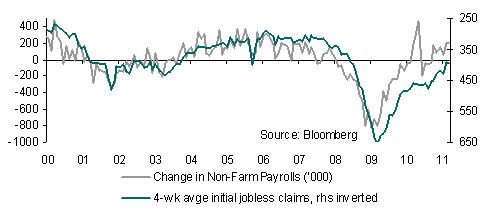
The better than expected March US jobs report will likely help to shift the debate further towards the hawkish camp in the Fed. There is little this week to match the potency of payrolls in terms of market moving data this week. Instead attention will focus on a raft of Fed speakers over coming days as well as the minutes of the March 15 FOMC meeting.
This week’s Fed speakers include Lockhart, Evans, Bernanke, Kocherlakota, Plosser and Lacker. Of these only Lockhart and Lacker are non voters. Given the intense focus on recent Fed comments FX markets will be on the lookout for anything that hints a broader Fed support for a quicker hike to interest rates and/or reduction in the Fed’s balance sheet.

In any case the USD may struggle to make much headway ahead of an anticipated European Central Bank (ECB) rate hike of 25 basis point on Thursday. Much will depend on the press statement, however. If the ECB merely validates market expectations of around 75bps of policy rate hikes this year the EUR will struggle to rally.

It may also be possible that once the ECB meeting is out of the way the EUR may finally be susceptible to pressure related to ongoing peripheral tensions. Last week the outcome of the Irish bank stress tests, and political vacuum in Portugal ahead of elections set for June 5 were well absorbed by the EUR but it is questionable whether the dichotomy between widening peripheral bond spreads and the EUR can continue.

The Tankan survey in Japan released today unsurprisingly revealed a deterioration in sentiment. The survey will provide important clues for the Bank of Japan (BoJ) at its meeting on April 6 & 7th. Although a shift in Japan’s ultra easy monetary policy is unlikely whilst strong liquidity provision is set to continue, pressure to do more will likely grow. This will be accentuated by a likely downward revision in the economic outlook by the BoJ.

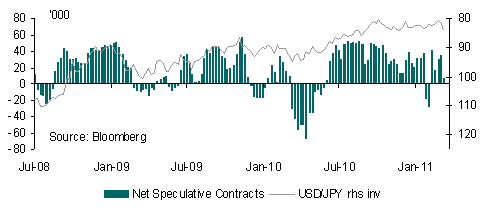
The JPY will not take much direction from this meeting. Nonetheless, its soft tone may continue helped by foreign securities outflows (particularly out of bonds), with USD/JPY eyeing the 16 December high around 84.51. Speculative positioning as reflected in the CFTC IMM data reveals a sharp deterioration in JPY sentiment as the currency evidence that finally the currency maybe regaining its mantle of funding currency.
It is still too early for the Bank of England to hike rates despite elevated inflation readings and MPC members are likely to wait for the May Quarterly Inflation Report before there is decisive shift in favour of raising policy rates. Even then, members will have to grapple with the fact that economic data remains relatively downbeat as reflected in the weaker than expected March manufacturing purchasing managers index (PMI) data.

Today’s PMI construction data will likely paint a similar picture. The fact that a rate hike is not expected by the market will mean GBP should not suffer in the event of a no change decision by the BoE this week but instead will find more direction from a host of data releases including industrial production. GBP has come under growing pressure against the EUR since mid February and a test of the 25 October high of 0.89415 is on the cards this week.

Finally, congratulations to the Indian cricket team who won a well deserved victory in the Cricket World Cup final over the weekend. The celebrations by Indians around the world will go on for a long while yet.
G7 Intervention Hits Japanese Yen

One could imagine that it was not difficult for Japan to garner G7 support for joint intervention in currency markets given the terrible disaster that has hit the country. Given expectations of huge repatriation flows into Japan and a possible surge in the JPY Japanese and G7 officials want to ensure currency stability and lower volatility. Moreover, as noted in the G7 statement today officials wanted to show their solidarity with Japan, with intervention just one means of showing such support.

Although Japanese Finance Minister Noda stated that officials are not targeting specific levels, the psychologically important level of 80.00 will likely stick out as a key level to defend. Note that the last intervention took place on 15 September 2010 around 83.00 and USD/JPY was trading below this level even before the earthquake struck. The amount of intervention then was around JPY 2.1 trillion and at least this amount was utilised today. The last joint G7 intervention took place in September 2000.

Unlike the one off FX intervention in September 2010, further intervention is likely over coming days and weeks by Japan and the Federal Reserve, Bank of France, Bundesbank, Bank of England, Bank of Canada and other G7 nations. The timing of the move today clearly was aimed at avoiding a further dramatic drop in USD/JPY, with Thursday’s illiquid and stop loss driven drop to around 76.25 adding to the urgency for intervention. USD/JPY will find some resistance around the March high of 83.30, with a break above this level likely to help maintain the upside momentum.

The JPY has become increasingly overvalued over recent years as reflected in a variety of valuation measures. Prior to today’s intervention the JPY was over 40% overvalued against the USD according to the Purchasing Power Parity measure, a much bigger overvaluation than any other Asian and many major currencies. The trade weighted JPY exchange rate has appreciated by around 56% since June 2007. In other words there was plenty of justification for intervention even before the recent post earthquake surge in JPY

Although Japanese exporters had become comfortable with USD/JPY just above the 80 level over recent months, whilst many have significant overseas operations, the reality is that a sustained drop in USD/JPY inflicts significant pain on an economy and many Japanese exporters at a time when export momentum is slowing. Japan’s Cabinet office’s annual survey in March revealed that Japanese companies would remain profitable if USD/JPY is above 86.30. Even at current levels it implies many Japanese companies profits are suffering.

Upward pressure on the JPY will remain in place, suggesting a battle in prospect for the authorities to weaken the currency going forward. Round 1 has gone to the Japanese Ministry of Finance and G7, but there is still a long way to go, with prospects of huge repatriation flows likely to make the task of weakening the JPY a difficult one. The fact that there is joint intervention will ensure some success, however and expect more follow up by other G7 countries today to push the JPY even weaker over the short-term.

Beyond Expectations

Egypt worries continue to reverberate across markets, yet there appears to be growing resilience or at least some perspective being placed on problems there. Encouraging economic data, particularly in the US has helped to shield markets to some extent, with equity market rallying and US bond yields rising last week. The main impact of Egypt and worries about Middle East contagion continues to be felt on oil prices.

Even the mixed US January jobs report has failed to dent market sentiment; the smaller than expected 36k increase in payrolls was largely attributed to severe weather. A further surprising drop in the unemployment rate to 9.0% due mainly to a significant drop in the labor force was also well received by the market.

There will be less market moving releases on tap this week and the data are unlikely to dent recovery hopes. Michigan confidence is set to record an improvement in February whilst the December trade deficit is set to widen to around $41.0 billion. There are also plenty of Federal Reserve speakers this week including a testimony by Chairman Bernanke.

One central bank that has softened its hawkish rhetoric is the European Central Bank (ECB), with President Trichet dampening speculation of an early rate hike last week and alleviating some of the pressure on eurozone interest rate markets. Consequently the EUR fell as the interest rate differential with the USD became somewhat less attractive. The EUR was also undermined by the opposition from some member states to French and German ideas for greater fiscal policy coordination, an aim apparently not shared across euro members.

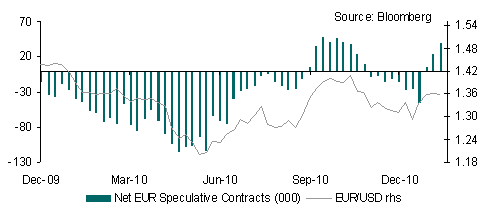
Data in Europe will be largely second tier. The EUR will look increasingly vulnerable to a further drop this week especially given the increase in net positioning over the past week to (1st February) according to the CFTC IMM data. The potential for position squaring looms large as positioning is now well above the three-month average. Stops are seen just below EUR/USD 1.3540.

In the UK the Bank of England policy meeting will take centre stage but there is unlikely to be any change in policy settings. Clues to policy thinking will be available in the monetary policy committee meeting minutes in two weeks times but it seems unlikely that any more members have joined the two voting for a hike at the last meeting.

Recent data have been a little more encouraging helping to wash off the disappointment of the surprise drop in Q4 GDP. The UK industrial production report is likely to be similarly firm on Thursday, with the annual pace accelerating. GBP/USD may however, struggle to make much headway against the background of a firmer USD and the weigh of long positioning, with GBP/USD 1.6279 seen as strong resistance.

There are plenty of releases in Australia this week to focus including the January employment data, consumer confidence, and a testimony by RBA governor Stevens in front of the House of Representatives on Friday. The data slate started off somewhat poorly this week, with December retail sales coming in softer than expected, up 0.2% MoM. AUD/USD is likely to be another currency that may struggle to sustain gains this week but much will depend on data over coming days. Resistance is seen around 1.0255.

On a final note, the weekend’s sporting events highlight how it’s not just economic data or moves in currencies that don’t always go as expected. After a solid run in the Ashes cricket England slumped to a 6-1 series loss to Australia in the one-day series, putting the Ashes win into distant memory. A similarly solid performance by Man United was dented with their unbeaten record broken by bottom of the table Wolves.

Econometer.org has been nominated in FXstreet.com’s Forex Best Awards 2011 in the “Best Fundamental Analysis” category. The survey is available at http://www.surveymonkey.com/s/fx_awards_2011

Your support in the survey is highly appreciated

Interest rate and FX gyrations

Following a brief rally at the start of the year the USD has found itself under growing pressure in the wake of widening interest rate differentials versus many other currencies. In particular, the contrasting stance between the hawkish rhetoric (bias for tighter monetary conditions) from European Central Bank (ECB) President Trichet and the relatively dovish US Federal Reserve stance as highlighted in the 26th January FOMC statement has provided more fuel to the widening in interest rate expectations between the US and eurozone. Since the end of last year interest rate differentials have widened by around 31 basis points in favour of the EUR (second general interest rate futures contract).

The Fed remains committed to carrying out its full $600 billion of asset purchases by end Q2 2011 whilst the ECB appears to be priming the market for a scaling back of its liquidity operations. Whilst there may be more juice in EUR over the short term based on the move in interest rate differentials as well as improved sentiment towards the eurozone periphery the upside potential for EUR/USD is looking increasingly limited. Even European officials are beginning to inject a dose of caution, with the ECB’s Nowotny stating that markets are too euphoric over a potential enlargement of the European Financial Stability Facility (EFSF) bailout fund. Indeed, it is highly likely that the euphoria fades quickly once it becomes apparent that enlarging the bailout fund is by no means a panacea to the region’s ailments.

GBP is another currency that has undergone sharp gyrations over recent days in the wake of a shift in interest rate expectations. A surprise 0.5% quarterly drop in UK Q4 GDP (which could not all be blamed on poor weather) set the cat amongst the pigeons and gave a GBP a thrashing but much of this was reversed following the release of Bank of England Monetary Policy Committee (MPC) minutes which revealed a hawkish shift within the MPC, with two dissenters voting for a rate hike and most members agreeing that the risks to inflation has probably shifted higher.

Does this imply an imminent rate hike? No, a policy rate hike closer to the end of the year appears more likely. BoE Governor King provided support to this view, in a speech that was interpreted as dovish, with the governor once again highlighting the temporary nature of the current rise in inflation pressure. Consequently UK interest rate expectations have shifted back and forth over recent days, but still remain wider relative to the US since the start of the year. GBP/USD has of course benefitted, but given worries about growth and the dovish message from King, it is unlikely that rate differentials will widen much further. Consequently GBP/USD is unlikely to make much if any headway above 1.6000.

Risk on mood prevails

The end of the year looks as though it will finish in a firmly risk on mood. Equity volatility in the form of the VIX index at its lowest since July 2007. FX volatility remains relatively low. A lack of market participants and thinning volumes may explain this but perhaps after a tumultuous year, there is a certain degree of lethargy into year end.

Whether 2011 kicks off in similar mood is debatable given the many and varied worries remaining unresolved, not the least of which is the peripheral sovereign debt concerns in the eurozone. It is no surprise that the one currency still under pressure is the EUR and even talk that China offered to buy Portuguese sovereign bonds has done little to arrest its decline.

Reports of officials bids may give some support to EUR/USD just below 1.31 but the various downgrades to ratings and outlooks from ratings agencies over the past week has soured sentiment for the currency. The latest move came from Fitch ratings agency which placed Greece’s major banks on negative ratings watch following the move to place the country’s ratings on review for a possible downgrade.

The USD proved resilient to weaker than forecast data including a smaller than forecast 5.6% gain in existing home sales in November. The FHFA house price index recorded a surprise gain of 0.7% in October, which mitigated some of the damage. The revised estimate of US Q3 GDP revealed a smaller than expected revision higher to 2.6% QoQ annualized from a previous reading of 2.5%. Moreover, the core PCE was very soft at 0.5% QoQ, supporting the view that the Fed has plenty of room to keep policy very accommodative.

Despite the soft core PCE reading Philadelphia Fed President Plosser who will vote on the FOMC next year indicated that if the economy continues to strengthen he will look for the Fed to cut back on completing the $600 billion quantitative easing (QE) program. Although the tax deal passed by Congress will likely reduce the need for QE3, persistently high unemployment and soft core inflation will likely see the full $600 billion program completed. Today marks the heaviest day for US data this week, with attention turning to November durable goods orders, personal income and spending, jobless claims, final reading of Michigan confidence and November new home sales.

Overall the busy US data slate will likely maintain an encouraging pattern, with healthy gains in income and spending, a rebound in new home sales and the final reading of Michigan confidence likely to hold its gains in December. Meanwhile jobless claims are forecast to match the 420k reading last week, which should see the 4-week average around the 425k mark. This will be around the lowest since August 2008, signifying ongoing improvement in payrolls. The data should maintain the upward pressure on US bond yields, which in turn will keep the USD supported.

Please note that this will be the last post on Econometer.org this year. Seasons greatings and best wishes for the new year to all Econometer readers.