Temporary Euro Relief

Eurozone peripheral country travails continue to garner most market attention. There was at least a semblance of improvement on this front as peripheral bond spreads with German bunds narrowed on Tuesday but this was largely due to European Central Bank (ECB) bond buying than any improvement in sentiment. The fact that German bund yields also rose helped to narrow bund-peripheral spreads further.

A clearer test of sentiment will be today’s debt sales by Portugal followed by actions by Spain and Italy tomorrow. ECB buying of Portuguese bonds has given some relief to other debt, with Spanish and Italian debt spreads narrowing too. Even Greece managed to sell short term debt (EUR 1.95 bn of 26 week T-bills) but at a higher cost than the previous sale.

Perhaps a stronger boost to sentiment will come from the news that European Union (EU) governments are discussing an increase in the EUR 440 billion bailout fund in recognition of the fact that the fund may prove too small to cope if the crisis spreads to Spain. However, don’t expect a decision anytime soon, with next week’s meeting of EU finance ministers unlikely to agree to such a move. Support (or lack) of from Germany may prove to be a sticking point against the background of domestic political pressure.

Other options being considered include the possibility of the EFSF (European Financial Stability Facility) purchasing bonds in the secondary market and lowering interest rates on EFSF bailout loans. News that Japan will buy 20% of EFSF bonds this month as well as recent supportive comments from China suggest that an increase in the size of the EFSF may be easily funded by such investors. The EUR will gain some support against the background of such speculation but its upside may be restrained around its 200-day moving average at EUR/USD 1.3071.

In the US the economic news was not so positive for a change as the National Federation of Independent Business (NFIB) small business optimism survey came in weaker than expected in December, an outcome that will come as a blow given that it suggests some stuttering in the recovery process as well as hiring.
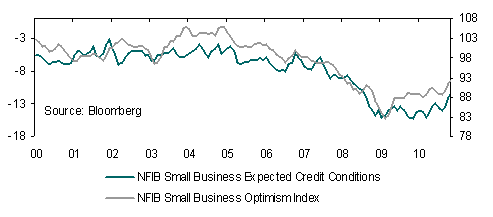
There is only secondary data scheduled today, with most attention on the Fed’s Beige Book later tonight. The survey of Federal Reserve districts will likely reveal a broad based but moderate improvement in economic conditions with the exception of housing activity. A speech by the Fed’s Fisher on Monetary policy will also be in focus. Like the Fed’s Plosser overnight he may highlight some caution about the impact of Fed quantitative easing (QE).

The AUD is increasingly feeling the impact of the flooding in Queensland Australia as the extent of economic damage is revealed. Reserve Bank of Australia (RBA) board member McKibbin estimated that it could knock off at least 1% from economic growth. This may prove too negative and although the flooding will result in a significantly negative impact on growth in Q1 rebuilding and reconstruction will mean that overall growth for 2011 will not be as significantly impacted. Nonetheless, a paring back in RBA policy tightening expectations will see the AUD come under further pressure, with a move down to around AUD/USD 0.9634 on the cards over the short-term.

US bonds sell off, USD rallies

US Treasuries didn’t like it but the compromise agreement to extend Bush era tax cuts, as well as a 13-month unfunded extension of long term unemployment benefits and a $120 billion payroll tax holiday will provide the US economy with further support and likely to lead to some upgrading of US growth forecasts. The agreement changes the dynamic of fiscal support for the US economy and means that the US is the only major country not tightening fiscal policy. It also implies less heavy lifting needed from the Federal Reserve.

Whilst some US taxpayers will not now face tax increases following the end of the year, the longer term question of fiscal adjustment and reform appears to have been postponed. US bond yields jumped on the news as the agreement effectively adds $1 trillion to US debt over the next couple of years. The contrasting fiscal stance with Europe could eventually haunt US markets as focus eventually return to US fiscal issues, with negative implications for the country’s credit ratings. However, at present, attention remains firmly fixed on European sovereign risk rather than US deficit fears.

There has been some relief to European debt markets, albeit temporarily, with debt markets ignoring the news that European Finance Ministers have not agreed to extend the size of the support fund (EFSF) and have also failed to agree on the introduction of recently touted “E-bonds”. ECB buying of peripheral bonds has given some support whilst the passage of the first votes of the Irish budget has eased tensions in its bond markets. Nonetheless as highlighted by the IMF, Europe’s ”piecemeal” response to the debt crisis in the region is insufficient to stem the crisis, suggesting that the current easing in pressure could prove short-lived.

The jump in US bond yields has given the USD some support but I wouldn’t overplay the impact on the USD of bond yields at present. Correlations reflecting the sensitivity of bond yields to various currencies remain relatively low suggesting that the influence of yield on FX is still limited. That said, the correlation is likely to increase over coming months as US yields move higher. The impact on USD/JPY is likely to be particularly sharp, with the currency pair likely to move higher over coming months. The USD has likely rallied due to the likelihood that the tax cut extensions will mean prospects of less quantitative easing by the Fed and prospects of relatively firmer US growth.

An ongoing concern for markets is the prospects of higher interest rates in China. As regular readers of Econometer many note, my blog posts have been a bit sporadic lately. This is not down to laziness but the fact that I have been on the road quite a bit travelling in Asia (and UK) visiting clients. One of the clear concerns that I have heard often repeated is the potential for China’s measures to curb real estate speculation, rising inflation, and lending, to slow China’s growth sharply and cause problems for the rest of the world. This is the topic of another post for another day, but against the background of such concerns the AUD and other high beta currencies are likely to fail to make much headway.

Talking about currencies

It’s always the same story.  Ahead of the G7 (or G8 and now more important G20) meetings speculation of decisive action on currencies intensifies.  Traders and investors become cautious on the off chance that something significant will happen but the majority of times nothing of note emerges.

There was no difference this time around.  The G7 Finance Ministers meeting in Istanbul failed to deliver anything substantive on currencies, repeating the usual mantra about the adverse impact of “excess volatility and disorderly movements”.  Although the group pledged to monitor FX markets there was no indication of imminent action. 

The lack of action is perhaps surprising in one respect as there were plenty of central bankers and finance officials talking about currencies in the run up to the G7 meeting, most of which were attempting to talk the dollar higher against their respective currencies.  Given the increase in rhetoric ahead of the meeting, the relatively weak statement now leaves the door open to further dollar weakness.

The strongest indication of any FX action or intervention came from the country that was supposedly the least concerned about currency strength; Japanese Finance Minister Fujii warned that Japan “will take action” if “currencies show some excessive moves”.  The shift in stance from Japan since the new government took power has been stark (considering that the new government was supposedly in favour of a stronger yen).  Markets will likely continue to test the resolve of the Japanese authorities and buy yen anyway.

Although the G7 statement said little to support the dollar and the overall tone to the dollar likely remains negative over coming months, the softer tone to equity markets and run of weaker economic data in the US – the latest data to disappoint was the September US jobs report – may give some risk aversion related relief to the dollar this week. 

Weaker data and equities alongside the impact of official rhetoric is being reflected in CFTC Commitment of Traders’ data (a good gauge of speculative market positioning) which revealed a sharp drop in short dollar positions, by around a quarter, highlighting for a change, an improvement in dollar sentiment over the last week. 

The biggest losers in terms of speculative positioning were the British pound, where the net short position reached its most extreme since mid September 2008, and Canadian dollar where the net long position was cut by almost half.  Again this may reflect official views on currencies, with Canadian officials expressing concern about the strength of the Canadian dollar in contrast to the perception that UK officials favour a weaker pound.
Central bank meetings (BoE, ECB, RBA) will dominate the calendar this week and more comments on currencies are likely even if interest rates are left unchanged.  Meanwhile FX markets will continue to watch equities, and the start of the US Q3 earnings season will give important signals to determine the sustainability of the recent equity market rally.  Recent weak economic data has already cast doubt about a speedy recovery and if earnings disappoint risk aversion could once again be back on the table.