Reflation Trade Is Back

A much softer than expected US January jobs report didn’t prevent US equities from closing higher at the end of last week as the reflation trade kicked back in.  One of the biggest driving forces for markets was the growing prospects that much of President Biden’s $1.9 trillion fiscal stimulus plan will be passed, albeit via a process of reconciliation, which allows Democrats to circumvent the need to gain the support of at least 10 republicans. This contrasts with prior expectations that the final stimulus was going to be less than $1 trillion. 

Pushing stimulus through this way highlights Biden’s urgency to inject more spending into the economy but could come at the cost of hurting bipartisan policy efforts. The impact of expectations of increased fiscal stimulus is particularly apparent in the US rates market, with US Treasuries selling off and bear steepening of the curve.  Although higher US Treasury yields failed to give support to the US dollar (USD) there is still scope for a short covering rally, which could still help give the USD relief.     

At the beginning of the year the US jobs market took a hit from renewed lockdowns and surge in COVID cases; US January non-farm payrolls increased 49k, and December was revised to -227k from -140k while more positively the unemployment rate fell to 6.3% from 6.7% though this was flattered by a drop in the participation rate as less people were looking for work.  According to the payrolls report there are still 9.9 million more unemployed compared to pre-COVID levels.  As such, the weak jobs data added more support to Biden’s fiscal stimulus proposals.   

This week focus will likely turn more to President Trump’s impeachment trial in the Senate than economic data.  Key data/events this week include China’s credit and monetary aggregates (9-15 Feb), central bank decisions in Sweden (Wed), Philippines, Mexico (Thu) and Russia (Fri).  Among these the consensus is for only Mexico to cut its policy rate. Also in focus are inflation readings in China (Wed), US (Wed) and India (Fri).  UK GDP (Fri) and US Michigan sentiment (Fri) will also garner attention. 

The return of the reflation trade, rally in risk assets and decline in cross-asset volatility bodes well for emerging markets (EM) assets.  However, there are definitely various cross currents impacting asset markets at present especially with US Treasury yields rising, which could potentially support the USD and pressure EM local bond rates markets.  EM assets were clearly favoured towards the end of last year, and while the positive story has not dissipated, EM assets may take a pause for breath before pushing higher again.  

In Asia, the Chinese-new-year holidays this week may dampen activity while China’s PBoC also appears to be limiting liquidity injections around the holidays, which could limit some of the gains in Chinese and impact China linked assets.  Chinese authorities have re-focussed attention on preventing an excessive build-up of leverage and credit metrics have peaked as a result.  As such, they may be less keen to inject a lot of liquidity into markets at present. 
Markets Firm Despite Weak Data and Political Mayhem

Following an eventful (to put it mildly) week in US politics, the main thrust for markets is that the prospects of another sizeable US fiscal stimulus package has increased as Democrats will now take the Senate following the Georgia run-off elections as well as the House and Presidency.  The Blue sweep effectively gives Democrats more potential to pass policies without the constraints of requiring Republican support in the Senate.  That said, the Senate may not be willing to pass significantly more progressive measures given that the seats will be 50/50 for Republicans and Democrats, with the deciding vote coming from VP-elect Harris.

The data/markets dichotomy was once again clear from the weakness in the US December payrolls data on Friday, which revealed a 140,000 drop (consensus +50, 000) as Covid restrictions severely impacted leisure and hospitality jobs.  If anything, this will just add to pressure for more fiscal stimulus. US markets don’t care about soft data or are at least looking past it, with key indices reaching record highs last week led by tech stocks. Stocks and risk assets overall registered a stellar first trading week of the year amid a glut of liquidity even as US Treasury yields pushed higher.  

The US dollar also finally strengthened, gaining some respite amid a market positioned short and despite very negative sentiment.  More gains are likely if the USDs positive relationship with US yields continues to re-establish itself, assuming US Treasury 10 year yields push higher amid further bear steepening as expectations of more fiscal stimulus grow. The same cannot be said for gold prices, which tanked 4% at the end of last week as gold’s negative correlation with US Treasury yields took effect.  Asian currencies and local currency bonds will likely also face headwinds in the near term as the USD consolidates further. 

Aside from steps in the US House towards impeaching President Trump for a second time and any measures announced by the US administration in its final days, markets will focus on US (Wed) and Chinese inflation (tomorrow) data this week.  Both releases are unlikely to provoke any concern about inflation pressures even as market inflation expectations push higher.  Australia (Nov) and US retail sales data (Dec) (both tomorrow) will give some colour on how the consumer is faring.  In this respect US data will likely disappoint.  Other key data and events this week include China trade data (Thu) and rate decisions in Poland (Wed) and Korea (Fri). Chinese trade data is likely to reveal another strong reading for both exports and imports while Poland and Korea policy rates are likely to remain unchanged.

Japan’s Earthquake Aftermath

The aftermath of the devastating earthquake and Tsunami in Japan will largely drive markets this week outweighing the ongoing tensions in the Middle East. Having been in Tokyo as the earthquake struck I can testify to the severity and shock impact of the earthquake. Aside from the terrible human cost the economic cost will be severe at least for the next few months before reconstruction efforts boost growth. An early estimate suggests around a 1% negative impact on GDP this year.

The government is expected to announce a spending package over coming weeks to help fund relief efforts but this will likely put additional strain on Japan’s precarious debt situation at a time when worries about the country’s fiscal health were already high. Nonetheless, there is around JPY 550 billion available from the Fiscal Year 2010 and FY 2011 budgets even before a supplementary budget is needed.

The initial negative JPY impact of the natural disaster gave way to strength in anticipation of expected repatriation flows by Japanese life insurance companies and other institutions as they liquidate assets abroad in order to pay for insurance payments in Japan. The bias to the JPY will likely continue to be upwards but trading will be choppy.

Many of the margin traders holding extreme long USD/JPY positions will likely reduce these positions in the weeks following the earthquake in order to fulfil JPY demand. This may be countered by some foreign selling of Japanese assets especially given that foreigners have accelerated Japanese asset purchases over recent weeks. Therefore, it’s not a straight forward bet to look for JPY strength.

If however, the JPY strengthens rapidly and threatens to drop well below the psychologically important level of 80 the spectre of FX intervention will loom large. Indeed, following the Kobe earthquake in 1995 the JPY strengthened sharply by around 18% but the USD was already in decline prior to the earthquake and USD/JPY was also being pressured lower by Barings Bank related liquidation.

Therefore, comparisons to 1995 should be taken with a pinch of salt. Nonetheless, Japanese authorities will be on guard for further upward JPY pressure. The immediate market focus will be on the Bank of Japan (BoJ) meeting today, with the BoJ announcing the addition of JPY 7 trillion in emergency liquidity support to help stabilise markets.

Euro Sentiment Jumps, USD Sentiment Dives

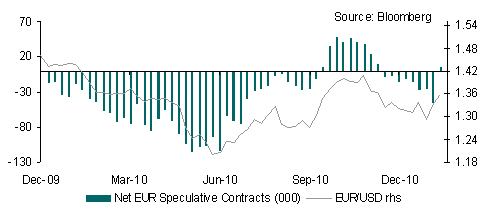
The bounce in the EUR against a broad range of currencies as well as a shift in speculative positioning highlights a sharp improvement in eurozone sentiment. Indeed, the CFTC IMM data reveals that net speculative positioning has turned positive for the first time since mid-November. A rise in the German IFO business confidence survey last week, reasonable success in peripheral bond auctions (albeit at unsustainable yields), hawkish ECB comments and talk of more German support for eurozone peripheral countries, have helped.

A big driver for EUR at present appears to be interest rate differentials. In the wake of recent commentary from Eurozone Central Bank (ECB) President Trichet following the last ECB meeting there has been a sharp move in interest rate differentials between the US and eurozone. This week’s European data releases are unlikely to reverse this move, with firm readings from the flash eurozone country purchasing managers indices (PMI) today and January eurozone economic sentiment gauges expected.

Two big events will dictate US market activity alongside more Q4 earnings reports. President Obama’s State of The Union address is likely to pay particular attention on the US budget outlook. Although the recent fiscal agreement to extend the Bush era tax cuts is positive for the path of the economy this year the lack of a medium to long term solution to an expanding budget deficit could come back to haunt the USD and US bonds.

The Fed FOMC meeting on Wednesday will likely keep markets treading water over the early part of the week. The Fed will maintain its commitment to its $600 billion asset purchase program. Although there is plenty of debate about the effectiveness of QE2 the program is set to be fully implemented by the end of Q2 2011. The FOMC statement will likely note some improvement in the economy whilst retaining a cautious tone. Markets will also be able to gauge the effects of the rotation of FOMC members, with new member Plosser possibly another dissenter.

These events will likely overshadow US data releases including Q4 real GDP, Jan consumer confidence, new home sales, and durable goods orders. GDP is likely to have accelerated in Q4, confidence is set to have improved, but at a low level, housing market activity will remain burdened by high inventories and durable goods orders will be boosted by transport orders. Overall, the encouraging tone of US data will likely continue but markets will also keep one eye on earnings. Unfortunately for the USD, firm US data are being overshadowed by rising inflation concerns elsewhere.

Against the background of intensifying inflation tensions several rate decisions this week will be of interest including the RBNZ in New Zealand, Norges Bank in Norway and the Bank of Japan. All three are likely to keep policy rates on hold. There will also be plenty of attention on the Bank of England (BoE) MPC minutes to determine their reaction to rising inflation pressures, with a slightly more hawkish voting pattern likely as MPC member Posen could have dropped his call for more quantitative easing (QE). There will also be more clues to RBA policy, with the release of Q4 inflation data tomorrow.

Both the EUR and GBP have benefitted from a widening in interest rate futures differentials. In contrast USD sentiment has clearly deteriorated over recent weeks as highlighted in the shift in IMM positioning, with net short positions increasing sharply. It is difficult to see this trend reversing over the short-term, especially as the Fed will likely maintain its dovish stance at its FOMC meeting this week. This suggests that the USD will remain on the back foot.

All Eyes On US Jobs Data

Happy New Year!

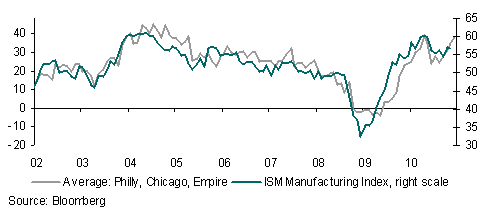
2010 ended on a sour note especially for eurozone equity markets (and the Australian cricket team) where there has yet to be a resolution to ongoing growth/fiscal/debt tensions.  The EUR strengthened into year end but this looked more like position adjustment than a shift in sentiment and EUR/USD is likely to face stiff resistance around the 1.3500 level this week, with a drop back towards 1.3000 more likely.  In the US there was some disappointment in the form of a surprise drop in December consumer confidence data but pending home sales and the Chicago PMI beat expectations, with the overall tone of US data remaining positive.

There will be plenty to chew on this week in terms of data and events which will provide some much needed direction at the beginning of the year.  The main event is the December US jobs report at the end of the week.   Ahead of this there will be clues from various other job market indicators including the Challenger jobs survey, ADP employment report, and the ISM manufacturing and non-manufacturing surveys.  The data will reflect a modest improvement in job market conditions and the preliminary forecast for December payrolls is for a 135k increase, with private payrolls set to rise by 145k and the unemployment rate likely to fall slightly to 9.7%.

The minutes of the 14 December Fed FOMC meeting (Tue) will also come under scrutiny against the background of rising US bond yields.  In addition, Fed Chairman Bernanke will speak on the monetary and fiscal outlook as well as the US economy to the Senate Budget Panel.   Bernanke will once again defend the use of quantitative easing whilst keeping his options open to extend it if needed.  However, the changing composition of the FOMC with four new members added in 2011 suggests a more hawkish tinge, which will likely make it more difficult to agree on further QE.   In any case, the tax/payroll holiday package agreed by the US administration means that more QE will not be necessary. 

It’s probably not the most auspicious time for new member Estonia to be joining the eurozone especially as much of the speculation last year focussed on a potential break up.  The beginning of the year will likely see ongoing attention on the tribulations of Ireland after its bailout, with looming elections in the country.  Portugal and Spain will also remain in focus as the “two-speed” recovery in 2011 takes shape.  Data releases this week include monetary data in the form of the eurozone December CPI estimate and M3 money supply.  Inflation will tick up to 2% but this ought to be of little concern for the ECB.  Final PMI data and confidence indices will likely paint a picture of slight moderation.   

The USD ended the year on a soft note, with year lows against the CHF and multi year lows vs. AUD registered, but its weakness is unlikely to extend much further.  The key driver will remain relative bond yields and on this front given the prospects for relative US yields to move higher, the USD will likely gain support.  There maybe a soft spot for the USD in Q1 2011 but for most of the rest of the year the USD is set to strengthen especially against the EUR which will increasingly comer under pressure as peripheral tensions and growth divergence weigh on the currency.