Euro pressure mounts

The effects of eurozone peripheral bond concerns are cascading through eurozone markets and hitting risk appetite in the process. The EUR is a clear casualty having dropped further against the USD and versus other currencies. EUR/Asian FX remains a sell in the current environment. Contagion outside Greece, Portugal and Ireland had been limited but Italy and Spain have also seen a growing impact on their bond markets. Having broke below support around 1.3734, EUR/USD will target 1.3508 support.
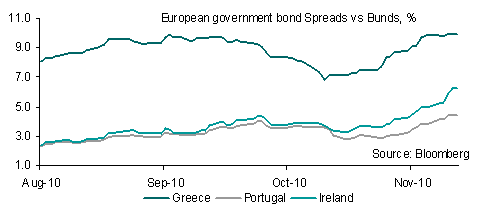
Speculation that Ireland will be forced to follow Greece in seeking international financial support has intensified. Although Ireland has sufficient funds to last until next spring, yields on its debt are already higher than Greek debt before it received funds a few months back. Attention is firmly fixed on the country’s budget on 7 December and the prospects of an agreement between the government and opposition in its austerity plans.

Not helping is the fact that the Irish government has a very slim majority. Even if the budget is passed there is no guarantee that sentiment will improve given the negative impact of even deeper fiscal tightening announced last week will have on economic growth. Moreover, Germany’s insistence that the cost of any Greek style bailout should be borne mostly by private investors has only added to market tension. Even the European Central Bank is unlikely to provide much support, with ECB member Stark suggesting that ECB bond purchases will remain limited.

This leaves eurozone markets in a precarious state and the EUR continues to look heavy as further downside opens up. Moreover, the problems in peripheral Europe are beginning to have a broader impact on risk appetite, with equity markets slipping, although some of this was related to a weaker sales forecast from Cisco in the US. Nonetheless, spreading risk aversion could also dampen sentiment for Asian currencies, which is why selling EUR/Asian FX looks a better bet than selling USD/Asian FX over the short term.

In contrast sentiment for the US is undergoing an improvement. Data releases over recent weeks have generally beaten forecasts and there is even growing speculation that the Fed’s calibrated asset purchases may end up being smaller than planned. Such speculation has boosted the USD but it is premature to suggest that the Fed is on the verge of scaling back asset purchases even as the program of purchases gets going. Although there are clearly some FOMC members who are opposed to significant asset purchases the probability that the Fed remains set to carry out its full $600 billion of planned purchases.

Attention today will focus squarely on day 2 of the G20 meeting and any resolution to disputes over trade imbalances and currencies. Unfortunately none is likely to be forthcoming. Despite a reported 80 minute meeting between US and Chinese leaders little agreement was reached, with plenty of finger pointing remaining in place. It appears that the mantra of moving towards “market-determined exchange rates” and efforts at “reducing excessive imbalances” as agreed at the G20 meeting of finance ministers and central bankers will be as far as any agreement reaches. As a result markets will be left with very little to chew on.
What QE2 means for currencies

The sweeping gains for the Republican party in the US mid term elections has sharply changed the political dynamic in the US, with the prospects of further fiscal stimulus looking even slimmer than before although the chances of the Bush tax cuts being extended have likely increased.

The onus is on monetary policy to do the heavy lifting and the Fed delivered on its end of the bargain, with the announcement of $600 billion of purchases of long-term securities over 8-months through June 2011.

Given the likelihood that the economic impact of the asset purchases is likely to be limited and with little help on the fiscal front the Fed has got a major job on its hands and $600 billion may end up being a minimum amount of purchases necessary for the Fed to fulfil its mandate.

The decline in the USD following the Fed decision is unlikely to mark the beginning of a more rapid pace of USD decline though further weakness over coming months remains likely. The USD remains a sell on rallies for now and an overshoot on the downside is highly probable as the Fed begins its asset purchases.

The bottom line is that the Fed’s program of asset purchases implies more USD supply and in simple economic terms more supply without an increase in demand implies a lower price. The USD will remain weak for some months to come and the Fed’s actions will prevent any USD recovery as the USD solidifies its position as the ultimate funding currency.

Nonetheless, with market positioning close to extreme levels, US bond yields unlikely to drop much further, and the USD already having sold off sharply in anticipation of QE2, (USD index has dropped by around 14% since June) those looking for a further sharp drop in the USD to be sustained are likely to be disappointed.

It is difficult however, to fight the likely further weakness in the USD even if turns out not to be a rapid decline. The path of least resistance to some likely USD weakness will be via the likes of the commodity currencies, scandies and emerging market currencies. There will be less marked appreciation in GBP, CHF and JPY against the USD.

The Fed’s actions will continue to fuel a rush of liquidity into emerging markets, particularly into Asia. This means more upward pressure on Asian currencies but will likely prompt a variety of responses including stronger FX intervention as well as measures to restrict and control such flows.

There have been various comments from central banks in the region warning about the Fed’s actions prompting further “hot money” flows into the region and even talk of a coordinated response to combat such flows.

This suggests more tensions ahead of the upcoming G20 meeting in Seoul. Assuming that at least some part of the additional USD liquidity flows into Asia, the implications of potentially greater FX intervention by Asian central banks to prevent Asian currencies from strengthening, will have a significant impact on major currencies.

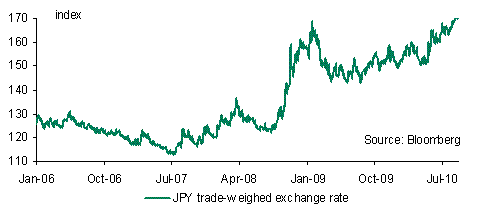
Already it is apparent that central banks in Asia have been strongly using the accumulated USDs from FX intervention to diversify into EUR and other currencies including AUD and even JPY. Perversely this could end up exacerbating USD weakness against major currencies.

US Dollar Tensions

There was considerable relief, most acutely in the US administration, that the US August jobs report revealed a better than expected outcome. To recap, private sector payrolls increased by 67k vs. an upwardly revised 107k in July whilst total non farm payrolls dropped 54k. The data sets the market up for a positive start to the week in terms of risk appetite despite Friday’s drop in the August US non-manufacturing ISM index, deflating some of the market’s upbeat mood.

Once again I wonder how long positive sentiment can be sustained with so many doubts about recovery prospects and limited ammunition on the fiscal front as well as some reluctance on the monetary front, to provide further stimulus should a double dip become a reality.

Markets will be treated to several major central bank decisions including from the Bank of Japan, Bank of England, Bank of Canada and Reserve Bank of Australia this week. These meetings are set to prove uneventful, with unchanged decisions across the board expected although the Bank of Canada decision is a tough call.

The main US release this week is the Fed’s Beige Book on Wednesday, a report which will help the Fed to prepare for the FOMC meeting on September 21. The evidence contained within it is unlikely to be positive reading, with consumer spending set to be relatively soft and evidence of recovery likely to remain patchy.

On Thursday the US July trade deficit is set to reveal some narrowing and as usual the deficit with China will be of interest given the renewed tensions over FX policy. FX tension seems to be intensifying once again due to the relatively slow pace of CNY appreciation since the June de-pegging as well as political posturing ahead of November US mid-term elections. A deterioration in US trade data, a factor that largely contributed to the soft Q2 GDP outcome in contrast to a strengthening in China’s trade surplus will have added fuel to the fire.

The firmer risk backdrop has put the USD on the back foot, with the USD index dropping sharply overnight. Nonetheless, speculative USD positioning as reflected in the CFTC IMM data reveals further short covering up to the end of August, implying USD speculative sentiment is actually turning less negative.

Another country which has a different sort of tension regarding the USD is Japan. Improving risk appetite will likely prevent the JPY from visiting previous highs against the USD but will do little to reduce FX intervention speculation. Indeed, there was more jawboning over the weekend on the subject, with Japan’s finance minister Noda reiterating that Japan would take decisive action to stem the JPY’s appreciation but adding that coordinated FX intervention was a difficult option. Clearly Japan us unlikely to succeed with unilateral FX intervention.

Political events have added to the debate on FX policy as focus turns to the election for leader of the ruling DPJ party next week, with a battle looming between current Prime Minister Kan and challenger Ozawa. Although Ozawa is unpopular with the electorate he yields plenty of political power, and appea rs to be more inclined towards FX intervention. Having failed to sustain a move above 85.00 the pull back in USD/JPY suggests little appetite to extend gains, likely leaving USD/JPY in a relatively tight range, with strong support around 83.55 and resistance around 85.23.

What goes down must go up

What goes down must go up! A day that began with a stronger than forecast increase in China’s purchasing managers index (PMI) and firm Australian Q2 GDP continued with a surprise jump in the August ISM manufacturing index. The ISM rose to 56.3 from 55.5 in July an outcome that contradicted most of the regional US manufacturing surveys. It was not all positive in terms of data, yesterday however, with a weaker UK manufacturing PMI and unexpected drop in the August US ADP employment report casting a shadow over markets.

Nonetheless, for a change the market decided to act on the good news, with risk assets surging. Despite the improvement in risk appetite it still feels as though the market is grasping for direction. The jump in equities is unlikely to prove durable in an environment characterized by various uncertainties about growth and policy, especially the US.

The next hurdle for markets is the US payrolls data tomorrow. Although the ADP jobs report revealed a surprise 10k decline the employment component of the ISM manufacturing survey strengthened to 60.4, suggesting an improvement in August manufacturing payrolls. Ahead of the payrolls release the US data slate today largely consists of second tier releases including July pending home sales, August chain store sales, weekly jobless claims, and factory orders. It is worth paying particular interest to jobless claims given that the four week moving average has been edging higher, suggesting renewed job market deterioration. The consensus is for a 475k increase in claims, which will still leave the 4-week average at an elevated level.

Given that one of the biggest debates raging through markets at present is whether the Fed will embark on further quantitative easing comments by Fed officials overnight were closely scrutinized for further clues. In the event, Fed Governor Kohn highlighted that the Fed’s reinvestment of the proceeds from mortgage-backed securities will not automatically lead to further QE, suggesting some hesitancy on his part. Meanwhile, Dallas Fed President Fisher noted his reluctance to expand the Fed’s balance sheet until fiscal and regulatory uncertainties are cleared up.

Both sets of comments highlight the difficulty in gaining a consensus within the FOMC for a further increase in QE, suggesting that the hurdle for further balance sheet expansion will be set quite high. Moreover, such comments put the onus on Congress to move quickly in clearing up fiscal policy uncertainties.

As markets flip from risk on to risk off almost on a daily basis the question for today is how sustainable the rally in risk trades will prove to be against the background of so much policy and growth uncertainty. Unfortunately today’s data will provide few clues and markets will turn their attention to tomorrow’s US non-farm payrolls report for further direction. To an extent this suggests that it may be a case of treading water until then. Nonetheless, I still maintain that risk trades remain a sell on rallies over coming weeks

Risk trade rally fizzles out

The risk trade rally spurred by China’s decision to de-peg the CNY fizzled out. The realization that China will only move very gradually on the CNY brought a dose of reality back to markets after the initial euphoria. The fact that unlike in July 2005 China ruled out a one off revaluation adds support to the view that China will move cautiously ahead with CNY reform. In addition, renewed economic worries have crept back in, with particular attention on a potential double dip in the US housing market following a surprise 2% drop in existing home sales in May.

European banking sector woes have not disappeared either with S&P raising the estimate of writedowns on Spanish bank losses, whilst Fitch ratings agency noted that there is an increased chance of the eurozone suffering a double-dip recession. The net impact of all of these factors is to dampen risk appetite and the EUR in particular.

The UK’s announcement of strong belt tightening measures in its emergency budget did not fall far outside of market expectations. The budget outlined a 5-year plan of deficit reduction, from 11% of GDP in 2009-10 to 2.1% of GDP in 2014-15. The main imponderable was the response of ratings agency and so far it appears to have been sufficient not to warrant a downgrade of the UK’s credit ratings. Fitch noted that the “ambitious” plan ensured that the UK would keep its AAA credit rating. The emergency budget and reaction to it has been mildly positive for GBP, which has shown some resilience despite the pull back in risk currencies.

The recent rally in Asian currencies is looking somewhat overdone but direction will come from gyrations in risk appetite and the CNY rather than domestic data or events. Encouragingly equity capital flows into Asia have picked up again over recent weeks, with most countries with the exception of the Philippines registering capital inflows so far this month, led by India and South Korea.

China’s CNY move may attract more capital inflows into the region, suggesting that equity capital flows will continue to strengthen unless there is a relapse in terms of sovereign debt/fiscal concerns in Europe. Nonetheless, central banks in the region will continue to resist strong FX gains via FX interventions, preventing a rapid strengthening in local currencies.

Although India and Korea have registered the most equity inflows this month, both the INR and KRW have had a low correlation with local equity market performance over recent weeks. In fact the most highly sensitive currencies to their respective equity market performance have been the MYR and IDR both of which have reversed some of their gains from yesterday. USD/MYR will likely struggle to break below its 26th April low around 3.1825 whilst USD/IDR will find a break below 9000 a tough nut to crack.