World Cup FX Positioning/Data Highlights

The market tone felt decidedly better over the course of the last week although it was difficult to tell if this was due to position squaring ahead of the World Cup football or a genuine improvement in sentiment. There was no particular event or data release that acted as a catalyst either, with the European Central Bank (ECB) and Bank of England (BoE) meetings passing with little fanfare.

US data ended the week mixed, with retail sales disappointing in May but in contrast June consumer confidence beating expectations. Although questions about the pace of recovery remain, other data such as the Fed’s Beige Book suggest that recovery remains on track, sentiment echoed, albeit cautiously by Fed Chairman Bernanke last week.

Attention this week will centre on inflation data. Expected benign CPI readings will support the view that the Fed will take its time to raise interest rates. Speeches by the Fed’s Bullard, Plosser and Bernanke this week will be eyed for further clues on Fed thinking.

Central banks in Brazil and New Zealand hiked rates last week but this is not likely to be echoed this week. No change is likely from both the Bank of Japan and Swiss National Bank although there will be plenty of attention on the SNB’s comments on the CHF following recent data showing a surge in FX reserves due to currency intervention. The BoJ is unlikely to announce anything new but perhaps some further detail on the loan support plan could be forthcoming.

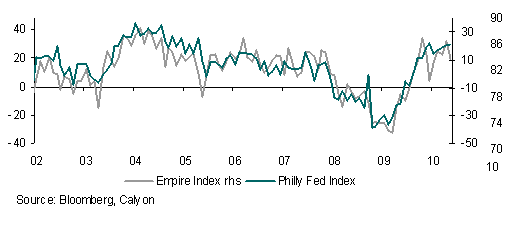
Manufacturing data will also garner some attention, with the US June Empire and Philly Fed surveys and May industrial production on tap. All three reports will confirm the improving trend in manufacturing activity in the US. Housing data will look weaker, with starts set to pull back in starts in May following the expiry of government tax incentive programmes though permits are set to rise.
In Europe, the June German ZEW (econ sentiment) investor sentiment survey will likely slip slightly due to ongoing fiscal/debt worries but this will be countered by stronger domestic data. In any case the index remains at a high level and a slight drop is unlikely to derail markets.

GBP may find some support form upgrade of UK growth forecasts by the CBI to 1.3% for 2010 and relatively hawkish comments from the BoE’s Sentance in the weekend press warning that inflation is higher than expected, indicating that the Bank may need to hike rates sooner than expected.

Further GBP/USD direction will come from CPI and retail sales data this week as well as public borrowing figures and a report by the new Office of Budget Responsibility on the UK’s fiscal position ahead of the June 22 budget. A break above GBP/USD resistance around 1.4760 is unlikely to materialise.

Despite the many data releases this week, the overall tone is likely to be one of consolidation and reduced volatility in the days ahead. This may allow EUR/USD to gain some ground due to short covering, with the CFTC commitment of traders (IMM) report revealing a further increase in net short speculative positions last week, close to the record set a few weeks back, though we suspect that there will be strong resistance around 1.2227.
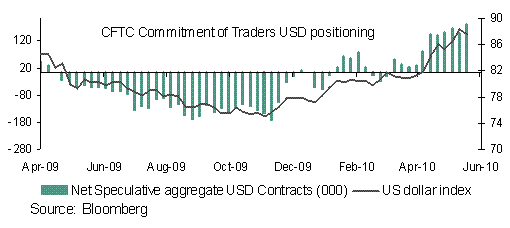
The fact that the IMM data revealed that net aggregate net USD long positions reached an all time high last week, highlights the potential for profit taking this week. USD/JPY will look to take out resistance around 92.55 but this looks unlikely unless the BoJ dishes up anything particularly dovish from its meeting.

EUR/USD to test 1.2510, GBP/USD heading for 1.4500

Following on from the EUR 750 billion EU / IMF package European governments are starting to hold up to their end of the bargain. Spain announced a bunch of austerity measures. The measures aim at cutting the country’s budget deficit by an additional EUR 15 billion from 11.2% of GDP in 2009 to close to 6% in 2011. This was accompanied by some better economic news as Spain edged out of a close to 2-year recession in Q1 2010.

Evidence that some action is being taken on the fiscal front in Europe accompanied a slightly stronger than expected reading for Eurozone GDP in Q1 2010, helping risk appetite to improve overnight. Portugal was also able to find some success in its sale of EUR 1 billion of 10-year bonds, with a bid to cover ratio of 1.8 and a premium of only 18bps above the yield at April’s sale. Portugal has also pledged to cuts its budget deficit further than initially planned, aiming for a deficit of 7.3% of GDP this year.

Of course, pledges need to be followed by action and implementation and execution will be essential to bring markets back on side given the likely damage inflicted on confidence in the whole EUR project. Continued skepticism explains why EUR/USD has failed to take much notice to the developments in Spain and Portugal, with the currency continuing to languish, heading towards technical support around 1.2510 in the short-term.

The new UK coalition government is also moving quickly to appease markets, with plans to cut the budget deficit in the country by GBP 6 billion this year. The plans failed to have a lasting impact on GBP, which was dealt a blow by the dovish interpretation of the Bank of England’s quarterly inflation report released yesterday. GBP/USD continues to struggle to gain a foothold above 1.5000 and technical indicators suggest the currency pair is still heading lower, with a move to 1.4500 likely over the short-term.

Greece In The Spotlight (again)

Once again Greek worries are hogging the limelight and although the Greek saga has become a rather tedious affair for markets, concerns are well founded.  The latest issue is whether Greece is willing to adhere to potentially tough measures that would be associated with IMF assistance for the country.  Latest speculation suggests that Greece may side step the IMF to avoid such measures though this was belatedly denied by the Greek authorities. 

Given the huge amount of bonds Greece needs to sell over the coming weeks renewed nervousness does not bode well for a good reception to this issuance. As it is financing costs are rising once again in the wake of a renewed widening in Greek sovereign bond spreads and servicing this debt will add to the economic misery.  Greece has little by way of upside over coming months and years.  Tough and necessary austerity measures mean that sharp growth deterioration is inevitable, deepening recession.

The lack of flexibility for Greece to devalue its way out of its quagmire means much more economic pain with no release valve.   The same applies to the likes of Spain and Portugal.  The overall loser will be the EUR which looks likely to succumb to further weakness in the months ahead; the parity trade remains a prospect. Perversely a weaker EUR may be exactly what is necessary to alleviate some of the pain for Southern European economies though the EUR would need to weaken by much more than we forecast to be of much help.   

Aside from Greek gyrations the overall market tone looks somewhat positive.  The Fed’s dovish minutes of its March 16 meeting in which it marginally downgraded growth and inflation forecasts, highlights that interest rates are unlikely to be raised by the Fed this year. This will keep in place an accommodative policy stance conducive to further improvements in risk appetite.     Moreover, data releases such as the US ISM manufacturing and non-manufacturing surveys, have been generally supportive to recovery,

Easing tensions on China/US exchange rate policy have also helped sentiment as the issue has been put to one side after the US administration delayed the decision whether to officially label China as a currency manipulator.  Pressure from the US Congress suggests that the issue will not be on the back burner for long and the issue of CNY revaluation will likely be a topic at the during the various meetings between US and Chinese officials over coming weeks. 

Nonetheless, the delay in the US Treasury report will work in favour of a Chinese currency revaluation sooner rather than later as China will likely react more favourable to less international pressure to revalue.

Why Buy Asian FX (Part 1)

Given all the attention on Greece and European fiscal/debt woes over recent weeks it’s been easy to forget about the success story of Asian economies. Of course, there has been a lot of attention on China and the international pressure to revalue its currency. However, the stability and resilience of Asian economies has been impressive throughout the financial crisis and recent Greek saga, helping to boost the attraction of Asian currencies.

Asia has managed to avoid the fiscal/debt problems associated with many developed economies, due to much better fiscal management over recent years. There are a couple of exceptions however, including the Philippines and India, but the fiscal positions in these countries have seen an improvement and are unlikely to lead to anywhere near the same sort of problems associated with Greece and other European countries.

So far this year capital inflows into Asian equity markets have much been stronger than 2009, albeit after a rocky start to the year when flows dried up due to rising risk aversion. Since then inflows have resumed strongly. The comparison to 2008 is even more dramatic as much of Asia registered significant capital outflows that year. South Korea, India and Taiwan, respectively, have led the way in term of inflows into equity markets in 2010, with inflows of $4.3 billion, $3.7 billion and $3.3 billion, respectively.

It is no coincidence that Asian currencies are most sensitive to the performance of Asian equity markets, with strong capital inflows and rising equities leading to stronger currency performance. Asia is set to continue to be a strong destination for equity flows over coming months, which given the high Asian equity correlation with local currencies, will lead to further appreciation in most Asian FX. A likely CNY revaluation in China will also help to fuel further Asian FX upside.

GBP bulls brave or crazy?

The UK Pound’s (GBP) performance over recent months has been dismal. The currency has failed to show any real sign of recovery, having fallen to and below the psychologically important level of 1.50 against the USD. A number of factors including fiscal/debt concerns, political worries, and uncertainties about whether the Bank of England will step up asset purchases, have accumulated to turn even the most ardent GBP bulls into bears.

The outcome of the upcoming UK general election widely expected on May 6, remains a major weight on GBP sentiment. Until the outcome is clear or unless one or other party develops a clear lead in the polls, it is difficult o see GBP sustain any durable recovery. In the near term GBP/USD is vulnerable to a test of its 2010 low around 1.4780 and then towards 1.44. The risk to this is that the market is very short GBP which could result in a sharp bounce in GBP in the wake of any good news. However, a rally in GBP will only result in fresh sellers.

Ahead of the elections will be the budget and this will be closely scrutinized for steps to reduce the size of the burgeoning fiscal deficit. Whichever party comes into power will need to convince markets that a credible and timely plan exists to reduce the size of the deficit and prevent a sovereign ratings downgrade. If not, GBP could see itself under much more pressure. In this respect it’s worth noting the Fitch ratings warning that the UK sovereign credit profile has deteriorated.

It’s not all bad for GBP, however. By some measures it’s now the most undervalued major currency, opening up the possibility of a sharper bounce back over the medium term. Moreover, UK debt markets are already trading as if a ratings downgrade has taken place, whilst arguably GBP has also priced in a lot of negative news already, as reflected in the very negative speculative positioning in the currency.

The economic news is also not as bad as the headlines might suggest and although recent housing data has been a bit mixed, both consumer spending and the housing market have held up reasonably well. Bearing all this in mind GBP is set to recover over the medium term, but it would be very brave to buy the currency any time soon, at least until UK elections are out of the way.