Euro’s Teflon Coating Wearing Thin

EUR has suffered a setback in the wake some disappointment from the European Union summit at the end of last week and the major defeat of German Chancellor Merkel and her ruling Christian Democratic Union party in yesterday’s election in Baden-Wuerttemberg. The EUR had been fairly resistant to negative news over recent weeks but its Teflon like coating may be starting to wear thin.

The setbacks noted above + others (see previous post) follow credit rating downgrades for Portugal by both S&P and Fitch ratings and growing speculation that the country is an imminent candidate for an EU bailout following the failure of the Portuguese government to pass its austerity measures last week and subsequent resignation of Portugal’s Prime Minister Socrates.
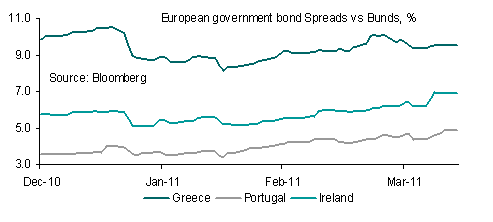
For its part Portugal has stated that it does not need a bailout but looming bond redemptions of around EUR 9 billion on April 15 and June 15 against the background of record high funding costs mean that the pressure for a rescue is intense. Complicating matters is the fact that fresh elections cannot be held earlier than 55 days after being announced, meaning that policy will effectively be in limbo until then. A June vote now appears likely.

After what was perceived to be a positive result of the informal EU leaders summit a couple of weeks ago, the outcome of the final summit last week failed to deliver much anticipated further details whilst more negatively the EU bailout fund’s paid-in capital was scaled back to EUR 16 billion (versus EUR 40 billion agreed on March 21) due to concerns expressed by Germany.

Ireland is also in focus ahead of European bank stress tests results on March 31. Ireland is pushing for increased sharing of bank losses with senior bondholders as part of a “final solution” for financial sector. Meanwhile the new government remains unwilling to increase the country’s relatively low corporation tax in exchange for a renegotiation of terms for the country’s bailout. This point of friction also threatens to undermine the EUR.

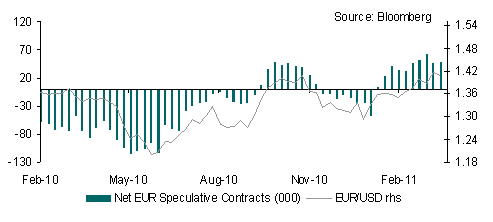
The bottom line is that the bad news is building up and the ability of the EUR to shake it off is lessening. Considering the fact that the market long EUR, with positioning well above the three-month average the EUR is vulnerable to position adjustment. After slipping over recent days EUR/USD looks supported above 1.3980 but its upside is looking increasingly restricted against the background of various pieces of bad news.
Euro resilient but for how long?

The resilience of the EUR to bad news has been impressive but is unlikely to persist. The recent negatives include 1) the rejection of the Portuguese government’s austerity plan and the increased likelihood of a bailout, 2) a likely delay in the decision on increasing the size and scope of the EFSF EU bailout fund, 3) a drop in Eurozone purchasing managers indices in March, 4) downgrades to Portugal’ sovereign credit ratings by Fitch last night and S&P and 5) Moodys downgrades of 30 Spanish banks. Despite all of this, and after hitting a low of around EUR/USD 1.4054, EUR has bounced back close to the 1.4200 level.

Further direction will come from the outcome of the EU leaders’ summit today and the March German IFO business confidence survey. For the former there is unlikely to be a decisive result, with the optimism following the informal March 11 leaders’ summit likely to give way to delay due to wrangling over details. For the latter, a slight moderation in the IFO is expected following February’s upside surprise. However, there is a bigger risk of a downside surprise following the softer than forecast March German manufacturing PMI released. Against this background, EUR/USD is likely to struggle to break resistance around 1.249.

In general FX markets look somewhat more stable and even the pressure on the USD appears to have abated slightly despite a much weaker than expected outcome for US February durable goods orders yesterday, which revealed a drop in both headline and ex-transportation orders. My composite FX volatility measure has dropped sharply over recent days, led by short term implied JPY volatility which has dropped close to pre-crisis levels. Lower volatility has also likely reduced the prospects of further FX intervention although USD/JPY 80 will continue to be well defended.

Lower volatility as also reflected in the sharp drop in the VIX index has corresponded with a general easing in risk aversion as both Middle East and Japan tensions have eased slightly. US data today are unlikely to offer much direction, with a slight upward revision to US Q4 GDP and an unchanged outcome for the final reading of Michigan consumer confidence expected.

Risk on mood prevails

The end of the year looks as though it will finish in a firmly risk on mood. Equity volatility in the form of the VIX index at its lowest since July 2007. FX volatility remains relatively low. A lack of market participants and thinning volumes may explain this but perhaps after a tumultuous year, there is a certain degree of lethargy into year end.

Whether 2011 kicks off in similar mood is debatable given the many and varied worries remaining unresolved, not the least of which is the peripheral sovereign debt concerns in the eurozone. It is no surprise that the one currency still under pressure is the EUR and even talk that China offered to buy Portuguese sovereign bonds has done little to arrest its decline.

Reports of officials bids may give some support to EUR/USD just below 1.31 but the various downgrades to ratings and outlooks from ratings agencies over the past week has soured sentiment for the currency. The latest move came from Fitch ratings agency which placed Greece’s major banks on negative ratings watch following the move to place the country’s ratings on review for a possible downgrade.

The USD proved resilient to weaker than forecast data including a smaller than forecast 5.6% gain in existing home sales in November. The FHFA house price index recorded a surprise gain of 0.7% in October, which mitigated some of the damage. The revised estimate of US Q3 GDP revealed a smaller than expected revision higher to 2.6% QoQ annualized from a previous reading of 2.5%. Moreover, the core PCE was very soft at 0.5% QoQ, supporting the view that the Fed has plenty of room to keep policy very accommodative.

Despite the soft core PCE reading Philadelphia Fed President Plosser who will vote on the FOMC next year indicated that if the economy continues to strengthen he will look for the Fed to cut back on completing the $600 billion quantitative easing (QE) program. Although the tax deal passed by Congress will likely reduce the need for QE3, persistently high unemployment and soft core inflation will likely see the full $600 billion program completed. Today marks the heaviest day for US data this week, with attention turning to November durable goods orders, personal income and spending, jobless claims, final reading of Michigan confidence and November new home sales.

Overall the busy US data slate will likely maintain an encouraging pattern, with healthy gains in income and spending, a rebound in new home sales and the final reading of Michigan confidence likely to hold its gains in December. Meanwhile jobless claims are forecast to match the 420k reading last week, which should see the 4-week average around the 425k mark. This will be around the lowest since August 2008, signifying ongoing improvement in payrolls. The data should maintain the upward pressure on US bond yields, which in turn will keep the USD supported.

Please note that this will be the last post on Econometer.org this year. Seasons greatings and best wishes for the new year to all Econometer readers.

Risk trade rally fizzles out

The risk trade rally spurred by China’s decision to de-peg the CNY fizzled out. The realization that China will only move very gradually on the CNY brought a dose of reality back to markets after the initial euphoria. The fact that unlike in July 2005 China ruled out a one off revaluation adds support to the view that China will move cautiously ahead with CNY reform. In addition, renewed economic worries have crept back in, with particular attention on a potential double dip in the US housing market following a surprise 2% drop in existing home sales in May.

European banking sector woes have not disappeared either with S&P raising the estimate of writedowns on Spanish bank losses, whilst Fitch ratings agency noted that there is an increased chance of the eurozone suffering a double-dip recession. The net impact of all of these factors is to dampen risk appetite and the EUR in particular.

The UK’s announcement of strong belt tightening measures in its emergency budget did not fall far outside of market expectations. The budget outlined a 5-year plan of deficit reduction, from 11% of GDP in 2009-10 to 2.1% of GDP in 2014-15. The main imponderable was the response of ratings agency and so far it appears to have been sufficient not to warrant a downgrade of the UK’s credit ratings. Fitch noted that the “ambitious” plan ensured that the UK would keep its AAA credit rating. The emergency budget and reaction to it has been mildly positive for GBP, which has shown some resilience despite the pull back in risk currencies.

The recent rally in Asian currencies is looking somewhat overdone but direction will come from gyrations in risk appetite and the CNY rather than domestic data or events. Encouragingly equity capital flows into Asia have picked up again over recent weeks, with most countries with the exception of the Philippines registering capital inflows so far this month, led by India and South Korea.

China’s CNY move may attract more capital inflows into the region, suggesting that equity capital flows will continue to strengthen unless there is a relapse in terms of sovereign debt/fiscal concerns in Europe. Nonetheless, central banks in the region will continue to resist strong FX gains via FX interventions, preventing a rapid strengthening in local currencies.

Although India and Korea have registered the most equity inflows this month, both the INR and KRW have had a low correlation with local equity market performance over recent weeks. In fact the most highly sensitive currencies to their respective equity market performance have been the MYR and IDR both of which have reversed some of their gains from yesterday. USD/MYR will likely struggle to break below its 26th April low around 3.1825 whilst USD/IDR will find a break below 9000 a tough nut to crack.

Volatility Within Ranges

Most investors will likely be happy to see the tail end of May given the sharp losses in many asset classes over the month. At least over the last few days there was a sense of some healing, particularly in risk assets though it is questionable how long this can continue given the still many and varied uncertainties afflicting markets. A reminder of this came late on Friday, with Fitch downgrading Spain’s sovereign credit ratings despite the passage of austerity measures.

The Fitch decision highlights that Spain is rapidly becoming the new epicenter of the crisis; focus on the savings banks or Cajas is intensifying ahead of the June 30 deadline for mergers to qualify for government money, the minority government’s popularity is in further decline, whilst unions are threatening more strikes across the country. Unions in Greece and Italy are also pushing for coordinated strikes, highlighting the difficulties in pushing through austerity measures.

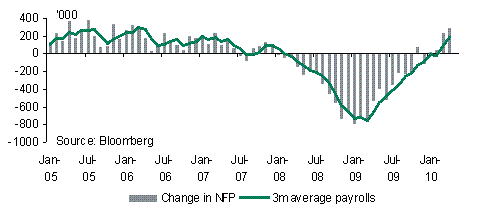
At least economic data is providing some solace to markets. Releases last week in the US highlighted the fact that consensus expectations are underestimating the pace of recovery; consumer confidence, durable goods orders and new home sales all came in above expectations. The same story is likely this week, but there is really only one piece of data that attention will focus on and that’s the May jobs report. The consensus is for a strong 508k increase in non-farm payrolls following a 290k increase in April, though around three-quarters of this will be related to census hiring. The unemployment rate is likely to dip slightly to 9.8%.

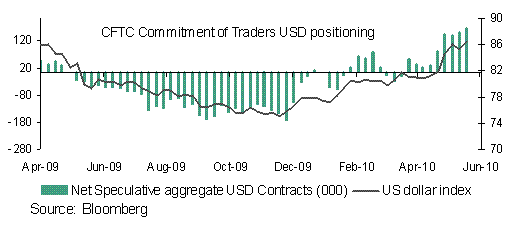
Markets are likely to be in limbo, with volatility in ranges likely this week. USD sentiment remains strong as reflected in the CFTC IMM data where net aggregate positioning is at an all time high, but further USD gains may be harder to come by ahead of the US jobs report and G20 meeting this weekend. Stretched USD positioning has proven no barrier to USD strength over recent weeks but the fact that markets are very long USDs could at the least result in a slower pace of further appreciation.

EUR speculative sentiment remains close to all time lows although there are signs of some relative stability over recent weeks. EUR/USD is likely to range between 1.2134 and 1.2475 this week. There was a sharp drop in net short JPY positions over the week (ie short-covering) though this appears at odds with the fall in the JPY. GBP speculative positions showed little improvement, languishing close to all time lows, whilst net longs in commodity currencies were pared back sharply, especially in AUD where net longs were cut by around half though sharp declines in positioning were also registered for NZD and CAD.

GBP could suffer due to worries about the UK government’s plans to reduce its burgeoning budget deficit following the resignation of Treasury Minister David Laws, following an expense scandal. The resignation hits the coalition just three weeks before the emergency budget and could result in complications on the negotiations between the Liberal Democrats and Conservatives on the substance of the deficit cutting measures. GBP/USD is likely to find support around 1.4260 and resistance around 1.4612 this week.