FX sensitivities to yield differentials

A lot has been made about the hawkish language from a few Federal Reserve FOMC members over recent days and growing speculation about whether quantitative easing (QE2) will end earlier than initially planned. In turn, this has been noted as a positive factor for the USD. Undoubtedly there are a few in the Fed who are becoming more nervous about current policy settings but it is highly unlikely that the Fed will not complete its $600 billion in planned asset purchases by the end of June.

The biggest imponderable is how and when the Fed begins its exit policy and how effectively/efficiently it can be done. Whilst it is likely to be over a year before the Fed Funds rate is hiked, the USD will be sensitive to balance sheet reduction. Moreover, the way in which the Fed reduces the size of the balance will also be important given the likely active approach to liquidity withdrawal required.

For the present, it should be noted that even with the hawkish Fed rhetoric and increase in US bond yields (2 year yields have risen by close to 25bps over the last couple of weeks) the USD is actually lower versus EUR than where it was two weeks ago. The reality is that German bund yields have risen by even more than US yields ahead of the anticipated European Central Bank (ECB) rate hike on 7 April (the case for which appears to have been sealed by the above consensus 2.6% YoY reading for March eurozone CPI).

However, I would be cautious about ascribing general FX moves at present to yield / interest rate differentials given that it is only EUR crosses (including EUR/JPY, EUR/GBP, EUR/CAD, and EUR/USD) that hold a statistically significant relationship with yields. All of this implies EUR crosses look supported ahead of the upcoming ECB meeting, with EUR/USD unlikely to sustain a drop below 1.4000 ahead of the rate decision. What happens after depends on the press conference. Bearing in mind that markets have already priced in 75bps of rate hikes by the ECB it would take an even stronger tone from the ECB to push the EUR higher, something that looks unlikely
EUR boosted, USD under pressure

Market attention remains fully focussed on events in Japan especially related to the country’s nuclear facilities. Risk aversion has spiked higher as a result, with ongoing Middle East tensions adding to the risk off tone. CHF is a key beneficiary of safe haven demand but the picture for JPY is obscured by repatriation expectations on one hand and FX intervention risks/Bank of Japan liquidity injections on the other, keeping USD/JPY clsoe to the 82.00 level. In contrast the AUD is vulnerable to a drop below parity with the USD on Japan worries, especially as Australia is a key destination for Japanese investment and therefore potential for reversal of such flows if Japanese institutions repatriate funds.

The EUR recovered over recent days as worries about the eurozone periphery ease and peripheral bonds spreads narrow. It is only a matter of time before overly long market positioning catches up with the EUR especially as the prospects of further interest rate support to the currency looked limited; markets have already priced in 75bps of policy rate hikes in the eurozone this year, which looks appropriate. It is difficult to see markets pricing in any more tightening than this over coming weeks. Despite its bounce back EUR/USD will struggle to break resistance around 1.4036.

Markets will digest the fallout from the informal EU leaders meeting last Friday which prepared the groundwork for the official meeting on 24/25 March. The initial reaction of the EUR appears to be positive but there is a significant risk of disappointment if the outcome of the meeting on 24/25 March does not live up to expectations. Indeed although Friday’s meeting resulted in an agreement in principle of a new “pact for the Euro” much will depend on the eventual details later this month.

Leaders also agreed on lowering interest rates to Greece by 100bps, and in principle enlarging the scope of the European Financial Stability Facility (EFSF) bailout fund to EUR 440 billion. The main positive surprise was opening the door for the fund to purchase eurozone debt. Data releases will offer little support to the EUR this week, with limited gains in the March German ZEW investor confidence survey today likely to leave markets unperturbed.

The USD’s gains last week proved short-lived and the currency will be tested by another relatively dovish Fed FOMC statement today and a benign reading for core CPI inflation in February. The Fed FOMC meeting is unlikely to deliver any changes to the Fed’s stance and whilst there has recently been some speculation that the Fed will soon remove its “extended period” comment, this is unlikely to happen any time soon. The statement will remind markets that the Fed is in no rush to alter its policy settings, an outcome that may limit the ability of the USD to strengthen this week even if data releases continue to remain on the positive side, including manufacturing survey and industrial production over coming days.

GBP troubles, KRW too weak

The Fed FOMC minutes for the January meeting revealed that behind the unanimous vote to leave policy settings unchanged there was some unease about the completion of QE2. Nonetheless, the USD was left weaker given the Fed’s sanguine view on inflation and worries about unemployment. Inflation data will garner most market attention today but the fact that the core rate of CPI inflation is expected to remain well below the Fed’s preferred level could undermine the USD and add a further barrier to the USD’s recovery so far in February. Jobless claims data will also be of interest given the sharp drop last week. Another firm outcome will help to dispel worries about job market recovery.

As warned in my last post, downside risks to GBP were high given the long GBP speculative positioning overhang and hawkish expectations for the BoE Quarterly Inflation Report. In the event the Report revealed a downward growth forecast revision and an upward inflation forecast revision but importantly showed some reluctance to play into market expectations of an early UK policy rate hike. Following on from a weaker than expected UK January jobs report in which unemployment increased, GBP was hit on both counts. GBP/USD is unlikely to veer far from the 1.6000 level, but with markets reassessing interest rate expectations downside risks are beginning to open up.

News yesterday that Moody’s ratings agency has placed Australia and New Zealand’s major banks on review for possible downgrades went down like a lead balloon but once again AUD and NZD showed their usual resilience and acted as if little has happened. AUD and NZD have weakened since the turn of the year. Weaker data and a paring back in policy tightening expectations have contributed to the weaker performance of the AUD and NZD, but markets have gone too far in scaling back the timing and magnitude of interest rate hikes, suggesting that both currencies may bounce back as interest rate expectations become more hawkish.

Asian currencies continue to register mixed performances largely influenced by capital flows. Most equity markets in the region have registered outflows so far in 2011, with the exception of Taiwan and Vietnam. This has been reflected in Asian FX performance, with the strongest performer being the IDR, but its gains have only been around 0.72% versus USD, coinciding with the fact that it has registered some of the least capital outflows this year. Interestingly the worst performing currency has been the THB, one of last year’s star performers. Korea has also registered strong equity capital outflows but this will not persist and a resumption of inflows taken together with positive fundamentals and higher interest rates will boost the KRW this year.

FX Winners and Losers

There has been a sense of mean reversion in FX markets so far this year as some of last year’s winners have become losers. Namely NZD, CHF, JPY and AUD have all lost ground whilst EUR and GBP have gained ground. The odd one out is the SEK which has strengthened over 2010 and in 2011 versus USD. I expect this pattern to change and the likely winners over the next 3- months are NZD, AUD and CAD, with CHF and JPY the likely losers.

EUR held up reasonably well in the wake of slightly disappointing growth data, with eurozone GDP rising less than expected in Q4, and a smaller than expected gain in the February German ZEW investor confidence survey (economic sentiment component). My sense is that the net long EUR speculative position has already been pared back somewhat over recent days reducing the potential selling pressure on the currency in the near term.

Given that EUR/USD is one of the only major currency pairs being influenced by interest rate differentials, its direction will hinge more on policy expectations but in the near the announcement by the German Finance Minister this morning of a restructuring plan for WestLB may give the currency some support.

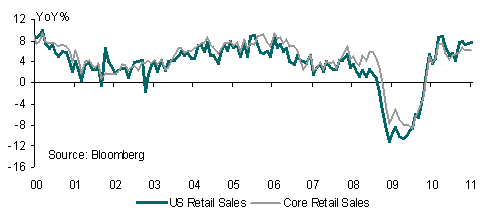
Perhaps one explanation for the stability of EUR/USD around the 1.3500 level is that US data was also disappointing yesterday. January retail sales rose less than forecast whilst revisions to back months suggest less momentum in Q4 consumer spending than previously envisaged. As with the eurozone data weather likely played a role in contributing to the outcome.

The net impact on currencies is that they are largely stuck within tight ranges. Further direction will come from the release of the Fed FOMC minutes for the January 26th meeting. The minutes may undermine the USD if a likely dovish slant continues to be expressed but given that the FOMC decision at that meeting to hold policy setting unchanged had no dissenters this should not come as a surprise.

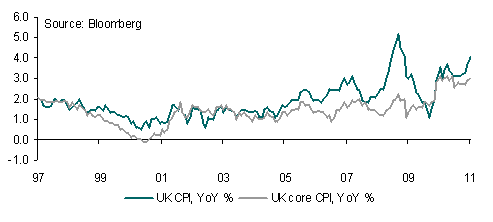
Whilst the battle between the USD and EUR ended in a stalemate GBP outperformed in the wake of the increase in UK January CPI inflation and in particular the letter from the BoE governor to the Chancellor keeping open the door to a rate hike. The Quarterly Inflation Report (QIR) today will be particularly important to determine whether the bounce in GBP is justified.

I remain hesitant to build on long GBP positions given the net long speculative overhang in the currency. The risks following yesterday’s jump in GBP are asymmetric, with a hawkish QIR likely to have less impact on the currency than the negative impact from a more dovish than expected report.

Econometer.org has been nominated in FXstreet.com’s Forex Best Awards 2011 in the “Best Fundamental Analysis” category. The survey is available at http://www.surveymonkey.com/s/fx_awards_2011

Egypt Unrest Hits Risk Trades

Recent weeks have seen a real contrast in policy and growth across various economies. A case in point was the surprise drop in UK GDP in Q4 contrasting sharply with the solid (albeit less than forecast) rise in US Q4 2010 GDP. The resilience of the US consumer was particularly evident in the data. The European Central Bank’s (ECB) hawkish slant as reflected in comments from President Trichet compared to the dovish pitch of the Fed FOMC is another clear contrast for markets to ponder.

The ECB’s hawkish tone gave the EUR a lift but expectations of an early Eurozone rate hike looks premature. Although Eurozone inflation data (Monday) will reveal a further rise in CPI above the ECB’s target, to around 2.4% in January, this will not equate to a policy rate hike anytime soon. This message is likely to be echoed at this week’s ECB meeting where policy will be characterised as “appropriate”.

Whilst monetary tightening expectations look overdone in the Eurozone the same can be said for hopes of an expansion in the EU bailout fund (EFSF). Indeed, the fact that EU Commissioner Rehn appeared to pour cold water over an expansion in the size of the fund could hit the EUR and the currency may find itself struggling to extend gains over coming weeks especially if interest rate expectations return to reality too, with a move to EUR/USD 1.4000 looking far harder to achieve than it did only a few days ago.

It’s worth noting that a renewed widening in peripheral debt spreads will also send an ominous signal for the EUR. Against this background the EU Council meeting on February 4 will be in focus but any expectation of a unified policy resolution will be disappointed.

However, markets perhaps should not solely focus on peripheral Europe as the downgrading of Japan’s credit ratings last week highlights. Warnings about US credit ratings also demonstrate that the US authorities will need to get their act together to find a solution to reversing the unsustainable path of the US fiscal deficit, something that was not particularly apparent in last week’s State of the Union Address.

Last week ended with a risk off tone filtering through markets as unrest in Egypt provoked a sell-off in risk assets whilst worries about oil supplies saw oil prices spike. Gold surged on safe haven demand too. This week, markets will focus on events in the Middle East but there will be thinner trading conditions as Chinese New Year holidays result in a shortened trading week in various countries in Asia.

The main release of the week is the US January jobs report at the end of the week. Regional job market indicators and the trend in jobless claims point to a 160k gain in January although the unemployment rate will likely edge higher. Final clues to the payrolls outcome will be deemed from the ISM manufacturing confidence survey and ADP private sector jobs report this week. Whilst the January jobs report is unlikely to alter expectations for Fed policy (given the elevated unemployment rate) the USD may continue to benefit from rising risk aversion.