Risk on mood prevails

The end of the year looks as though it will finish in a firmly risk on mood. Equity volatility in the form of the VIX index at its lowest since July 2007. FX volatility remains relatively low. A lack of market participants and thinning volumes may explain this but perhaps after a tumultuous year, there is a certain degree of lethargy into year end.

Whether 2011 kicks off in similar mood is debatable given the many and varied worries remaining unresolved, not the least of which is the peripheral sovereign debt concerns in the eurozone. It is no surprise that the one currency still under pressure is the EUR and even talk that China offered to buy Portuguese sovereign bonds has done little to arrest its decline.

Reports of officials bids may give some support to EUR/USD just below 1.31 but the various downgrades to ratings and outlooks from ratings agencies over the past week has soured sentiment for the currency. The latest move came from Fitch ratings agency which placed Greece’s major banks on negative ratings watch following the move to place the country’s ratings on review for a possible downgrade.

The USD proved resilient to weaker than forecast data including a smaller than forecast 5.6% gain in existing home sales in November. The FHFA house price index recorded a surprise gain of 0.7% in October, which mitigated some of the damage. The revised estimate of US Q3 GDP revealed a smaller than expected revision higher to 2.6% QoQ annualized from a previous reading of 2.5%. Moreover, the core PCE was very soft at 0.5% QoQ, supporting the view that the Fed has plenty of room to keep policy very accommodative.

Despite the soft core PCE reading Philadelphia Fed President Plosser who will vote on the FOMC next year indicated that if the economy continues to strengthen he will look for the Fed to cut back on completing the $600 billion quantitative easing (QE) program. Although the tax deal passed by Congress will likely reduce the need for QE3, persistently high unemployment and soft core inflation will likely see the full $600 billion program completed. Today marks the heaviest day for US data this week, with attention turning to November durable goods orders, personal income and spending, jobless claims, final reading of Michigan confidence and November new home sales.

Overall the busy US data slate will likely maintain an encouraging pattern, with healthy gains in income and spending, a rebound in new home sales and the final reading of Michigan confidence likely to hold its gains in December. Meanwhile jobless claims are forecast to match the 420k reading last week, which should see the 4-week average around the 425k mark. This will be around the lowest since August 2008, signifying ongoing improvement in payrolls. The data should maintain the upward pressure on US bond yields, which in turn will keep the USD supported.

Please note that this will be the last post on Econometer.org this year. Seasons greatings and best wishes for the new year to all Econometer readers.
The Week Ahead

As markets make the last strides towards year end it appears that currencies at least are becoming increasingly resigned to trading in ranges. Even the beleaguered EUR has not traded far from the 1.3200 level despite significant bond market gyrations. Even news that inflation in China came in well above expectations in November (5.1% YoY) and increased prospects of a rate hike is likely to prompt a limited reaction from a lethargic market.

At the tail end of last week US data provided further support to the growing pool of evidence indicating strengthening US economic conditions, with the trade deficit surprisingly narrowing in October, a fact that will add to Q4 GDP growth, whilst the Michigan measure of consumer confidence registered a bigger than expected increase in November to its highest level since June.

The jump in consumer confidence bodes well for retail spending and highlights the prospects that US November retail sales tomorrow are set to reveal solid gains both headline and ex-autos sales driven by sales and promotions over the holiday season. Other data too, will paint an encouraging picture, with November industrial production (Wed) set to reveal a healthy gain helped by a bounce in utility output. Manufacturing surveys will be mixed with a rebound in the Empire manufacturing survey in December likely but in contrast a drop in the Philly Fed expected.

The main event this week is the FOMC decision tomorrow the Fed is expected to deliver few surprises. The Fed funds rate is expected to remain “exceptionally low for an extended period”. Despite some recent encouraging data recovery remains slow and the fact that core inflation continues to decelerate (CPI inflation data on Wednesday is set to reveal a benign outcome with core CPI at 0.6%) whilst the unemployment rate has moved higher means that the Fed is no rush to alter policy including its commitment to buy $600 billion in Treasuries including $105 billion between now and January 11.

In Europe there are also some key releases that will garner plenty of attention including the December German ZEW and IFO investor and manufacturing confidence surveys and flash purchasing managers indices (PMI) readings. The data are set to remain reasonably healthy and may keep market attention from straying to ongoing problems in the eurozone periphery but this will prove temporary at least until the markets are convinced that European Union leaders are shifting away from “piecemeal” solutions to ending the crisis. The EU leaders’ summit at the end of the week will be important in this respect. A Spanish debt auction on Thursday will also be in focus.

Assuming the forecasts for US data prove correct it is likely that US bond markets will remain under pressure unless the Fed says something that fuels a further decline in yield such as highlighting prospects for more quantitative easing (QE). However, following the tax compromise agreement last week this seems unlikely. Higher relative US bond yields will keep the USD supported, and as I have previously noted, the most sensitive currencies will be the AUD, EUR and JPY, all of which are likely to remain under varying degrees of downward pressure in the short term. The AUD will also be particularly sensitive to prospects of further Chinese monetary tightening.

FX sensitivity to yield

It’s all about yield. The back up in US bond yields in reaction to the US tax compromise from the Obama administration has been particularly sharp. US 10 year bond yields jumped around 35bps this week prior to a small correction in yields overnight whilst 2s were up 21bps. US bond yields are now back where they were in June, a fact that makes a mockery out of the Fed’s attempts to drive bond yields lower via quantitative easing (QE). Yields elsewhere increased too but by a smaller degree whilst equity market sentiment has been dampened by the rise in global yields although US stocks still ended higher overnight.

There is plenty of commentary discussing the impact on currencies of the move in bond yields so it’s worth looking in more detail how sensitive FX markets have been to yield. The most sensitive currencies i.e. those with the highest 3-month correlations with relative bond yield differentials (2 year) are the AUD/USD, EUR/USD, and of course USD/JPY. However, there is less sensitivity to gyrations in 10 year yields with no currency pair registering a statistically significant correlation with 10-year bond yield differentials over the past 3-months.

Assuming that US bond yields continue to push higher into 2011, with much lager increases in both nominal and yields expected, this means that AUD, EUR and JPY will face the most pressure relative to the USD. Moreover, the stimulus measures agreed by the US administration will likely lead to many analysts penciling in higher growth forecasts over 2011 whilst reducing the prospects of QE3 from taking place, all of which is USD positive. I still retain a degree of caution in Q1 2011, especially with regard to a potential bounce in EUR, especially if the ECB becomes more aggressive in its bond buying, but even so, any EUR rally is likely to prove termporary.

The impact of higher US yields on the AUD may be more limited however, despite the high correlation with relative bond yields, as Australian bond yields are also likely to rise somewhat given the resilience of its economy. This was clearly demonstrated by Australian November employment data released overnight revealing yet another consensus beating outcome of +54.6k, with all the gains coming from full time employment. Against the background of a generally firm USD, the best way to play AUD resilience is via the NZD, with the currency pair likely break through resistance around 1.3220 (21 October high).

Drastic Action Needed

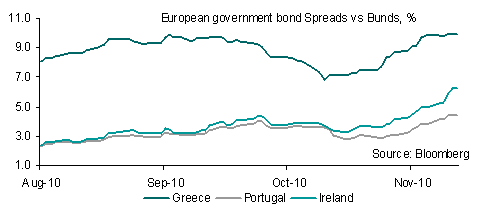
There has been no let up in pressure on eurozone markets and consequently risk aversion continues to increase. The failure of Ireland’s bailout package to stem the haemorrhaging in eurozone bond markets highlights the difficulties in finding in a lasting solution and worsening liquidity conditions in several eurozone bond markets highlights the urgency to act.

Indeed, if spreads continue to widen as they have since late October, by early to mid 2011, Portuguese, Spanish and Italian Euribor spreads would be higher than the EFSF loan spread. In the (admittedly extreme) case that sovereigns could not raise money in the market, peripherals would run out of money early in 2011. Policy makers will try to not let the situation get so out of hand but what can be done to stem the damage?

The European Central Bank (ECB) may be forced to delay its exit strategy by maintaining unlimited liquidity allotments to banks into next year and/or implement further liquidity support measures. The ECB meeting will be closely scrutinized for details, with ECB President Trichet having to adjust policy accordingly. A further option could be for the ECB to step up its bond buying programme which may provide some relief to peripheral eurozone bond markets and the EUR.

Whether this offers a lasting solution however, is debatable. The risk of action by the ECB tomorrow may fuel some caution in the market towards selling the EUR further in the short term and could even prompt some short EUR covering around the meeting which could see EUR/USD regain a sustainable hold above 1.3000 again but this may be temporary, offering better levels to sell.

Meanwhile, speculation of a break up of the eurozone into a core euro and a peripheral euro has intensified given the growing divergence in growth and competitiveness across the region. Such speculation looks far fetched. The eurozone project has been politically driven from the start and over the last 60 years or so internal economic strains have been papered over by politicians. The political will is likely to remain in place even if the divergence in fundamentals across Europe has continued to widen.

Bond market sentiment was not helped by the fact that S&P put Portugal’s ratings on creditwatch negative citing downward economic pressure and concerns over the government’s credit worthiness. Importantly S&P still expects Portugal to remain at investment grade if downgraded. Note that Portugal’s central bank highlighted that the country’s banking sector faced “intolerable” risk unless the government implements planned austerity measures.

In contrast the US story is looking increasingly positive, highlighting that the USD’s strength is not merely a reaction to EUR weakness but more likely inherent and broad improvement in USD sentiment. US consumer confidence, Chicago PMI and the Milwaukee PMI beat forecasts in November, continuing the trend of consensus beating data releases over recent weeks.
Although this does not change the outlook for quantitative easing (QE) as the Fed remains focused on core CPI and the unemployment rate, the data paints an encouraging picture of the economy.

Euro pressure mounts

The effects of eurozone peripheral bond concerns are cascading through eurozone markets and hitting risk appetite in the process. The EUR is a clear casualty having dropped further against the USD and versus other currencies. EUR/Asian FX remains a sell in the current environment. Contagion outside Greece, Portugal and Ireland had been limited but Italy and Spain have also seen a growing impact on their bond markets. Having broke below support around 1.3734, EUR/USD will target 1.3508 support.

Speculation that Ireland will be forced to follow Greece in seeking international financial support has intensified. Although Ireland has sufficient funds to last until next spring, yields on its debt are already higher than Greek debt before it received funds a few months back. Attention is firmly fixed on the country’s budget on 7 December and the prospects of an agreement between the government and opposition in its austerity plans.

Not helping is the fact that the Irish government has a very slim majority. Even if the budget is passed there is no guarantee that sentiment will improve given the negative impact of even deeper fiscal tightening announced last week will have on economic growth. Moreover, Germany’s insistence that the cost of any Greek style bailout should be borne mostly by private investors has only added to market tension. Even the European Central Bank is unlikely to provide much support, with ECB member Stark suggesting that ECB bond purchases will remain limited.

This leaves eurozone markets in a precarious state and the EUR continues to look heavy as further downside opens up. Moreover, the problems in peripheral Europe are beginning to have a broader impact on risk appetite, with equity markets slipping, although some of this was related to a weaker sales forecast from Cisco in the US. Nonetheless, spreading risk aversion could also dampen sentiment for Asian currencies, which is why selling EUR/Asian FX looks a better bet than selling USD/Asian FX over the short term.

In contrast sentiment for the US is undergoing an improvement. Data releases over recent weeks have generally beaten forecasts and there is even growing speculation that the Fed’s calibrated asset purchases may end up being smaller than planned. Such speculation has boosted the USD but it is premature to suggest that the Fed is on the verge of scaling back asset purchases even as the program of purchases gets going. Although there are clearly some FOMC members who are opposed to significant asset purchases the probability that the Fed remains set to carry out its full $600 billion of planned purchases.

Attention today will focus squarely on day 2 of the G20 meeting and any resolution to disputes over trade imbalances and currencies. Unfortunately none is likely to be forthcoming. Despite a reported 80 minute meeting between US and Chinese leaders little agreement was reached, with plenty of finger pointing remaining in place. It appears that the mantra of moving towards “market-determined exchange rates” and efforts at “reducing excessive imbalances” as agreed at the G20 meeting of finance ministers and central bankers will be as far as any agreement reaches. As a result markets will be left with very little to chew on.