No Let Up in USD Pressure

At the end of a momentous week for currency markets it’s worth taking stock of how things stand. Much uncertainty remains about the global growth outlook, especially with regard to the US economy, potential for a double-dip and further Fed quantitative easing. Although there is little chance of QE2 being implemented at next week’s Fed FOMC meeting speculation will likely remain rife until there is clearer direction about the path of the US economy.

In Europe, sovereign debt concerns have eased as reflected in the positive reception to debt auctions this week. Nonetheless, after a strong H1 2010 in terms of eurozone economic growth the outlook over the rest of the year is clouded. Such uncertainty means that markets will also find it difficult to find a clear direction leaving asset markets at the whim of day to day data releases and official comments.

The added element of uncertainty has been provided by Japan following its FX intervention this week. Whilst Japanese officials continue to threaten more intervention this will not only keep the JPY on the back foot but will provide a much needed prop for the USD in general. Indeed Japan’s intervention has had the inadvertent effect of slowing but not quite stopping the decline in the USD, at least for the present.

The fact that Japanese officials continue to threaten more intervention suggests that markets will be wary of selling the USD aggressively in the short term. The headwinds on the USD are likely to persist for sometime however, regardless of intervention by Japan and/or other Asian central banks across Asia, until the uncertainty over the economy and QE2 clears.

Japan’s intervention has not gone down well with the US or European authorities judging by comments made by various officials. In particular, the FX intervention comes at a rather sensitive time just as the US is piling on pressure on China to allow its currency the CNY to strengthen further. Although US Treasury Secretary Geithner didn’t go as far as proposing trade and legal measures in his appearance before Congress yesterday there is plenty of pressure from US lawmakers for the administration to take a more aggressive stance, especially ahead of mid-term Congressional elections in November. Ironically, the pressure has intensified just as China has allowed a more rapid pace of CNY nominal appreciation over recent days although it is still weaker against its basket according to our calculations.

Another country that has seen its central bank intervening over many months is Switzerland, with the SNB having been aggressively intervening to prevent the CHF climbing too rapidly. However, in contrast to Japan the SNB is gradually stepping back from its intervention policy stating yesterday that it would only intervene if the risk of deflation increased. Even so, Japan may have lent the Swiss authorities a hand, with EUR/CHF climbing over recent days following Japan’s intervention.

The move in EUR/CHF accelerated following yesterday’s SNB policy meeting in which the Bank cut its inflation forecasts through 2013, whilst stating that the current policy stance in “appropriate”. Moreover, forecasts of “marked” slowdown in growth over the rest of the year highlight the now slim chance of policy rates rising anytime soon. Markets will eye technical resistance around 1.3459 as a near term target but eventually the CHF will likely resume its appreciation trend, with a move back below EUR/CHF 1.3000 on the cards.
What goes down must go up

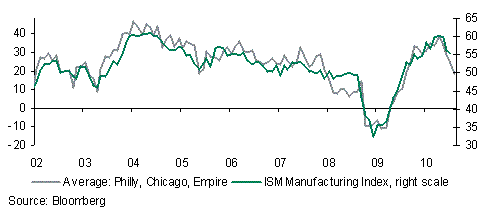
What goes down must go up! A day that began with a stronger than forecast increase in China’s purchasing managers index (PMI) and firm Australian Q2 GDP continued with a surprise jump in the August ISM manufacturing index. The ISM rose to 56.3 from 55.5 in July an outcome that contradicted most of the regional US manufacturing surveys. It was not all positive in terms of data, yesterday however, with a weaker UK manufacturing PMI and unexpected drop in the August US ADP employment report casting a shadow over markets.

Nonetheless, for a change the market decided to act on the good news, with risk assets surging. Despite the improvement in risk appetite it still feels as though the market is grasping for direction. The jump in equities is unlikely to prove durable in an environment characterized by various uncertainties about growth and policy, especially the US.

The next hurdle for markets is the US payrolls data tomorrow. Although the ADP jobs report revealed a surprise 10k decline the employment component of the ISM manufacturing survey strengthened to 60.4, suggesting an improvement in August manufacturing payrolls. Ahead of the payrolls release the US data slate today largely consists of second tier releases including July pending home sales, August chain store sales, weekly jobless claims, and factory orders. It is worth paying particular interest to jobless claims given that the four week moving average has been edging higher, suggesting renewed job market deterioration. The consensus is for a 475k increase in claims, which will still leave the 4-week average at an elevated level.

Given that one of the biggest debates raging through markets at present is whether the Fed will embark on further quantitative easing comments by Fed officials overnight were closely scrutinized for further clues. In the event, Fed Governor Kohn highlighted that the Fed’s reinvestment of the proceeds from mortgage-backed securities will not automatically lead to further QE, suggesting some hesitancy on his part. Meanwhile, Dallas Fed President Fisher noted his reluctance to expand the Fed’s balance sheet until fiscal and regulatory uncertainties are cleared up.

Both sets of comments highlight the difficulty in gaining a consensus within the FOMC for a further increase in QE, suggesting that the hurdle for further balance sheet expansion will be set quite high. Moreover, such comments put the onus on Congress to move quickly in clearing up fiscal policy uncertainties.

As markets flip from risk on to risk off almost on a daily basis the question for today is how sustainable the rally in risk trades will prove to be against the background of so much policy and growth uncertainty. Unfortunately today’s data will provide few clues and markets will turn their attention to tomorrow’s US non-farm payrolls report for further direction. To an extent this suggests that it may be a case of treading water until then. Nonetheless, I still maintain that risk trades remain a sell on rallies over coming weeks

US payrolls clues

Most investors will be glad to see the back of August, a month that marked the biggest monthly decline in US stocks in nine years. The main imponderable is whether September will be any better. A series of manufacturing surveys globally today will do little to restore confidence although there was some good news in a slight increase in China’s official August purchasing managers index (PMI) as well a stronger than forecast increase in Australian Q2 GDP, which will likely provide some short-term relief for risk trades.

There was also some slight solace for markets in terms of US data at least from the point of view that the data was not as disappointing as many recent releases. Although the August Chicago PMI slipped (to 56.7) consumer confidence increased (to 53.5) though admittedly confidence remains at a relatively low level. The job market situation detailed within the consumer confidence report was more pessimistic in August than the previous month, however, with those reporting jobs hard to get moving higher. This sends a negative signal for Friday’s payrolls data.

There will be more clues to Friday’s US jobs report today which will enable any fine tuning of forecasts to take place in the wake of the August ADP employment report and ISM manufacturing survey. Consensus forecasts centre on a 15k increase in private jobs. Despite the slight increase in the Empire manufacturing survey in August, the falls in other manufacturing surveys point to some downside risks to the ISM today, with a simple average of the three pointing to the ISM closer to the 50 mark, which will highlight a loss in US manufacturing momentum.

Manufacturing surveys elsewhere will also be in focus, with the final PMI readings scheduled to be released for the eurozone and UK. There is likely to be confirmation of the slight drop in the eurozone PMI to 55.0 in August while the UK PMI is likely to drop to around 57.0 over the month. Both surveys remain at a relatively high level but it is clear that activity is moderating in H2 2010 from a healthy level in H2. The data will give little support to the EUR but the currency has found a degree of stability over the last couple of days. Nonetheless, a further downward move is in prospect.

The Fed FOMC minutes provided little for markets to get excited about. The minutes noted concerns about large scale asset purchases from some Fed officials, indicating resilience to increasing quantitative easing despite acknowledging increased downside risks to the growth and inflation outlook. It is unclear exactly what will be the trigger for further QE as acknowledged by Fed Chairman Bernanke last week.

The minutes will do little to help market confidence given the hesitancy to pursue further QE and provide further stimulus to the economy but the USD is likely to benefit from the fact that the Fed may not be as eager to expand its balance sheet further. Other currencies that remain beneficiaries in the current risk averse environment are the JPY and CHF. The JPY may find further upside more difficult given ongoing intervention fears but the trend remains for a lower USD/JPY in the coming weeks.

EUR strength is overdone

The latest in a long line of disappointing US data was released on Friday. University of Michigan consumer confidence sent an alarming signal about the propensity of the US consumer to contribute to economic recovery. Confidence dropped much more than expected, to its lowest level since August 2009, fuelling yet more angst about a double-dip in growth.

The Fed’s relatively dovish FOMC minutes last week contributed to the malaise and undermined the USD in the process as attention switched from the timing of exit strategies to whether the Fed will expand quantitative easing. Friday’s benign June CPI report left no doubt that the Fed has plenty of room on its hands, with core inflation remaining below 1% and likely to decelerate further over the coming months. Against this background Fed Chairman Bernanke’s semi-annual testimony to the US Congress (Wed/Thu) will be a particular focus, especially if he hints at potential for further QE, a possibility that appears remote, but could harm the USD.

Arguably the biggest event of the week is the European bank stress test results on Friday. Although several European governments have suggested that the banks in their countries will pass the tests there is still a considerable event risk surrounding the announcement. 91 banks are being tested and much will depend on how rigorous the tests are perceived to be. Should they be seen not to be sufficiently thorough, for instance in determining a realistic haircut on sovereign debt holdings, the potential for pressure on the EUR to increase once again will be high. Similarly debt auctions across Europe this week will also garner interest but similar success to last week’s Spanish auction cannot be guaranteed.

The big question in FX markets is whether the EUR can hold onto its recent gains and whether the USD will be punished further amidst growing double-dip worries. Interestingly the USD’s reaction on Friday to the soft consumer confidence data was not as negative as has been the case recently, with higher risk aversion once again outweighing negative cyclical influences. Various risk currencies actually came under pressure against the USD and this is likely to extend into this week. Despite a threat to the USD from any QE hints by Bernanke, speculative positioning has turned net short USD once again suggesting potential for less USD selling.

The bigger risk this week is to the EUR, which could face pressure on any disappointment from the bank stress test results. The EUR was strong against most major currencies last week, suggesting that the strengthening in EUR/USD is less to do with USD weakness, but more related to EUR strength. This strength in the EUR is hard to tally with the worsening economic outlook in the eurozone and the fact that a stronger EUR from an already overvalued level will crimp eurozone growth further. The latest CFTC IMM data has revealed a further covering of short positions, but this is likely to be close to running its course. Technically EUR/USD has broken above its ‘thick’ Ichimoku cloud, and the weekly MACD is turning above its signal line from oversold levels suggesting a period of further strength but its gains are set to be short-lived.

Double Whammy

Markets were dealt a double whammy resulting in a broad global equity and commodities sell off, and a jump in equity and FX volatility. The risk asset selling began following the news that the Conference Board revised its leading economic indicator for China to reveal a 0.3% gain in April compared to 1.7% increase initially reported earlier.

Given that this indicator has not been a market mover in the past it is difficult to see how it had such a big impact on the market but the fact that the release came at a time when the mood was already downbeat gave a further excuse to sell.

The damage to markets was exacerbated by a much steeper drop than forecast in US consumer confidence, with the index falling to 52.9 in June, almost 10 points lower than the consensus expectation. Consumer confidence remains at a relatively low level in the US, another reason to believe that the US economy will grow at a sub-par pace.

Renewed economic and job market worries were attributable for the fall in confidence, with an in increase in those reporting jobs as “hard to get” supporting the view of a below consensus outcome for June non-farm payrolls on Friday. Further clues will be derived from the June ADP jobs report today for which the consensus is looking for a 60k increase.

A run of weaker than forecast US data releases over recent weeks have resulted in a softening in the Fed’s tone as revealed in the last FOMC statement as well as a fears of a double-dip recession. There will not be any good news today either, with the June Chicago PMI index set to have recorded a slight decline in June, albeit from a high level.

There will also be attention on the release of the US Congressional Budget Office (CBO) 10-year budget outlook, which will put some focus back on burgeoning US fiscal deficit and relative (to Europe) lack of action to rectify it.

European worries remain a key contributor to the market’s angst, with plenty of nervousness about the repayment of EUR 442 billion in 12-month borrowing to the ECB. Demand for 3-month money today will give clues to the extent of funding issues in European banks given that the 12-month cash will not be rolled over.

Elevated risk aversion will keep most risk currencies under pressure, with the likes of the AUD, NZD and CAD also suffering on the back of lower commodity prices. The AUD has failed to gain much traction from a purported deal being offered to miners including various concessions to the mining industry. Much will depend on the reaction of mining companies, and despite the concessions there is importantly no reduction in the 40% rate of the tax.

Equity markets, especially the performance of Chinese stocks will give direction today but a weak performance for Asian equities points to more risk being taken off the table in the European trading session. EUR/USD will now set its sights on a drop to support around 1.2110 ahead of a likely drop towards 1.2045. Having dropped below support around 88.95 USD/JPY will see support coming in around 87.95.

Asian currencies also remain vulnerable to more selling pressure today, with the highly risk sensitive KRW looking most at risk in the short-term, with markets likely to ignore the upbeat economic data released this morning. USD/KRW looks set to target the 11 June high around 1247.80. Other risk sensitive currencies including MYR and IDR also face pressure in the short-term. TWD will be slightly more resilient in the wake of the China/Taiwan trade deal but much of the good news has been priced in, suggesting the currency will not escape the downturn in risk appetite.