The Week Ahead

As last week progressed there was a clear deterioration in sentiment as growth worries crept back into the market psyche. It all started well enough, with a positive reaction to China’s de-pegging of the CNY but the euphoria faded as it became evident that there was still plenty of two-way risk on the CNY. A change in Prime Minister in Australia, which fuelled hopes of a resolution to a controversial mining tax, and an austere budget in the UK, were also key events. However, sentiment took a hit as the Fed sounded more cautious on the US economy in its FOMC statement.

The US Congress finalised a major regulatory reform bill towards the end of the week and markets, especially financial stocks, reacted positively as the bill appeared to give some concessions to banks and was not as severe as feared. However, equity market momentum has clearly faded against the background of renewed growth concerns including sprouting evidence of a double-dip in the US housing market as well as fresh worries about the European banking sector. As if to demonstrate this US Q1 GDP was duly revised lower once again, to a 2.7% annualised rate of growth.

The US Independence Day holiday and World Cup football tournament will likely keep liquidity thin in the run up to month and half year end. However, there is still plenty to digest this week including the all important employment report and consumer confidence data in the US. In Europe economic sentiment gauges, purchasing managers indices and the flash CPI estimate will be in focus. Elsewhere, Japan’s Tankan survey and usual slate of month end Japanese releases, Switzerland’s KoF leading indicator and Australian retail sales will be of interest.

On balance, economic data this week is unlikely to relieve growth concerns, with Eurozone, US and UK consumer and manufacturing confidence indicators likely to post broad based declines due to a host of factors. The data will further indicate a slowing in growth momentum following Q2 2010, with forward looking surveys turning lower, albeit gradually. Whilst a double-dip scenario still seems unlikely there can be no doubt that austerity measures and the waning of fiscal stimulus measures are beginning to weigh on growth prospects even if there is still plenty of optimism for emerging market and particularly Asian growth prospects.

This suggests that Q3 could turn into a period of heightened uncertainty in which equity markets and risk assets will struggle to gain traction. In addition to growth worries, some tensions in money markets remain in place whilst banking sector concerns seem to be coming back to the fore, especially in Europe and these factors will prevent a sustained improvement in risk appetite from taking place over the coming quarter. Some more clarity may come from the results of European stress tests but much will depend on just how stressful the tests are.

In the near term, the main focus of attention will be on the US June jobs report released at the end of the week. Non-farm payrolls are set to record a decline over the month due to a reversal in census hiring, with a consensus expectation of a 110k fall. Private sector hiring is likely to record a positive reading, however, suggesting some improvement in the underlying trend in jobs growth, albeit a very gradual one. Downside risks to consensus suggest plenty of scope for disappointment.

Interestingly, weaker US data of late, has managed to restrain the USD, suggesting that cyclical factors and not just risk aversion are beginning to play into FX movements. Notably the USD was on the back foot against a number of currencies as last week progressed. Even the beleaguered EUR managed to end the week well off its weekly low and close to where it closed the previous week whilst risk currencies such as the AUD and NZD as well as GBP also posted firm performances.

Perhaps some reversal of the optimism towards US recovery prospects give USD bulls some cause for concern, but pressure is likely to prove temporary, especially given that the US economy is still on course to outperform many other major economies. Over the short-term, especially ahead of the US jobs report markets are set to remain cautious with range trading likely to dominate in the week ahead, suggesting that EUR/USD is unlikely to breach the key level of 1.2500. GBP performance has been robust but even this currency is likely to make much headway above GBP/USD 1.5000, where there are likely to be plenty of sellers.
World Cup FX Positioning/Data Highlights

The market tone felt decidedly better over the course of the last week although it was difficult to tell if this was due to position squaring ahead of the World Cup football or a genuine improvement in sentiment. There was no particular event or data release that acted as a catalyst either, with the European Central Bank (ECB) and Bank of England (BoE) meetings passing with little fanfare.

US data ended the week mixed, with retail sales disappointing in May but in contrast June consumer confidence beating expectations. Although questions about the pace of recovery remain, other data such as the Fed’s Beige Book suggest that recovery remains on track, sentiment echoed, albeit cautiously by Fed Chairman Bernanke last week.

Attention this week will centre on inflation data. Expected benign CPI readings will support the view that the Fed will take its time to raise interest rates. Speeches by the Fed’s Bullard, Plosser and Bernanke this week will be eyed for further clues on Fed thinking.

Central banks in Brazil and New Zealand hiked rates last week but this is not likely to be echoed this week. No change is likely from both the Bank of Japan and Swiss National Bank although there will be plenty of attention on the SNB’s comments on the CHF following recent data showing a surge in FX reserves due to currency intervention. The BoJ is unlikely to announce anything new but perhaps some further detail on the loan support plan could be forthcoming.

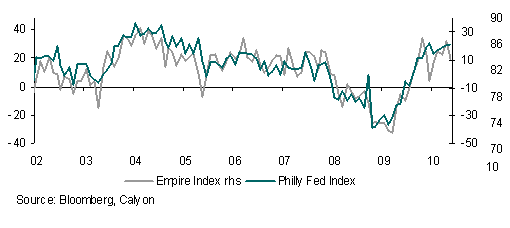
Manufacturing data will also garner some attention, with the US June Empire and Philly Fed surveys and May industrial production on tap. All three reports will confirm the improving trend in manufacturing activity in the US. Housing data will look weaker, with starts set to pull back in starts in May following the expiry of government tax incentive programmes though permits are set to rise.

In Europe, the June German ZEW (econ sentiment) investor sentiment survey will likely slip slightly due to ongoing fiscal/debt worries but this will be countered by stronger domestic data. In any case the index remains at a high level and a slight drop is unlikely to derail markets.

GBP may find some support form upgrade of UK growth forecasts by the CBI to 1.3% for 2010 and relatively hawkish comments from the BoE’s Sentance in the weekend press warning that inflation is higher than expected, indicating that the Bank may need to hike rates sooner than expected.

Further GBP/USD direction will come from CPI and retail sales data this week as well as public borrowing figures and a report by the new Office of Budget Responsibility on the UK’s fiscal position ahead of the June 22 budget. A break above GBP/USD resistance around 1.4760 is unlikely to materialise.

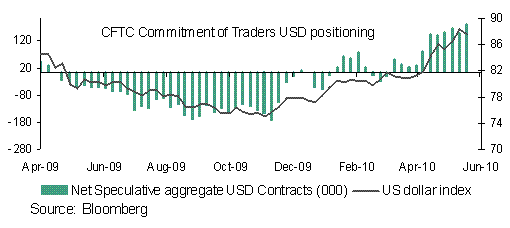
Despite the many data releases this week, the overall tone is likely to be one of consolidation and reduced volatility in the days ahead. This may allow EUR/USD to gain some ground due to short covering, with the CFTC commitment of traders (IMM) report revealing a further increase in net short speculative positions last week, close to the record set a few weeks back, though we suspect that there will be strong resistance around 1.2227.

The fact that the IMM data revealed that net aggregate net USD long positions reached an all time high last week, highlights the potential for profit taking this week. USD/JPY will look to take out resistance around 92.55 but this looks unlikely unless the BoJ dishes up anything particularly dovish from its meeting.

Some Respite For The Euro

Following several days in which confidence in Greece’s ability to weather the storm was deteriorating, news that Greece asked for EU/IMF help helped to boost global markets and the EUR.  Meanwhile strengthening economic and earnings news helped to provide an undercurrent of support for markets, which boosted the end week rally in risk appetite.  

A 27% jump in US new home sales in March, a firm durable goods orders report as well better than expected earnings, with around 80% of companies reporting first quarter earnings beating expectations, highlight that US economic recovery is becoming increasingly well entrenched.  This is likely to be confirmed by the release of US Q1 GDP this week, set to register over 3% annualised quarterly growth.  

In Europe the picture is far more divergent, with exporting countries such as Germany doing well as evidenced from surveys such as the IFO and ZEW surveys, but in contrast the club med countries are not doing so well.  The highlights of the data calendar this week are April confidence indicators and the flash reading of Eurozone CPI.  Confidence indicators are likely to reveal some improvement, but despite Friday’s EUR/USD bounce, the data will be insufficient to prevent EUR/USD continue to move lower, with 1.3150 still a firm target over coming weeks.  

The official request for aid from Greece from the EU/IMF begins a new chapter in the long running saga for the country.  Greece will officially detail the amount of aid needed in a letter to the European Commission and European Central Bank who will then decide whether to approve it.  

A few dates to note are the maturing of EUR 8.5 billion in bonds on May 19, the completion of discussion with the IMF, EU and ECB on May 6 and state elections in Germany on May 9, which could throw a spanner in any financial support from Germany for Greece.   Meanwhile Greek unions are threatening further strikes to protest against austerity measures that Greece needs to carry out to win any aid package.   

Aside from Greece, attention will continue to be focussed on earnings but the main event of the week will be the Fed FOMC meeting on 27/28 April. Whilst a no change outcome is highly likely, with interest rates set to be left at between 0-0.25%, there will be plenty of attention on whether the Fed removes the comment that policy rates will remain low for an “extended period”. If the comment is removed the statement will be taken in somewhat of a hawkish context, which would boost the USD.

Greece In The Spotlight (again)

Once again Greek worries are hogging the limelight and although the Greek saga has become a rather tedious affair for markets, concerns are well founded.  The latest issue is whether Greece is willing to adhere to potentially tough measures that would be associated with IMF assistance for the country.  Latest speculation suggests that Greece may side step the IMF to avoid such measures though this was belatedly denied by the Greek authorities. 

Given the huge amount of bonds Greece needs to sell over the coming weeks renewed nervousness does not bode well for a good reception to this issuance. As it is financing costs are rising once again in the wake of a renewed widening in Greek sovereign bond spreads and servicing this debt will add to the economic misery.  Greece has little by way of upside over coming months and years.  Tough and necessary austerity measures mean that sharp growth deterioration is inevitable, deepening recession.

The lack of flexibility for Greece to devalue its way out of its quagmire means much more economic pain with no release valve.   The same applies to the likes of Spain and Portugal.  The overall loser will be the EUR which looks likely to succumb to further weakness in the months ahead; the parity trade remains a prospect. Perversely a weaker EUR may be exactly what is necessary to alleviate some of the pain for Southern European economies though the EUR would need to weaken by much more than we forecast to be of much help.   

Aside from Greek gyrations the overall market tone looks somewhat positive.  The Fed’s dovish minutes of its March 16 meeting in which it marginally downgraded growth and inflation forecasts, highlights that interest rates are unlikely to be raised by the Fed this year. This will keep in place an accommodative policy stance conducive to further improvements in risk appetite.     Moreover, data releases such as the US ISM manufacturing and non-manufacturing surveys, have been generally supportive to recovery,

Easing tensions on China/US exchange rate policy have also helped sentiment as the issue has been put to one side after the US administration delayed the decision whether to officially label China as a currency manipulator.  Pressure from the US Congress suggests that the issue will not be on the back burner for long and the issue of CNY revaluation will likely be a topic at the during the various meetings between US and Chinese officials over coming weeks. 

Nonetheless, the delay in the US Treasury report will work in favour of a Chinese currency revaluation sooner rather than later as China will likely react more favourable to less international pressure to revalue.

What To Watch This Week

A “crisis over” mode is being adopted across markets as worries about Greece wane and economic data provides support to recovery hopes, whilst importantly allaying fears of a “double-dip”. Equities, bonds and currencies are reacting accordingly; equities are close to year highs, bond yields have risen and spreads have narrowed, whilst the USD and JPY are weaker, and conversely risk currencies are stronger. Even EUR/USD pushed higher on its way to 1.3800 as a number of stops were cleared and shorts were squeezed.

The coming weeks will be important to determine whether there is any staying power in the upward move in risk assets. A lot of the February data in the US will likely be obscured by bad weather however, including industrial production figures this week, leaving markets with little to go on. In Europe, the key release is the March German ZEW investor confidence survey, and better news in Greece, will likely prevent a sharper decline in confidence.

After both the Swish National Bank (SNB) and Reserve Bank of New Zealand (RBNZ) unsurprisingly left policy unchanged last week this week sees the turn of the US Federal Reserve and Bank of Japan (BoJ). Neither central bank is likely to shift policy but the Fed statement will be looked upon for guidance on the timing of rate hikes. The comment in the FOMC statement that the Fed Funds rate is expected to remain low for an “extended period” is set to be retained, even if some FOMC members are itching to remove it soon.

The BoJ meeting will be particularly interesting. I have just returned from a week long trip in Japan and on the ground there is plenty of speculation that the BoJ will take extra action to combat deflation and weaken the JPY. Additionally comments by Japan’s Prime Minister and Deputy PM have highlighted the potential for action to weaken the JPY although the usual market hesitation to sell JPY into fiscal year end and repatriation talk may mean a weaker JPY path is not straightforward.

Greece will not move too far from the spotlight, with EU officials likely to give the official stamp of approval on Greece’s deficit cutting measures and plenty of discussion at the Eurogroup Finance Minister’s meeting and Ecofin meeting early in the week. Moreover, weekend press reports suggest that a bailout up to EUR 25 billion is close to being agreed. Other topics of conversation will include the possible formation of a European Monetary Fund, though this looks like it will be a non-starter given the many objections to it.

Overall, risk appetite is set to continue its upward trajectory, likely keeping the USD on the back foot. Some deterioration in USD sentiment was reflected in the fact that net long aggregate USD speculation positioning has turned negative again according to the latest CFTC Commitment of Traders (IMM) report. Much in terms of FX direction will depend on what the FOMC says rather than does tomorrow.

EUR/USD may take a crack at resistance around 1.3840 on improving Greek news but it is difficult to see much upside from current levels. The one to watch will be the JPY, especially if the BoJ embarks on aggressive actions at this week’s meeting, leaving USD/JPY plenty of scope to test resistance around 92.16.