Double Whammy

Markets were dealt a double whammy resulting in a broad global equity and commodities sell off, and a jump in equity and FX volatility. The risk asset selling began following the news that the Conference Board revised its leading economic indicator for China to reveal a 0.3% gain in April compared to 1.7% increase initially reported earlier.

Given that this indicator has not been a market mover in the past it is difficult to see how it had such a big impact on the market but the fact that the release came at a time when the mood was already downbeat gave a further excuse to sell.

The damage to markets was exacerbated by a much steeper drop than forecast in US consumer confidence, with the index falling to 52.9 in June, almost 10 points lower than the consensus expectation. Consumer confidence remains at a relatively low level in the US, another reason to believe that the US economy will grow at a sub-par pace.

Renewed economic and job market worries were attributable for the fall in confidence, with an in increase in those reporting jobs as “hard to get” supporting the view of a below consensus outcome for June non-farm payrolls on Friday. Further clues will be derived from the June ADP jobs report today for which the consensus is looking for a 60k increase.

A run of weaker than forecast US data releases over recent weeks have resulted in a softening in the Fed’s tone as revealed in the last FOMC statement as well as a fears of a double-dip recession. There will not be any good news today either, with the June Chicago PMI index set to have recorded a slight decline in June, albeit from a high level.

There will also be attention on the release of the US Congressional Budget Office (CBO) 10-year budget outlook, which will put some focus back on burgeoning US fiscal deficit and relative (to Europe) lack of action to rectify it.

European worries remain a key contributor to the market’s angst, with plenty of nervousness about the repayment of EUR 442 billion in 12-month borrowing to the ECB. Demand for 3-month money today will give clues to the extent of funding issues in European banks given that the 12-month cash will not be rolled over.

Elevated risk aversion will keep most risk currencies under pressure, with the likes of the AUD, NZD and CAD also suffering on the back of lower commodity prices. The AUD has failed to gain much traction from a purported deal being offered to miners including various concessions to the mining industry. Much will depend on the reaction of mining companies, and despite the concessions there is importantly no reduction in the 40% rate of the tax.

Equity markets, especially the performance of Chinese stocks will give direction today but a weak performance for Asian equities points to more risk being taken off the table in the European trading session. EUR/USD will now set its sights on a drop to support around 1.2110 ahead of a likely drop towards 1.2045. Having dropped below support around 88.95 USD/JPY will see support coming in around 87.95.

Asian currencies also remain vulnerable to more selling pressure today, with the highly risk sensitive KRW looking most at risk in the short-term, with markets likely to ignore the upbeat economic data released this morning. USD/KRW looks set to target the 11 June high around 1247.80. Other risk sensitive currencies including MYR and IDR also face pressure in the short-term. TWD will be slightly more resilient in the wake of the China/Taiwan trade deal but much of the good news has been priced in, suggesting the currency will not escape the downturn in risk appetite.
Risk Appetite Puts Dollar On The Back Foot

Markets look somewhat calmer going into this week helped by comments by Fed members who noted that the discount rate hike did not signal a shift in monetary policy, something which is likely to be repeated by Fed Chairman Bernanke in his testimony to Congress on Wednesday and Thursday.  A tame US January CPI report last Friday helped too, giving further support to the view that the Fed will not hike the Fed Funds rate for some time yet; a rate hike this year seems highly unlikely in my view.  

Data this week will be conducive to a further improvement in risk appetite and despite the lingering concerns about Greece the EUR may find itself in a position to extend gains.  In Europe all eyes will be on the February German IFO survey and eurozone sentiment indicators, which following the surprising strength in the manufacturing Purchasing Managers Indices (PMIs), are likely to reveal solid gains. 

The main highlights in Japan this week includes January trade data and industrial production. The trade numbers will be particularly important to determine whether the rebound in exports due in large part to robust Asian demand, has continued whilst the bounce back in exports will be a key factor in fuelling a further gain in industrial output. 

In the US aside from the testimonies by Fed Chairman Bernanke there are plenty of releases on tap including consumer confidence, new and existing home sales, durable goods orders and a likely upward revision to Q4 GDP.  For the most part the data will show improvement and play for a further improvement in risk appetite. 

FX direction will depend on whether markets focus on the potentially positive USD impact of a reduction in USD liquidity or on the likely firmer tone to risk appetite this week.  Given expectations of firmer data and the soothing tone of the Fed, risk currencies will likely perform better, with crosses such as AUD/JPY favoured.  The USD will likely be placed on the back foot, especially given the very long market positioning in the currency.

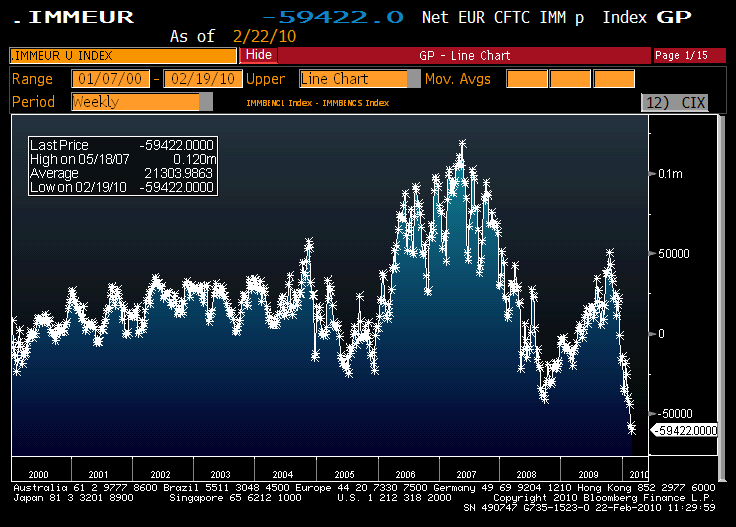
The EUR will be helped by the fact that speculative market, according to the CFTC IMM data, holds record short positions in the EUR (as of the week ended 16 February) giving plenty of potential for short-covering.   The more timely Tokyo Financial Exchange (TFX) data also reveals that positioning in EUR/JPY has continued to be scaled back.  

CFTC Commitment of Traders (IMM) data – Net EUR speculative positioning

EUR/USD bounced smartly from its lows around 1.3444 on Friday, partly reflecting some short covering and the drop in FX volatility suggests the market is more comfortable with EUR/USD around these levels.  A positive IFO survey and improved risk appetite could see EUR/USD test resistance around 1.3774, its 20 day moving average, over coming days.  Ongoing Greek concerns suggest that any EUR bounce will be limited, however. 

USD/JPY looks well supported and although data this week will suggest that exports are improving despite JPY strength, the relatively more aggressive stance of the Fed compared to the BoJ, long JPY positioning, and improved risk appetite, give plenty of scope for the JPY to extend losses, with technical USD/JPY support seen around 91.28.

What To Watch This Week

As usual the G7 meeting will leave markets with little to chew on. G7 officials maintained their commitment to stimulus measures and timely exit strategies but there was little of note for FX markets aside from the usual comments about wanting to avoid excess FX volatility. There was certainly know step up in pressure on China to strengthen though a report prepared for the meeting did push for countries with inflexible currencies to make adjustments. Meanwhile US officials mouthed the usual “strong dollar” mantra.

Where does this leave markets this week? Well I must admit my bullish view on risk currencies is clearly suffering after a positive start to the year. The pullback in high beta currencies (those with the highest sensitivity to risk aversion) has been dramatic. I have highlighted many of the factors weighing on sentiment in previous posts and whilst I still think the US dollar will find itself under renewed pressure over coming months the current environment remains conducive to more USD and JPY buying and selling of currencies such as the AUD, NZD, CAD, GBP, NOK, SEK, ZAR etc.

Ironically the US and Japan have arguably more severe deficit/debt concerns than some of the European countries under pressure but as most of Japan’s debt is held domestically there is little worry of a collapse in JGBs. Unlike Japan foreign investors hold over half of US debt but are not yet losing confidence with US Treasuries though this may not last unless there is some tangible sign that the burgeoning US budget deficit is being reduced. For now, attention remains firmly focussed on Greece, Spain, Portugal and to a lesser extent Italy.

Like the G7 meeting the US January jobs report released at the end of last week will give little direction for markets. Although the 20k drop in payrolls and revisions to past months were slightly disappointing the surprise drop in the unemployment rate was better news. This week’s data highlights include the January US retail sales report and December trade balance. The sales data is likely to help allay some concerns about faltering economic recovery, with retail sales forecast to rise over the month despite a likely pull back in autos spending.

How will this play out for currencies this week? Overall, the risk off tone is set to continue though the moves are looking increasingly stretched. The USD, JPY and CHF will remain on the front foot whilst risk currencies will remain under pressure. The EUR is set to continue to struggle against the background of eurozone deficit concerns and after its dive through 1.40 last week 1.35 now looms large. Meanwhile, the AUD may also struggle following the recent reassessment of interest rate expectations after the recent Reserve Bank of Australia (RBA) meeting in which interest rates were left unchanged.

UK markets will focus on the Quarterly Inflation Report from the Bank of England though the political situation may hold some interesting implications for GBP if polls continue to show that the gap between the governing Labour party and Conservative opposition continues to narrow. Prospects of a hung parliament will hardly hold any positive implications for GBP, a prospect which could limit any potential for GBP to recover ahead of May elections. The drop below 1.60 for Cable (GBP/USD) could extend further, especially as the BoE has kept the door open to further asset purchases if needed.

EUR/USD takes a crack at 1.50, where now?

It seemed inevitable and finally after flirting with the 1.50 level, EUR/USD managed to break through although there seems to be little momentum in the move, with the currency pair dipping back below 1.50 in the Asian trading session. Contrary to expectations the break above 1.50 did not lead to a sharp stop loss driven move higher. 

Even the break through 1.50 only provoked a limited reaction in the FX options market where implied EUR/USD volatility only moved slightly higher. In fact despite the warnings by ECB President Trichet about “excessive currency volatility” FX options volatility for most currency pairs has been on a downward trajectory over the past few months, implying that the move in EUR/USD and the USD itself has been quite orderly. 

Trichet’s warning is more likely a veiled threat on the level of EUR/USD rather than its volatility, unless of course the ECB chief is seeing something that the FX options market is not. Assuming that EUR/USD closes above 1.50 this week it technically has plenty of open ground on the run up to the record high of 1.6038 hit in July 2008 but there will also be plenty of official resistance to limit its appreciation. Such resistance is limited to rhetoric but it will not be long before markets begin discussing the prospects of actual FX intervention.  

Perhaps the reason that EUR/USD did not move sharply higher following the break of 1.50 was the late sell off in US stocks on Wednesday which helped to fuel some USD short covering.  The USD index is holding just above the 75.00 level but it’s not a big stretch from here to move down to the March 2008 low around 70.698, with the overall tone of broad USD weakness remaining intact and ongoing. 

GBP was helped by relief that the minutes of the BoE meeting showed no inclination to increase the level of quantitative easing despite the ongoing debate within the MPC.   The minutes even sounded slightly upbeat about economic prospects. GBP/USD hit a high of 1.6638 in the wake of these developments due in large part to more short covering whilst EUR/GBP briefly dipped below 0.90.  GBP/USD may find it tough going to make much headway above 1.66 as has been the case over recent months, with strong resistance seen around 1.6661.

Talking about currencies

It’s always the same story.  Ahead of the G7 (or G8 and now more important G20) meetings speculation of decisive action on currencies intensifies.  Traders and investors become cautious on the off chance that something significant will happen but the majority of times nothing of note emerges.

There was no difference this time around.  The G7 Finance Ministers meeting in Istanbul failed to deliver anything substantive on currencies, repeating the usual mantra about the adverse impact of “excess volatility and disorderly movements”.  Although the group pledged to monitor FX markets there was no indication of imminent action. 

The lack of action is perhaps surprising in one respect as there were plenty of central bankers and finance officials talking about currencies in the run up to the G7 meeting, most of which were attempting to talk the dollar higher against their respective currencies.  Given the increase in rhetoric ahead of the meeting, the relatively weak statement now leaves the door open to further dollar weakness.

The strongest indication of any FX action or intervention came from the country that was supposedly the least concerned about currency strength; Japanese Finance Minister Fujii warned that Japan “will take action” if “currencies show some excessive moves”.  The shift in stance from Japan since the new government took power has been stark (considering that the new government was supposedly in favour of a stronger yen).  Markets will likely continue to test the resolve of the Japanese authorities and buy yen anyway.

Although the G7 statement said little to support the dollar and the overall tone to the dollar likely remains negative over coming months, the softer tone to equity markets and run of weaker economic data in the US – the latest data to disappoint was the September US jobs report – may give some risk aversion related relief to the dollar this week. 

Weaker data and equities alongside the impact of official rhetoric is being reflected in CFTC Commitment of Traders’ data (a good gauge of speculative market positioning) which revealed a sharp drop in short dollar positions, by around a quarter, highlighting for a change, an improvement in dollar sentiment over the last week. 

The biggest losers in terms of speculative positioning were the British pound, where the net short position reached its most extreme since mid September 2008, and Canadian dollar where the net long position was cut by almost half.  Again this may reflect official views on currencies, with Canadian officials expressing concern about the strength of the Canadian dollar in contrast to the perception that UK officials favour a weaker pound.
Central bank meetings (BoE, ECB, RBA) will dominate the calendar this week and more comments on currencies are likely even if interest rates are left unchanged.  Meanwhile FX markets will continue to watch equities, and the start of the US Q3 earnings season will give important signals to determine the sustainability of the recent equity market rally.  Recent weak economic data has already cast doubt about a speedy recovery and if earnings disappoint risk aversion could once again be back on the table.