Drastic Action Needed

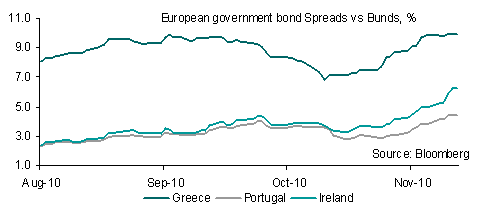
There has been no let up in pressure on eurozone markets and consequently risk aversion continues to increase. The failure of Ireland’s bailout package to stem the haemorrhaging in eurozone bond markets highlights the difficulties in finding in a lasting solution and worsening liquidity conditions in several eurozone bond markets highlights the urgency to act.

Indeed, if spreads continue to widen as they have since late October, by early to mid 2011, Portuguese, Spanish and Italian Euribor spreads would be higher than the EFSF loan spread. In the (admittedly extreme) case that sovereigns could not raise money in the market, peripherals would run out of money early in 2011. Policy makers will try to not let the situation get so out of hand but what can be done to stem the damage?

The European Central Bank (ECB) may be forced to delay its exit strategy by maintaining unlimited liquidity allotments to banks into next year and/or implement further liquidity support measures. The ECB meeting will be closely scrutinized for details, with ECB President Trichet having to adjust policy accordingly. A further option could be for the ECB to step up its bond buying programme which may provide some relief to peripheral eurozone bond markets and the EUR.

Whether this offers a lasting solution however, is debatable. The risk of action by the ECB tomorrow may fuel some caution in the market towards selling the EUR further in the short term and could even prompt some short EUR covering around the meeting which could see EUR/USD regain a sustainable hold above 1.3000 again but this may be temporary, offering better levels to sell.

Meanwhile, speculation of a break up of the eurozone into a core euro and a peripheral euro has intensified given the growing divergence in growth and competitiveness across the region. Such speculation looks far fetched. The eurozone project has been politically driven from the start and over the last 60 years or so internal economic strains have been papered over by politicians. The political will is likely to remain in place even if the divergence in fundamentals across Europe has continued to widen.

Bond market sentiment was not helped by the fact that S&P put Portugal’s ratings on creditwatch negative citing downward economic pressure and concerns over the government’s credit worthiness. Importantly S&P still expects Portugal to remain at investment grade if downgraded. Note that Portugal’s central bank highlighted that the country’s banking sector faced “intolerable” risk unless the government implements planned austerity measures.

In contrast the US story is looking increasingly positive, highlighting that the USD’s strength is not merely a reaction to EUR weakness but more likely inherent and broad improvement in USD sentiment. US consumer confidence, Chicago PMI and the Milwaukee PMI beat forecasts in November, continuing the trend of consensus beating data releases over recent weeks.
Although this does not change the outlook for quantitative easing (QE) as the Fed remains focused on core CPI and the unemployment rate, the data paints an encouraging picture of the economy.
Euro pressure mounts

The effects of eurozone peripheral bond concerns are cascading through eurozone markets and hitting risk appetite in the process. The EUR is a clear casualty having dropped further against the USD and versus other currencies. EUR/Asian FX remains a sell in the current environment. Contagion outside Greece, Portugal and Ireland had been limited but Italy and Spain have also seen a growing impact on their bond markets. Having broke below support around 1.3734, EUR/USD will target 1.3508 support.

Speculation that Ireland will be forced to follow Greece in seeking international financial support has intensified. Although Ireland has sufficient funds to last until next spring, yields on its debt are already higher than Greek debt before it received funds a few months back. Attention is firmly fixed on the country’s budget on 7 December and the prospects of an agreement between the government and opposition in its austerity plans.

Not helping is the fact that the Irish government has a very slim majority. Even if the budget is passed there is no guarantee that sentiment will improve given the negative impact of even deeper fiscal tightening announced last week will have on economic growth. Moreover, Germany’s insistence that the cost of any Greek style bailout should be borne mostly by private investors has only added to market tension. Even the European Central Bank is unlikely to provide much support, with ECB member Stark suggesting that ECB bond purchases will remain limited.

This leaves eurozone markets in a precarious state and the EUR continues to look heavy as further downside opens up. Moreover, the problems in peripheral Europe are beginning to have a broader impact on risk appetite, with equity markets slipping, although some of this was related to a weaker sales forecast from Cisco in the US. Nonetheless, spreading risk aversion could also dampen sentiment for Asian currencies, which is why selling EUR/Asian FX looks a better bet than selling USD/Asian FX over the short term.

In contrast sentiment for the US is undergoing an improvement. Data releases over recent weeks have generally beaten forecasts and there is even growing speculation that the Fed’s calibrated asset purchases may end up being smaller than planned. Such speculation has boosted the USD but it is premature to suggest that the Fed is on the verge of scaling back asset purchases even as the program of purchases gets going. Although there are clearly some FOMC members who are opposed to significant asset purchases the probability that the Fed remains set to carry out its full $600 billion of planned purchases.

Attention today will focus squarely on day 2 of the G20 meeting and any resolution to disputes over trade imbalances and currencies. Unfortunately none is likely to be forthcoming. Despite a reported 80 minute meeting between US and Chinese leaders little agreement was reached, with plenty of finger pointing remaining in place. It appears that the mantra of moving towards “market-determined exchange rates” and efforts at “reducing excessive imbalances” as agreed at the G20 meeting of finance ministers and central bankers will be as far as any agreement reaches. As a result markets will be left with very little to chew on.

What QE2 means for currencies

The sweeping gains for the Republican party in the US mid term elections has sharply changed the political dynamic in the US, with the prospects of further fiscal stimulus looking even slimmer than before although the chances of the Bush tax cuts being extended have likely increased.

The onus is on monetary policy to do the heavy lifting and the Fed delivered on its end of the bargain, with the announcement of $600 billion of purchases of long-term securities over 8-months through June 2011.

Given the likelihood that the economic impact of the asset purchases is likely to be limited and with little help on the fiscal front the Fed has got a major job on its hands and $600 billion may end up being a minimum amount of purchases necessary for the Fed to fulfil its mandate.

The decline in the USD following the Fed decision is unlikely to mark the beginning of a more rapid pace of USD decline though further weakness over coming months remains likely. The USD remains a sell on rallies for now and an overshoot on the downside is highly probable as the Fed begins its asset purchases.

The bottom line is that the Fed’s program of asset purchases implies more USD supply and in simple economic terms more supply without an increase in demand implies a lower price. The USD will remain weak for some months to come and the Fed’s actions will prevent any USD recovery as the USD solidifies its position as the ultimate funding currency.

Nonetheless, with market positioning close to extreme levels, US bond yields unlikely to drop much further, and the USD already having sold off sharply in anticipation of QE2, (USD index has dropped by around 14% since June) those looking for a further sharp drop in the USD to be sustained are likely to be disappointed.

It is difficult however, to fight the likely further weakness in the USD even if turns out not to be a rapid decline. The path of least resistance to some likely USD weakness will be via the likes of the commodity currencies, scandies and emerging market currencies. There will be less marked appreciation in GBP, CHF and JPY against the USD.

The Fed’s actions will continue to fuel a rush of liquidity into emerging markets, particularly into Asia. This means more upward pressure on Asian currencies but will likely prompt a variety of responses including stronger FX intervention as well as measures to restrict and control such flows.

There have been various comments from central banks in the region warning about the Fed’s actions prompting further “hot money” flows into the region and even talk of a coordinated response to combat such flows.

This suggests more tensions ahead of the upcoming G20 meeting in Seoul. Assuming that at least some part of the additional USD liquidity flows into Asia, the implications of potentially greater FX intervention by Asian central banks to prevent Asian currencies from strengthening, will have a significant impact on major currencies.

Already it is apparent that central banks in Asia have been strongly using the accumulated USDs from FX intervention to diversify into EUR and other currencies including AUD and even JPY. Perversely this could end up exacerbating USD weakness against major currencies.

The loss of a great forecaster

Forecasters around the world will mourn the loss of one of their finest following the death of Paul the Octopus at the age of 2 ½ (apparently an average age for Octopi). Although Paul had various threats to his life and insults to his mother’s honour he passed away from natural causes. Many forecasters envious of Paul’s record will look now a successor being groomed to take his place. Markets could do with Paul’s abilities in trying to ascertain the magnitude of Fed quantitative easing (QE) to be announced on 3 November. Conflicting comments from the Fed’s Hoenig (hawkish) and Dudley (dovish) yesterday will keep the market’s guessing.

Interestingly US bond yields are backing up and although yields elsewhere are also rising US yields are beginning to move relatively higher. The FX impact is evident in the growing resilience of the USD. Major Currencies with the highest correlations with bond yield differentials are EUR/USD, AUD/USD, EUR/CAD and USD/CHF although USD/JPY correlations have also been pushing higher. These currencies will ultimately suffer the most if US yields back up further.

Part of the reason for the shift higher in US bond yields is growing speculation that the Fed will take a more measured approach to asset purchases whilst recent data, particularly in the US housing market is showing some stabilisation as revealed in existing home sales data on Monday and a surprise gain in the August US FHFA home price index overnight. September new homes sales will be closely watched today to determine whether this stability is becoming broader based.

US consumer confidence continued this pattern, with the Conference Board index rising to 50.2 in October. Perhaps more interesting was the outcome of the US 5-year TIPS auction at a negative yield (-0.55%). The increased demand for inflation protection hints at QE2 working even before it has been carried out but there is a long way to go on this road and it would be premature to read too much into the auction outcome.

It’s worth noting that UK bond yields bucked the trend versus US bond yields following the release of stronger than expected UK GDP. The data alongside persistently above target inflation will likely dampen expectations that the Bank of England (BoE) will follow the path of the Fed into more QE. Consequently GBP has been a key outperformer. EUR/GBP in particular underwent a sharp reversal and technically the currency pair is showing a negative divergence from the 9-day RSI and the MACD is turning lower from overbought levels. The cross needs to drop below 0.8696 to confirm the technical signals.

Closer to home Australian CPI data this morning played into the hands of those looking for the Reserve Bank of Australia (RBA) to remain on hold next week. Although CPI was slightly softer than expected at 0.6% QoQ in Q3, the AUD took the news badly. The RBA has kept the cash rate on hold at 4.5% since May and at the last meeting there was little indication of an urgency to hike. Nonetheless, recent data plays towards a rate hike next week though the outcome is now a much closer call

G20 Leaves The US Dollar Under Pressure

The G20 meeting of Finance Ministers and Central bankers failed to establish any agreement on clear targets or guidelines. Perhaps the problem of trying to achieve consensus amongst a variety of sometimes conflicting views always pointed to an outcome of watered down compromise but in the event the G20 summit appears to pass the buck to November’s summit of G20 leaders in Seoul where more concrete targets may be outlined.

Officials pledged to “move towards more market determined exchange rate systems” and to “refrain from competitive devaluation of currencies”. What does this actually mean? The answer is not a great deal in terms of practical implications. The first part of the statement is the usual mantra from such meetings and the addition of the latter part will do little to stop central banks, especially in Asia from continuing to intervene given that no central bank is actually devaluing their currency but rather preventing their currencies from strengthening too rapidly.

The communiqué highlighted the need for advanced economies being “vigilant against excess volatility and disorderly movements in exchange rates”, but once again this is the mantra found in the repertoire of central bankers over past years and is unlikely to have the desired effect of reducing the “excessive volatility in capital flows facing some emerging countries”. In other words many emerging countries will continue to have an open door to impose limited restrictions on “hot money” flows.

Although the language on currencies was stronger than in previous summits it arguably changes very little in terms of the behaviour of central banks and governments with respect to currencies. The communiqué is wide open to varying interpretations by countries and is unlikely to prevent the ongoing trend of USD depreciation and emerging market country FX appreciation and interventions from continuing over coming weeks.

The onus has clearly shifted to the November summit of G20 leaders but once again it seems unlikely that substantial agreements will be found. In the interim the November 3 Fed FOMC meeting will be the next major focus and if the Fed embarks on renewed asset purchases as widely expected FX tensions will remain in place for some time yet.

So whilst a “currency war” was always unlikely “skirmishes” will continue. In the meantime the USD is set to remain under pressure although it’s worth noting that speculative positioning has recorded a reduction in net aggregate USD short positions over the last couple of weeks, suggesting that some of the USD selling pressure may have abated. Whether this reflected caution ahead of the G20 meeting (as the data predates the G20 meeting) or indicated the USD having priced in a lot of quantitative easing (QE2) expectations already, is debatable.

The path of least resistance to USD weakness remains via major currencies including AUD, CAD and NZD. Officials in Europe are also showing little resistance to EUR strength despite the premature tightening in financial conditions and negative impact on growth that it entails. Scandinavian currencies such as SEK and NOK have also posted strong gains against the USD and will likely continue to show further outperformance.

The JPY has been the best performing major currency this year followed not far behind by the CHF despite the FX interventions of the authorities in Japan and Switzerland. Although USD/JPY is fast approaching the 80.00 line in the sand level expected to result in fresh FX intervention by the Japanese authorities, the path of the JPY remains upwards. Japan is unlikely to go away from the G20 meeting with any change in policy path as indicated by officials following the weekend deliberations.