Follow The Oracle

Many investors are probably wishing they had the psychic abilities of Paul the octopus. The mollusc once again gave the correct prediction, by picking Spain to beat the Netherlands to become the winner of the World Cup. This ability would have been particularly useful for currency forecasters, many of which have been wrong footed by the move higher in EUR/USD over recent weeks.

Confidence appeared to return to markets over the past week helped by a string of rate hikes in Asia from India, South Korea and Malaysia, and firm data including yet another consensus beating jobs report in Australia. An upward revision to global growth forecasts by the International Monetary Fund (IMF) also helped, with the net result being an easing in double-dip growth concerns.

The good news culminated in a much stronger than forecast June trade surplus in China. However, China’s trade numbers will likely keep the pressure on for further CNY appreciation, and notably US Senators are still pushing ahead with legislation on China’s FX policy despite the US Treasury decision not to name China as a currency manipulator.

Political uncertainty on the rise again in Japan following the loss of control of the upper house of parliament by the ruling DPJ party. The JPY has taken a softer tone following the election and will likely remain under pressure. CFTC IMM speculative JPY positioning has increased but this has been met with significant selling interest by Japanese margin accounts who hold their biggest net long USD/JPY position since October 2009 according to Tokyo Financial Exchange (TFX) data.

In the absence of the prodigious abilities of an “oracle octopus” data and events this week will continue to show slowing momentum in G3 country growth indicators but not enough to warrant renewed double-dip concerns. Direction will be largely driven by US Q2 earnings. S&P 500 company earnings are expected to have increased 27% from a year ago according to Thomson Reuters.

There are several data releases of interest in the US this week but the main release is the retail sales report for June which is likely to record another drop over the month. Data and events in Europe include the Eurogroup finance ministers meeting, with markets looking for further insight into bank stress tests across the region. Early indications are positive but the scope of the tests remains the main concern. The July German ZEW survey will garner some interest and is likely to show a further slight decline in economic sentiment.

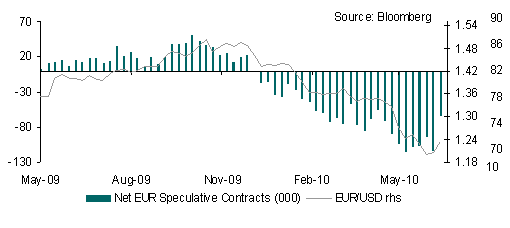
EUR/USD gains looked increasingly stretched towards the end of last week, as it slipped back from a high of around 1.2722. Technical resistance around 1.2740 will prove to be tough level to crack over coming days, with a pullback to support around 1.2479 more likely. CFTC IMM data reveals that short covering in EUR has been particularly sharp in the last week, with net short positions cut by over half, highlighting that the scope for further short covering is becoming more limited.

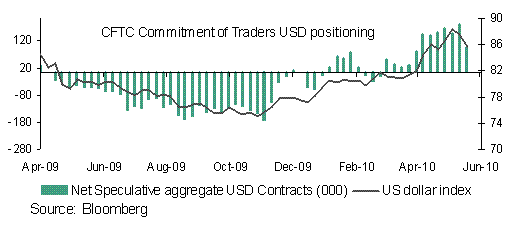
Conversely aggregate net USD long positions have fallen by over half in the last week as USD sentiment has soured, with longs at close to a three-month low. The scope for a further reduction in USD positioning is less significant, suggesting that selling pressure may abate.
China’s gradual renminbi move

China’s decision to “proceed further with reform” of the CNY exchange rate regime will dictate market activity at the turn of the week. The decision to act now reflects the fact that China is no longer in crisis mode policy. Although the eurozone sovereign crisis may have delayed China’s move, the authorities in China clearly felt that conditions had improved sufficiently enough to act. The decision will pre-empt some of the criticism that China would have faced at the G20 meeting next weekend, leaving attention firmly on Europe.

Before we all get too excited it should be noted that it is unlikely that China’s announcement presages aggressive action on the CNY. Stability appears to be the name of the game, a fact that has already drawn criticism from some in the US Senate who may still push for legislation over China’s exchange rate.

China will likely allow some, albeit gradual appreciation of the CNY. In this respect, it’s worth noting that the CNY appreciated by around 6.6% against the USD during 2007 and around the same amount in 2008 prior to the formal peg with the USD. Appreciation at a similar pace of coming months is unlikely.

The initial impact on the USD was an echo of the July 2005 move but to a far smaller degree. The USD was sold off across the board as market players reacted to the likelihood of the USD playing a less important role in China’s exchange rate mechanism. The USD rallied when China maintained its CNY fixing but lost ground as the CNY appreciated against the fixing.

The fact that net USD speculative positions halved over the past week according to the CFTC IMM data, suggest that the USD is far less vulnerable this week to selling pressure from a positioning perspective. In other words there will be no repeat of the sharp FX moves that were seen post the July 2005 CNY revaluation. Whilst the major currency impact is likely to prove muted, Asian currencies are set to benefit more significantly, with further strengthening likely this week.

China’s announcement will play into the tone of firmer risk appetite at the beginning of the week but the move in some risk currencies, especially the EUR is looking increasingly stretched. The EUR and risk appetite may have benefited from recent positive news flow including the announcement of European bank stress tests and the relatively positive reception to Spain’s bond auction, but speculative positioning (IMM) data reveals that there was already a strong short-covering rally over the past week, which saw net EUR short positions almost halve.

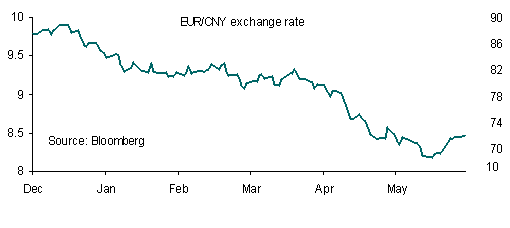
Further EUR/USD gains will be harder to come by, with an immediate obstacle around 1.2500. Perhaps another reason for China to be cautious about the pace of CNY appreciation is the likelihood of further EUR weakness and the impact that this would have on China’s trade with Europe. As it is EUR/CNY has already dropped by over 13% so far this year and China will not want to enact measures that will accelerate the pace of the move in the currency pair.

Euro Rally To Fade

It is not an easy time to forecast currencies. Just as many forecasters fought for the accolade of being the most bearish on the EUR and many others were forced to capitulate or risk falling behind the curve, EUR/USD has started to perk up. Similarly, commodity currencies and many emerging market currencies have bounced.

Perhaps the explanation of these moves is merely position adjustments as traders and investors square positions as they keep one eye on the World Cup or maybe its just fatigue after weeks of selling pressure. Either way, the fact that speculative USD market positioning is at a very high level, suggests there is plenty of scope to take profits on long USD positions.

There are various reasons to expect the calm to give way to renewed tensions, however. Public opposition to austerity plans in Europe, added to the prospects for slowing growth as the plans are implemented, in addition to banking sector concerns, suggest that the outlook for the EUR remains downbeat. These factors also point to the prospects of risk aversion rising over the coming weeks, reversing the recent rally in risk currencies.

Further out, the EUR’s travails will not be over quickly and in the wake of the implementation of austerity plans the EUR will struggle from the impact of relatively slower growth in the eurozone compared to the US and other countries. The EUR will continue to remain under pressure even as risk appetite improves and many risk currencies appreciate.

The interruption of risk as an FX determinant is likely to fade towards the end of the year and investors will then go back to differentiating on the basis of relative growth and interest rate dynamics, which will play well for the USD as US growth strengthens.

Relative growth differentials will also bode well for commodity currencies and there will be scope for plenty of upside in the AUD and NZD as growth strengthens. Both countries have benefited from firm demand in Asia and China in particular and this source of support will likely continue to be beneficial.

Funding currencies including JPY and CHF will likely weaken this year against the USD based on the likely improvement in risk appetite later this year. The outlook for the JPY will be particularly interesting in the wake of the change in Prime Minister in Japan, especially given the new PM’s preference for a weaker JPY and reflationary policies. USD/JPY will likely reach 100 by the end of the year.

GBP should not be seen in the same context as the EUR. Although the UK has got its own share of fiscal problems the new government appears to be moving quickly to mollify both investor and ratings agency concerns. The test will come with the reaction of the emergency budget on June 22nd but I suspect that the downside risk to GBP will be limited.

Unlike the EUR which is trading around “fair value”, GBP is highly undervalued. Arguably past GBP weakness puts the UK economy on a stronger recovery footing. Moreover, problems that Europe will face in implementing multi country austerity plans and widening growth divergence, will not be repeated in the UK. Overall, there is likely to be significant outperformance of GBP versus EUR over coming months

Singapore revalues, Asian currencies jump

The positive tone to risk appetite is keeping the USD on the back foot and for once FX attention has turned away from events in Greece. Before elaborating further and staying with Greece, it’s worth highlighting that the outcome of Greece’s note auction was reasonably solid, with more debt than anticipated being sold. However, the cost of borrowing for Greece rose compared to the previous auction in January, which means that the Greece will still suffer higher funding costs to roll over debt.

The positive reception to the debt offering was not particularly surprising given that it followed so closely after the EU/IMF loan package announcement but it is difficult to see sentiment for Greece and the EUR for that matter, getting much of a lift. The main positive for the EUR is the fact that market positioning remains very short but EUR/USD is likely to struggle to make much headway above technical resistance around 1.3653.

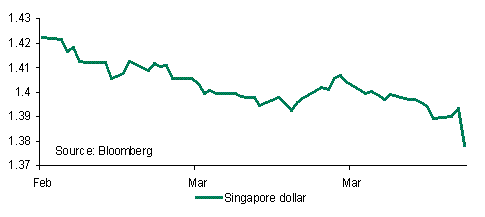
More interestingly Asian central banks are continuing on the track towards fighting rising inflation pressure and Asian currencies, in particular the SGD, were boosted by the Monetary Authority of Singapore (MAS) decision to revalue its currency. Singapore has moved back to a policy of a “modest and gradual appreciation” of the SGD from a policy of zero appreciation, which obviously implies openness to further FX appreciation in the weeks and months ahead.

The rationale for the decision was clear and as revealed in the strong first quarter Singapore GDP data which revealed a 13.1% annual rise. Stronger growth is fuelling growing inflationary concern and to combat this Singapore’s MAS will allow greater SGD appreciation. The reaction in other Asian currencies was also positive, with markets (quite rightly in my view) that other Asian central banks will be more tolerant of currency strength in their respective currencies.

Moreover, Singapore’s move was pre-emptive, perhaps with one eye on an imminent revaluation in China. The recent easing in tensions between the US and China has if anything increased the likelihood that China revalues its currency, the CNY, sooner rather than later, and most likely before the end of Q2 2010. Whatever the rationale, strengthening inflation pressure across the region, will mean a less FX interventionist stance in Asia, and likely stronger currencies over coming months.

FX Prospects for 2010

There can be no doubt that for the most part 2009 has been a year for risk trades, not withstanding the sell off into year end. The policy successes in preventing a systemic crisis and the massive flood of USD liquidity injected globally kept the USD under pressure for most of the year and the currency became a victim of this success. Risk appetite is likely to improve only gradually over coming months given the still significant obstacles to recovery in the months ahead.  This will coincide with the declining influence of risk on FX markets. 

2010 will not be as straightforward and whilst risk will dominate early in the year interest rate differentials will gain influence in driving currencies as the year progresses. The problem for the USD is that market expectations for the timing of the beginning of US interest rate hikes is likely to prove premature as the Fed is set to hold off until at least late 2010/early 2011 before raising interest rates. The liquidity tap will stay open for some time, and risk trades will still find further support at least in the early part of 2010, whilst the USD will come under renewed pressure.    

The ECB will be much quicker in closing its liquidity tap than the Fed and arguably an earlier reduction in credit easing and interest rate hikes compared to the Fed would favour a stronger EUR.  However, the EUR is already very overvalued and a relatively aggressive ECB policy is unwarranted. Consequently rather than benefiting from more favourable relative interest rate expectations, the EUR could be punished and the EUR is set to decline over much of 2010 following a brief rally in Q1 2010, with EUR/USD set to fall over the year. 

Japan is moving in the opposite direction to the ECB.  FX intervention is firmly on the table though the risk is limited unless USD/JPY drops back to around 85.00. Even at current levels the JPY is overvalued but for it to resume weakness it will need to regain the role of funding currency of choice, a title that the USD has assumed. Efforts by the BoJ to combat deflation will likely help result in fuelling some depreciation of the JPY and it is likely to be the worst performing major currency over 2010, with a move back up to around USD/JPY in prospect.

The issue of global rebalancing will need to involve currencies but the currency adjustments necessary will not be forthcoming in 2010.  USD weakness early in the year will be mostly exhibited against freely floating major currencies which will bear the brunt of USD weakness.  However, the bulk of adjustment is needed in Asian currencies and there is little sign that central banks in the region will allow a rapid appreciation.  China holds the key and a gradual appreciation in the CNY over 2010 suggests little incentive to allow other Asian currencies to appreciate strongly. 

So in many ways 2010 will be one of two halves for currency markets and this has the potential to reignite some volatility in FX markets.  High beta risk trades including the AUD, NZD, NOK and many emerging currencies will see further upside in H1 as the USD falls further.  Gains in risk currencies will look even more impressive when played against the JPY and/or CHF than vs. USD given that they will succumb to growing pressure in the months ahead as their usage as funding currencies increases.

Ongoing rate hikes in Australia and Norway and the likely beginning of the process to raise rates in New Zealand early next year will mean that these currencies will also have the additional support of yield to drive them higher unlike the JPY.  There is a limit to most things however, and eventually the USD will recover some of its lost ground against risk currencies, as it undergoes a cyclical recovery over H2 2010.