Greek Confusion, India Tightening

It is highly interesting that markets could take fright from a rate hike in India but this appears to be what has happened. India’s surprise 25bps rate hike has provoked another bout of risk aversion whilst the lack of any concrete agreement on a framework for a Greek bail out dealt a further blow to confidence. FX tensions between the US and China have not helped, with China threatening retaliation to any US move to name the country as a currency manipulator in the mid April US Treasury report.

Should we really be worried by a rate hike in India or China? Whilst the India rate move reflects the fact that emerging market central banks are moving far more aggressively to raise rates than their G7 counterparts, global fears that India’s move will dampen recovery prospects are unfounded. Monetary tightening in India and China and other economies is taking place against the backdrop of economic strength not weakness.

As such the global impact on growth should be limited. Rising inflation pressure in Asia is reflection of the much quicker economic recovery, relatively low rates and undervalued currencies in the region. Not only will central banks in Asia have to raise interest rates but will also have to allow further currency appreciation.

There is still plenty of confusion about a bail out for Greece ahead of the 25-26th March EU summit. German Chancellor Merkel dampened expectations of a bailout by stating that it was not even on the agenda for the summit. In contrast, EU President Barroso has pushed EU members to agree on an explicit stand-by aid agreement for Greece as soon as possible.

There is also disagreement about whether there should be any IMF involvement, with Germany favouring some help from the Fund whilst France opposes it. Meanwhile, the Greek Prime Minister has reportedly given an ultimatum that should no aid plan be forthcoming at the EU summit, Greece will turn to the IMF for assistance.

All of this suggests more downside for EUR/USD, with a test of support around 1.3422 looming. In the event that the EU summit offers good news for Greece, EUR/USD sentiment could turn quickly so a degree of caution is warranted. Speculative sentiment for the EUR has improved according to the latest CFTC Commitment of Traders (IMM) data for the week to 16th March, with net short EUR positions at their lowest since the beginning of February. Nonetheless, the short covering seen over the past week could come to an abrupt end should there be no aid package for Greece.

The most volatile currency over the past week was GBP/USD and after hitting a high of around 1.5382 it has slid all the way back to around the 1.5000 level. Much of this was related to the gyrations in EUR/USD but GBP took on a life of its own towards the end of the week and has not been helped by comments by BoE MPC member Sentence who highlighted the risk of a “double-dip” recession in the UK.

GBP is highly undervalued and market positioning is close to a record low but a sustainable recovery looks unachievable at present. Attention this week will centre on the 2010 UK Budget announcement and markets will scrutinise the details of how the government plans to cut the burgeoning budget deficit. Failure to restore some credibility to the government’s plans will dent GBP sentiment further and lead to a sharper decline against both the EUR and USD.
GBP bulls brave or crazy?

The UK Pound’s (GBP) performance over recent months has been dismal. The currency has failed to show any real sign of recovery, having fallen to and below the psychologically important level of 1.50 against the USD. A number of factors including fiscal/debt concerns, political worries, and uncertainties about whether the Bank of England will step up asset purchases, have accumulated to turn even the most ardent GBP bulls into bears.

The outcome of the upcoming UK general election widely expected on May 6, remains a major weight on GBP sentiment. Until the outcome is clear or unless one or other party develops a clear lead in the polls, it is difficult o see GBP sustain any durable recovery. In the near term GBP/USD is vulnerable to a test of its 2010 low around 1.4780 and then towards 1.44. The risk to this is that the market is very short GBP which could result in a sharp bounce in GBP in the wake of any good news. However, a rally in GBP will only result in fresh sellers.

Ahead of the elections will be the budget and this will be closely scrutinized for steps to reduce the size of the burgeoning fiscal deficit. Whichever party comes into power will need to convince markets that a credible and timely plan exists to reduce the size of the deficit and prevent a sovereign ratings downgrade. If not, GBP could see itself under much more pressure. In this respect it’s worth noting the Fitch ratings warning that the UK sovereign credit profile has deteriorated.

It’s not all bad for GBP, however. By some measures it’s now the most undervalued major currency, opening up the possibility of a sharper bounce back over the medium term. Moreover, UK debt markets are already trading as if a ratings downgrade has taken place, whilst arguably GBP has also priced in a lot of negative news already, as reflected in the very negative speculative positioning in the currency.

The economic news is also not as bad as the headlines might suggest and although recent housing data has been a bit mixed, both consumer spending and the housing market have held up reasonably well. Bearing all this in mind GBP is set to recover over the medium term, but it would be very brave to buy the currency any time soon, at least until UK elections are out of the way.

Disappointments Galore

Well the calm at the beginning of the week did not last very long.  Although the overnight price action can hardly be labelled as panic given both FX and equity volatility remain relatively well behaved, there is no doubt that worries are creeping back into the market psyche.  It seems that markets are once again trading on each piece of news and for the most part the news is not encouraging.  

A plethora of disappointments will set a negative tone for markets today.   Risk has come off the table in the wake of the worse than expected February German IFO business confidence survey and US Conference Board consumer confidence.   Cautious comments by Bank of England Governor King in which he kept the door open to further quantitative easing and a ratings downgrade of four of the largest Greek banks has added to the damage.

The German IFO was likely dealt a temporary blow by severe weather conditions.   The 10.5 point fall in US consumer confidence from an already relatively low level had no mitigating factors however, and revealed a deterioration in job market conditions, which combined with renewed weakness in jobless claims, does not bode well for next week’s US payrolls report, pointing to a decline of around 40k in February payrolls.

Overall, the market mood has darkened and there is little to turn sentiment around in the near term.  In prospect of likely weak reading for US payrolls next week and continuing worries about European fiscal/debt problems any improvement in risk appetite is likely to be limited.  This will help bond markets, the USD and JPY but most risk trades will face pressure. 

It is still worth being selective in FX markets.  The EUR remains the weak link and is set to struggle to make any headway, with upside likely to be restricted to resistance around 1.3747.  Similarly GBP is set to struggle in the wake of King’s comments as well as ongoing economic and deficit concerns, with GBP/USD vulnerable to a drop to around 1.5293.   In contrast, Asian currencies and commodity currencies look far more resilient.

Fed discount rate move boosts dollar

The Fed’s move to hike the discount rate by 25bps has set the cat amongst the pigeons.   Although the move was signalled in the FOMC minutes yesterday a hike in the discount rate was not expected to happen so soon.  The Fed sees the modifications which also include reducing the typical maximum maturity for primary credit loans to overnight, as technical adjustments, rather than a signal of any change in monetary policy. 

Nonetheless, the market reaction has been sharp, with the USD strengthening across the board and short term interest rate and stock futures falling.  Although the reaction looks overdone and will likely be followed by some consolidation over the short term, the move will be interpreted as the beginning of a move towards monetary policy normalisation despite the Fed’s insistence that this is not the case.  The firm USD tone is set to remain in place for now but the bulk of the strengthening has likely already occurred following the announcement.  

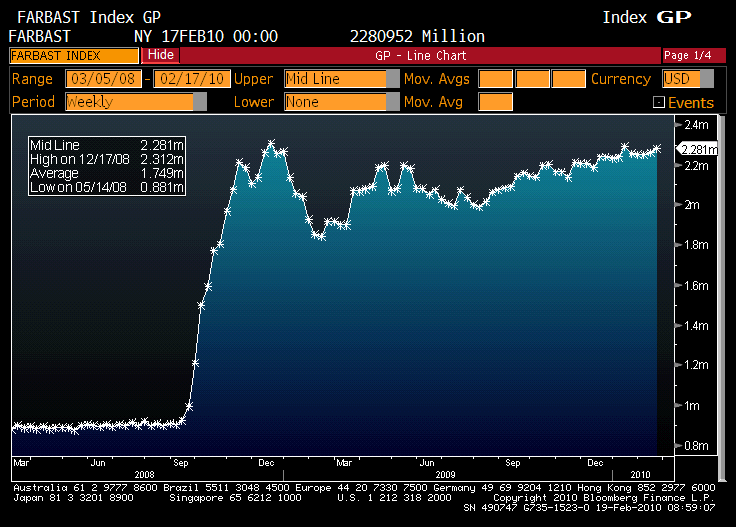
The Fed’s desire to reduce the size of its burgeoning balance sheet, which at $2.3 trillion is roughly around three times its size before the financial crisis began, will imply further measures to reduce USD liquidity over the coming months.   A withdrawal of liquidity could have positive implications for the USD but given that the Fed is still some months away from hiking the Fed Funds rate, interest rate differentials will not turn positive for the USD for a while yet. 

The move has however, changed the complexity of the FX market and likely shifted currencies into new lower ranges against the USD.  There were plenty of reasons to sell EUR even before the Fed move and the discount rate hike inflicted further damage on EUR/USD which dropped below the key psychological level of 1.35.  GBP and commodity currencies were also big losers, with GBP/USD below 1.55.  Key technical support levels to watch will be EUR/USD 1.3422, GBP/USD 1.5374 and AUD/USD 0.884.

US Federal Reserve Balance Sheet ($trillion)

What To Watch This Week

As usual the G7 meeting will leave markets with little to chew on. G7 officials maintained their commitment to stimulus measures and timely exit strategies but there was little of note for FX markets aside from the usual comments about wanting to avoid excess FX volatility. There was certainly know step up in pressure on China to strengthen though a report prepared for the meeting did push for countries with inflexible currencies to make adjustments. Meanwhile US officials mouthed the usual “strong dollar” mantra.

Where does this leave markets this week? Well I must admit my bullish view on risk currencies is clearly suffering after a positive start to the year. The pullback in high beta currencies (those with the highest sensitivity to risk aversion) has been dramatic. I have highlighted many of the factors weighing on sentiment in previous posts and whilst I still think the US dollar will find itself under renewed pressure over coming months the current environment remains conducive to more USD and JPY buying and selling of currencies such as the AUD, NZD, CAD, GBP, NOK, SEK, ZAR etc.

Ironically the US and Japan have arguably more severe deficit/debt concerns than some of the European countries under pressure but as most of Japan’s debt is held domestically there is little worry of a collapse in JGBs. Unlike Japan foreign investors hold over half of US debt but are not yet losing confidence with US Treasuries though this may not last unless there is some tangible sign that the burgeoning US budget deficit is being reduced. For now, attention remains firmly focussed on Greece, Spain, Portugal and to a lesser extent Italy.

Like the G7 meeting the US January jobs report released at the end of last week will give little direction for markets. Although the 20k drop in payrolls and revisions to past months were slightly disappointing the surprise drop in the unemployment rate was better news. This week’s data highlights include the January US retail sales report and December trade balance. The sales data is likely to help allay some concerns about faltering economic recovery, with retail sales forecast to rise over the month despite a likely pull back in autos spending.

How will this play out for currencies this week? Overall, the risk off tone is set to continue though the moves are looking increasingly stretched. The USD, JPY and CHF will remain on the front foot whilst risk currencies will remain under pressure. The EUR is set to continue to struggle against the background of eurozone deficit concerns and after its dive through 1.40 last week 1.35 now looms large. Meanwhile, the AUD may also struggle following the recent reassessment of interest rate expectations after the recent Reserve Bank of Australia (RBA) meeting in which interest rates were left unchanged.

UK markets will focus on the Quarterly Inflation Report from the Bank of England though the political situation may hold some interesting implications for GBP if polls continue to show that the gap between the governing Labour party and Conservative opposition continues to narrow. Prospects of a hung parliament will hardly hold any positive implications for GBP, a prospect which could limit any potential for GBP to recover ahead of May elections. The drop below 1.60 for Cable (GBP/USD) could extend further, especially as the BoE has kept the door open to further asset purchases if needed.