Euro support unwinding

The USD is set to end the year in firm form aided by rising US bond yields. Yesterday’s data supported this trend. The Empire manufacturing survey beat expectations rebounding nearly 22 points in December and industrial production rose 0.4% in November although there was a downward revision to the previous month. This was against the background of soft inflation, with headline and core CPI rising 0.1%, indicating that the Fed will remain committed to its $600 billion program of asset purchases.

EUR/USD dropped below support around 1.3280, weighed down by various pieces of negative news. Moodys downgrade of Spain’s credit ratings outlook dented sentiment but the bigger sell off in EUR followed the move in US bond yields. The prospect of EUR recovery over the short term looks limited. The issue of finding agreement on a permanent debt resolution fund continues to fuel uncertainty and will likely come to a head at the EU summit starting today.

Added to this Ireland’s main opposition party which will likely play a part in forming a new government early next year wants some of the debt burden shared with senior bank debt holders. The good news in Europe was few and far between but at least Ireland’s parliament backed the EU/IMF bailout for the country. Of course the backing could be derailed following elections in January. Perhaps the most surprising aspect of the move in EUR is that it’s not weaker. The next support level for EUR/USD is around 1.3160.

The divergence between the US and Europe on policy is stark, with loose fiscal and monetary policy in the US providing a significant prop to the US economy, whilst the much tighter fiscal stance and less loose monetary policy threatens to result in more pressure on eurozone growth especially against the background of an overvalued EUR. This divergence will manifest itself next year in the form of US growth outperformance and stronger USD vs. EUR.

The resilience of the UK consumer continues to surprise, with the CBI distributive trades survey coming in strong and rising further to +56 in December. The only problem with the survey data is that is has not tracked official data. November retail sales data today will give further clues to the strength of spending heading into Christmas. More worryingly from the Bank of England’s perspective is the fact that inflation continues to rise despite assurances that the increase in inflation is temporary. At the least the likelihood of more quantitative easing QE from the BoE has evaporated though it is still a long way off before interest rates are hiked. In the meantime GBP continues to underperform both EUR and USD though GBP/USD will find strong support around 1.5512.

Upward pressure on US yields and the USD us unlikely be derailed US data releases today. Housing starts are set to bounce back in November, with a 6% gain expected, whilst the trend in jobless claims will likely continue to move lower. The Philly Fed manufacturing survey is set to lose a little momentum reversing some of November’s sharp gain but will still remain at a healthy level.
Currencies At Pivotal Levels

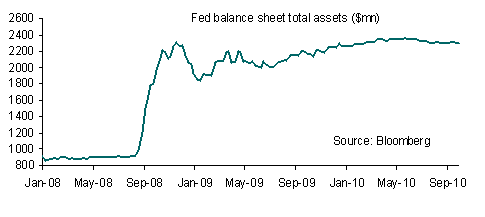
Ahead of today’s highly anticipated Fed FOMC meeting markets are holding their breath to determine exactly what the Fed will deliver. The consensus view is for the Fed to announce a programme of $500 billion in asset purchases spread over a period of 6-months. The reaction in currency markets will depend on the risks around this figure. Should the Fed deliver a bigger outcome, say in the region of $1 trillion or above, the US dollar will likely come under renewed pressure. However, a more cautious amount of asset purchases will be US dollar positive.

It has to be noted that the Fed will likely keep its options open and keep the program open ended depending on the evolution of economic data which it will use to calibrate its asset purchases. The USD will likely trade with a soft tone ahead of the Fed outcome, but with so much in the price, it may be wise to be wary of a sell on rumour, buy on fact outcome.

Whatever the outcome many currencies are at pivotal levels against the USD at present, with AUD/USD flirting around parity following yesterday’s surprise Australian rate hike, EUR/USD holding above 1.4000, GBP/USD resuming gains above 1.600 despite a knock back from weaker than forecast construction data, whilst USD/JPY continues to edge towards 80.00. Also, both AUD and CAD are trading close to parity with the USD. The Fed decision will be instrumental in determining whether the USD continues to remain on the weaker side of these important levels.

Going into the FOMC meeting the USD has remained under pressure especially against Asian currencies as noted by the renewed appreciation in the ADXY (a weighted index of Asian currencies) against the USD this week. Although it appears that the central banks in Asia have the green light to intervene at will following the recent G20 meeting the strength of capital inflows into the region is proving to be a growing headache for policy makers. One option is implementing measures to restrict “hot money” inflows but so far no central bank in the region has shown a willingness to implement measures that are deemed as particularly aggressive.

There has been some concern that Asia’s export momentum was beginning to fade as revealed in September exports and purchasing managers index (PMI) data in the region and this in turn could have acted as a disincentive to inflows of capital, resulting in renewed Asian currency weakness. The jury is still out on this front but its worth noting that Korean exports in October reversed a large part of the decline seen over previous months. Moreover, the export orders component of Korea’s PMI remained firm suggesting that exports will resume their recovery.

Nonetheless, manufacturing PMIs have registered some decline in October in much of Asia suggesting some loss of momentum, with weaker US and European growth likely to impact negatively. However, China’s robust PMI, suggests that this source of support for Asian trade will remain solid. Similarly a rise in India’s manufacturing PMI in October driven largely by domestic demand, highlights the resilience of its economy although with inflation peaking its unlikely that the Reserve Bank of India (RBI) will follow its rate hike on Tuesday with further tightening too quickly.

Temporary relief for US Dollar

Downbeat US economic news in the form of a widening US trade deficit, increase in jobless claims and bigger than expected increase in top line PPI inflation contrasted with upbeat earnings from Google. Google shares surged over 9% in after hours trading but US data tarnished the risk on mood of markets, leaving commodity prices and equities lower and the USD firmer. Higher US Treasury yields, especially in the longer end following a poor 30 year auction, helped the USD to push higher.

The USD’s trend is undoubtedly lower but profit taking may be the order of the day ahead of a speech by Fed Chairman Bernanke on monetary policy later today and the release of the highly anticipated US Treasury Report in which China may be named as a currency manipulator. A speech by the Minneapolis Fed’s Kocherlatoka (non voter) this morning sounded downbeat, even suggesting that “Fed asset purchases may have a muted effect”. Despite such comments the Fed appears likely to embark on QE2 at its 3 November meeting.

Today is also a key data for US data releases with September data on US retail sales, and CPI and October data on Michigan confidence and Empire manufacturing scheduled for release. Retail sales are likely to look reasonable, with headline sales expected to rise 0.5% and ex-autos sales expected up 0.4%. The gauges of both manufacturing and consumer confidence are also likely to show some recovery whilst inflation pressures will remain benign. Given the uncertainty about the magnitude of QE the Fed will undertake in November, the CPI data will have added importance.

The US trade will likely have resulted in an intensification of expectations that China will be labelled as a currency manipulator in the US Treasury report later today. The August trade deficit with China widened $28.04 billion, the largest on record. At the least it will give further ammunition to the US Congress who are spoiling for a fight ahead of mid-term congressional elections, whilst heightening tensions ahead of the November G20 meeting.

Indeed currency frictions continue to increase although “currency war” seems to be an extreme label for it. Nonetheless, Singapore’s move yesterday to widen the SGD band highlighted the pressure that many central banks in the region are coming under to combat local currency strength. Singapore’s move may be a monetary tightening but it is also a tacit recognition of the costs of intervening to weaken or at least limit the strength of currencies in the region. To have maintained the previous band would have required ongoing and aggressive FX intervention which has its own costs in terms of sterilization.

This problem will remain as long as the USD remains weak and this in turn will depend on US QE policy and bond yields. A lot of negativity is priced into the USD and market positioning has become quite extreme suggesting that it will not all be a downhill bet for the currency. Many currencies breached or came close to testing key psychological and technical levels yesterday, with EUR/USD breaching 1.4000, GBP/USD breaking 1.6000, USD/CAD breaking below parity and AUD/USD coming close to testing parity. Some reversal is likely today, but any relief for the USD is likely to prove temporary.

USD pressure, EUR resilience, GBP whipsawed

Speculation the Fed will begin a new program of asset purchases or QE2 as soon as November is intensifying. The weaker than expected reading for US consumer confidence in September released on Tuesday has only added to this expectation as sentiment continues to be hit by job market concerns. Against this background the USD remains under strong downward pressure, with little sign of any turnaround.

The prospects of further USD debasing as well as intervention in many countries to prevent their currencies from strengthening against the USD continues to power gold prices which hit a new record high having breezed through the $1300 per troy ounce mark. In the current environment it is hard to see gold prices turning much lower although there may be some risk of profit taking in the weeks ahead.

The EUR remains a key beneficiary of USD weakness but this currency has problems of its own to contend with. Indeed, peripheral debt concerns, especially with regard to Ireland and to a lesser extent Portugal have increased, with borrowing costs rising as the yield on their debt widens against core eurozone debt. The stronger EUR will only make it harder for these countries to achieve any sort of recovery and could also damage the stronger exporting countries of Northern Europe led by Germany.

So far however, the EUR has managed to show some impressive resilience to renewed peripheral country sovereign debt concerns including comments by S&P about the high costs of rescuing an Irish Bank. Perhaps the knowledge that there is a still a huge bailout fund from the EU and IMF available if needed and also the prospect that the ECB will increase its buying of eurozone debt, has provided a buffer for the EUR.

At some point the ECB may be forced to join the battle in at least attempting to talk its currency lower but at this stage the central bank is showing no inclination to either talk down the currency or physically intervene to weaken the EUR. In the meantime, EUR/USD is likely to strengthen further despite the likely negative impact on European growth, with the currency likely to set its sights on an eventual break above 1.40.

One currency that may struggle in the wake of expectations of Fed QE2 is GBP. Uncertainty over whether the Bank of England will follow the Fed in implementing further quantitative easing could see GBP lag the gains in other currencies against the USD. Conflicting comments from MPC members Posen who noted that there may be a need for further QE in the UK to support the faltering economy were countered by Sentance who noted that there was no need for more QE. GBP/USD is likely be whipsawed as the debate continues and is set to lose further ground against the EUR.

The Week Ahead

As last week progressed there was a clear deterioration in sentiment as growth worries crept back into the market psyche. It all started well enough, with a positive reaction to China’s de-pegging of the CNY but the euphoria faded as it became evident that there was still plenty of two-way risk on the CNY. A change in Prime Minister in Australia, which fuelled hopes of a resolution to a controversial mining tax, and an austere budget in the UK, were also key events. However, sentiment took a hit as the Fed sounded more cautious on the US economy in its FOMC statement.

The US Congress finalised a major regulatory reform bill towards the end of the week and markets, especially financial stocks, reacted positively as the bill appeared to give some concessions to banks and was not as severe as feared. However, equity market momentum has clearly faded against the background of renewed growth concerns including sprouting evidence of a double-dip in the US housing market as well as fresh worries about the European banking sector. As if to demonstrate this US Q1 GDP was duly revised lower once again, to a 2.7% annualised rate of growth.

The US Independence Day holiday and World Cup football tournament will likely keep liquidity thin in the run up to month and half year end. However, there is still plenty to digest this week including the all important employment report and consumer confidence data in the US. In Europe economic sentiment gauges, purchasing managers indices and the flash CPI estimate will be in focus. Elsewhere, Japan’s Tankan survey and usual slate of month end Japanese releases, Switzerland’s KoF leading indicator and Australian retail sales will be of interest.

On balance, economic data this week is unlikely to relieve growth concerns, with Eurozone, US and UK consumer and manufacturing confidence indicators likely to post broad based declines due to a host of factors. The data will further indicate a slowing in growth momentum following Q2 2010, with forward looking surveys turning lower, albeit gradually. Whilst a double-dip scenario still seems unlikely there can be no doubt that austerity measures and the waning of fiscal stimulus measures are beginning to weigh on growth prospects even if there is still plenty of optimism for emerging market and particularly Asian growth prospects.

This suggests that Q3 could turn into a period of heightened uncertainty in which equity markets and risk assets will struggle to gain traction. In addition to growth worries, some tensions in money markets remain in place whilst banking sector concerns seem to be coming back to the fore, especially in Europe and these factors will prevent a sustained improvement in risk appetite from taking place over the coming quarter. Some more clarity may come from the results of European stress tests but much will depend on just how stressful the tests are.

In the near term, the main focus of attention will be on the US June jobs report released at the end of the week. Non-farm payrolls are set to record a decline over the month due to a reversal in census hiring, with a consensus expectation of a 110k fall. Private sector hiring is likely to record a positive reading, however, suggesting some improvement in the underlying trend in jobs growth, albeit a very gradual one. Downside risks to consensus suggest plenty of scope for disappointment.

Interestingly, weaker US data of late, has managed to restrain the USD, suggesting that cyclical factors and not just risk aversion are beginning to play into FX movements. Notably the USD was on the back foot against a number of currencies as last week progressed. Even the beleaguered EUR managed to end the week well off its weekly low and close to where it closed the previous week whilst risk currencies such as the AUD and NZD as well as GBP also posted firm performances.

Perhaps some reversal of the optimism towards US recovery prospects give USD bulls some cause for concern, but pressure is likely to prove temporary, especially given that the US economy is still on course to outperform many other major economies. Over the short-term, especially ahead of the US jobs report markets are set to remain cautious with range trading likely to dominate in the week ahead, suggesting that EUR/USD is unlikely to breach the key level of 1.2500. GBP performance has been robust but even this currency is likely to make much headway above GBP/USD 1.5000, where there are likely to be plenty of sellers.