Disappointments Galore

Well the calm at the beginning of the week did not last very long.  Although the overnight price action can hardly be labelled as panic given both FX and equity volatility remain relatively well behaved, there is no doubt that worries are creeping back into the market psyche.  It seems that markets are once again trading on each piece of news and for the most part the news is not encouraging.  

A plethora of disappointments will set a negative tone for markets today.   Risk has come off the table in the wake of the worse than expected February German IFO business confidence survey and US Conference Board consumer confidence.   Cautious comments by Bank of England Governor King in which he kept the door open to further quantitative easing and a ratings downgrade of four of the largest Greek banks has added to the damage.

The German IFO was likely dealt a temporary blow by severe weather conditions.   The 10.5 point fall in US consumer confidence from an already relatively low level had no mitigating factors however, and revealed a deterioration in job market conditions, which combined with renewed weakness in jobless claims, does not bode well for next week’s US payrolls report, pointing to a decline of around 40k in February payrolls.

Overall, the market mood has darkened and there is little to turn sentiment around in the near term.  In prospect of likely weak reading for US payrolls next week and continuing worries about European fiscal/debt problems any improvement in risk appetite is likely to be limited.  This will help bond markets, the USD and JPY but most risk trades will face pressure. 

It is still worth being selective in FX markets.  The EUR remains the weak link and is set to struggle to make any headway, with upside likely to be restricted to resistance around 1.3747.  Similarly GBP is set to struggle in the wake of King’s comments as well as ongoing economic and deficit concerns, with GBP/USD vulnerable to a drop to around 1.5293.   In contrast, Asian currencies and commodity currencies look far more resilient.
Fed discount rate move boosts dollar

The Fed’s move to hike the discount rate by 25bps has set the cat amongst the pigeons.   Although the move was signalled in the FOMC minutes yesterday a hike in the discount rate was not expected to happen so soon.  The Fed sees the modifications which also include reducing the typical maximum maturity for primary credit loans to overnight, as technical adjustments, rather than a signal of any change in monetary policy. 

Nonetheless, the market reaction has been sharp, with the USD strengthening across the board and short term interest rate and stock futures falling.  Although the reaction looks overdone and will likely be followed by some consolidation over the short term, the move will be interpreted as the beginning of a move towards monetary policy normalisation despite the Fed’s insistence that this is not the case.  The firm USD tone is set to remain in place for now but the bulk of the strengthening has likely already occurred following the announcement.  

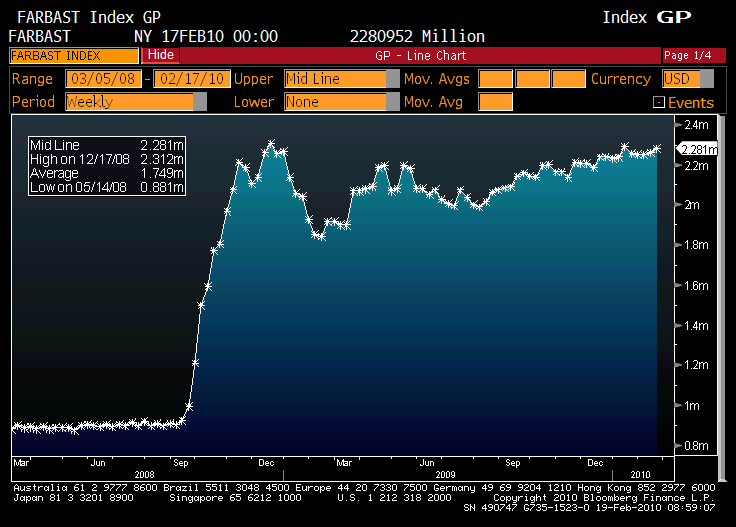
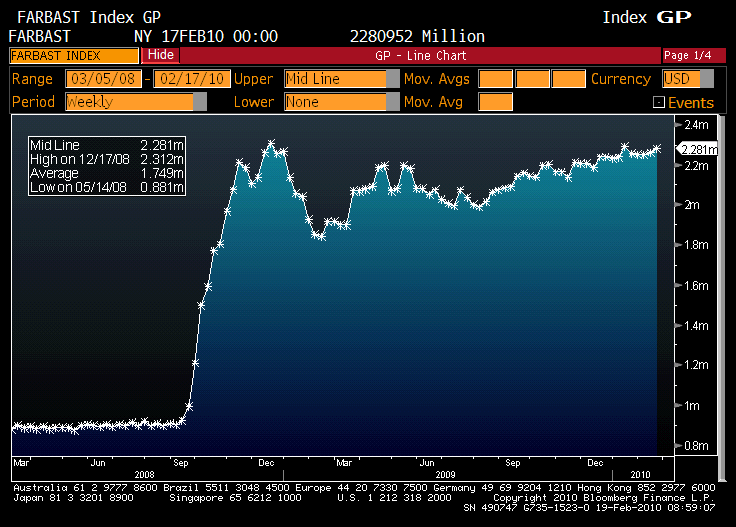
The Fed’s desire to reduce the size of its burgeoning balance sheet, which at $2.3 trillion is roughly around three times its size before the financial crisis began, will imply further measures to reduce USD liquidity over the coming months.   A withdrawal of liquidity could have positive implications for the USD but given that the Fed is still some months away from hiking the Fed Funds rate, interest rate differentials will not turn positive for the USD for a while yet. 

The move has however, changed the complexity of the FX market and likely shifted currencies into new lower ranges against the USD.  There were plenty of reasons to sell EUR even before the Fed move and the discount rate hike inflicted further damage on EUR/USD which dropped below the key psychological level of 1.35.  GBP and commodity currencies were also big losers, with GBP/USD below 1.55.  Key technical support levels to watch will be EUR/USD 1.3422, GBP/USD 1.5374 and AUD/USD 0.884.

US Federal Reserve Balance Sheet ($trillion)

Renewed caution

Risk appetite is struggling to make any headway, with equities losing ground overnight. The positive impact on markets and adjustment to growth expectations following the US jobs report has given way to renewed concerns. Caution increased as Fed Chairman Bernanke introduced a dose of reality to markets talking about “formidable headwinds” to growth. As a result, bonds gained some lost ground and markets pared back expectations of interest rate hikes, leaving the USD vulnerable.

Eurozone risk factors continue to dampen market enthusiasm too, with ECB President Trichet warning of further bank writedowns and S&P downgrading the outlook for Greece and Portugal. The release of German factory orders data revealing a sharp 2.1% fall in October fed into concerns and played against strengthening recovery hopes in the region. EUR/USD failed to close below 1.4820 suggesting some alleviation of downside pressure. FX markets are likely eye stocks for further direction, with various EUR negative specific factors set to limit the upside.

The delayed release of additional stimulus measures in Japan will be the main focus of attention in Japanese markets assuming that an agreement is reached within the coalition. In the meantime markets will digest news that the current account surplus narrowed in October but was still up 51.4% from a year earlier. Additionally loan growth continued to slow, for the 11th straight month in November, adding further evidence that the injections of liquidity into banks are not finding their way into the economy.

GBP has come under growing pressure over recent days and bulls will be disappointed by the BRC retail sales data. The 1.8% YoY rise in like-for-like sales according will come as another disappointment for GBP. The gain was the slowest since August and below forecasts and as noted by the BRC looks even weaker when considering that the year ago figure was very weak. The sales data may fuel concerns about the recovery in consumer spending, especially going into the all important Christmas season. Attention will turn to the release of November Halifax house price data and October industrial production data later today and the pre-budget report tomorrow. GBP/USD looks likely to track EUR/USD for now and looks supported above 1.6390.

Although the USD has slipped as markets pare back expectations of rate hikes, the currency appears to be in a win-win situation and will likely see limited downside as risk aversion creeps back. Lingering concerns about Dubai as well as short covering towards year as well as other factors pushing risk aversion higher will likely see the USD retaining some support into the end of the week ahead of the US retail sales and Michigan confidence data

Buffer for risk trades

Firmer data, most recently in the form of the stronger than expected US consumer confidence and dovish Fed comments as reiterated in the Fed FOMC minutes will provide a buffer for risk trades, supporting the USDs role as the prime funding currency over coming weeks.  Nonetheless, any improvement in sentiment will have to push against the weight of position adjustment into year-end as investors book profits on risk trades.  The net effect could be an increase in volatility especially in thinning liquidity expected in the wake of holidays in Japan and the Thanksgiving holiday in the US.

This could make it difficult for many asset markets to sustain key psychological and technical levels.  Whether the S&P 500 can hold gains above 1100 could prove significant as could EUR/USD’s ability to hold onto gains above 1.50.  The expiry of last week’s EUR/USD 1.48/1.51 option may provoke a move out of its range but there seems to be little appetite for a sustained break above the 23rd October high around 1.5061.  Even so, an upside bias is more likely given the likely softer tone to the USD. EUR/USD looks well supported around 1.4865.

Position adjustment towards the end of the year has been particularly evident in FX markets.  For instance, the latest CFTC Commitment of Traders’ data revealed that speculative investors have sharply reduced net long EUR positions into last week whilst there was a significant degree of short covering of GBP positions.  It is worth noting however, that aggregate USD net short speculative positions actually increased, largely due to a sharp jump in net JPY positioning, suggesting that overall sentiment for the USD remains very negative.

It is difficult to see a strong reversal in USD sentiment into year-end and the Fed’s commitment to maintaining interest rates at a low-level for an “extended period” taken together with hints of extending asset purchase programmes suggests little support to the USD over the short-term unless there is a more significant increase in risk aversion and or profit taking/book closing into year-end.  It seems that the impact of improved risk appetite is winning for now, giving no respite to the USD.

EUR/USD takes a crack at 1.50, where now?

It seemed inevitable and finally after flirting with the 1.50 level, EUR/USD managed to break through although there seems to be little momentum in the move, with the currency pair dipping back below 1.50 in the Asian trading session. Contrary to expectations the break above 1.50 did not lead to a sharp stop loss driven move higher. 

Even the break through 1.50 only provoked a limited reaction in the FX options market where implied EUR/USD volatility only moved slightly higher. In fact despite the warnings by ECB President Trichet about “excessive currency volatility” FX options volatility for most currency pairs has been on a downward trajectory over the past few months, implying that the move in EUR/USD and the USD itself has been quite orderly. 

Trichet’s warning is more likely a veiled threat on the level of EUR/USD rather than its volatility, unless of course the ECB chief is seeing something that the FX options market is not. Assuming that EUR/USD closes above 1.50 this week it technically has plenty of open ground on the run up to the record high of 1.6038 hit in July 2008 but there will also be plenty of official resistance to limit its appreciation. Such resistance is limited to rhetoric but it will not be long before markets begin discussing the prospects of actual FX intervention.  

Perhaps the reason that EUR/USD did not move sharply higher following the break of 1.50 was the late sell off in US stocks on Wednesday which helped to fuel some USD short covering.  The USD index is holding just above the 75.00 level but it’s not a big stretch from here to move down to the March 2008 low around 70.698, with the overall tone of broad USD weakness remaining intact and ongoing. 

GBP was helped by relief that the minutes of the BoE meeting showed no inclination to increase the level of quantitative easing despite the ongoing debate within the MPC.   The minutes even sounded slightly upbeat about economic prospects. GBP/USD hit a high of 1.6638 in the wake of these developments due in large part to more short covering whilst EUR/GBP briefly dipped below 0.90.  GBP/USD may find it tough going to make much headway above 1.66 as has been the case over recent months, with strong resistance seen around 1.6661.