Euro resilient but for how long?

The resilience of the EUR to bad news has been impressive but is unlikely to persist. The recent negatives include 1) the rejection of the Portuguese government’s austerity plan and the increased likelihood of a bailout, 2) a likely delay in the decision on increasing the size and scope of the EFSF EU bailout fund, 3) a drop in Eurozone purchasing managers indices in March, 4) downgrades to Portugal’ sovereign credit ratings by Fitch last night and S&P and 5) Moodys downgrades of 30 Spanish banks. Despite all of this, and after hitting a low of around EUR/USD 1.4054, EUR has bounced back close to the 1.4200 level.

Further direction will come from the outcome of the EU leaders’ summit today and the March German IFO business confidence survey. For the former there is unlikely to be a decisive result, with the optimism following the informal March 11 leaders’ summit likely to give way to delay due to wrangling over details. For the latter, a slight moderation in the IFO is expected following February’s upside surprise. However, there is a bigger risk of a downside surprise following the softer than forecast March German manufacturing PMI released. Against this background, EUR/USD is likely to struggle to break resistance around 1.249.

In general FX markets look somewhat more stable and even the pressure on the USD appears to have abated slightly despite a much weaker than expected outcome for US February durable goods orders yesterday, which revealed a drop in both headline and ex-transportation orders. My composite FX volatility measure has dropped sharply over recent days, led by short term implied JPY volatility which has dropped close to pre-crisis levels. Lower volatility has also likely reduced the prospects of further FX intervention although USD/JPY 80 will continue to be well defended.

Lower volatility as also reflected in the sharp drop in the VIX index has corresponded with a general easing in risk aversion as both Middle East and Japan tensions have eased slightly. US data today are unlikely to offer much direction, with a slight upward revision to US Q4 GDP and an unchanged outcome for the final reading of Michigan consumer confidence expected.
Japan’s Earthquake Aftermath

The aftermath of the devastating earthquake and Tsunami in Japan will largely drive markets this week outweighing the ongoing tensions in the Middle East. Having been in Tokyo as the earthquake struck I can testify to the severity and shock impact of the earthquake. Aside from the terrible human cost the economic cost will be severe at least for the next few months before reconstruction efforts boost growth. An early estimate suggests around a 1% negative impact on GDP this year.

The government is expected to announce a spending package over coming weeks to help fund relief efforts but this will likely put additional strain on Japan’s precarious debt situation at a time when worries about the country’s fiscal health were already high. Nonetheless, there is around JPY 550 billion available from the Fiscal Year 2010 and FY 2011 budgets even before a supplementary budget is needed.

The initial negative JPY impact of the natural disaster gave way to strength in anticipation of expected repatriation flows by Japanese life insurance companies and other institutions as they liquidate assets abroad in order to pay for insurance payments in Japan. The bias to the JPY will likely continue to be upwards but trading will be choppy.

Many of the margin traders holding extreme long USD/JPY positions will likely reduce these positions in the weeks following the earthquake in order to fulfil JPY demand. This may be countered by some foreign selling of Japanese assets especially given that foreigners have accelerated Japanese asset purchases over recent weeks. Therefore, it’s not a straight forward bet to look for JPY strength.

If however, the JPY strengthens rapidly and threatens to drop well below the psychologically important level of 80 the spectre of FX intervention will loom large. Indeed, following the Kobe earthquake in 1995 the JPY strengthened sharply by around 18% but the USD was already in decline prior to the earthquake and USD/JPY was also being pressured lower by Barings Bank related liquidation.

Therefore, comparisons to 1995 should be taken with a pinch of salt. Nonetheless, Japanese authorities will be on guard for further upward JPY pressure. The immediate market focus will be on the Bank of Japan (BoJ) meeting today, with the BoJ announcing the addition of JPY 7 trillion in emergency liquidity support to help stabilise markets.

The Week Ahead

Housing and durable goods orders data will form the highlights of the US calendar this week. Speeches from several Fed speakers will also give some further guidance to the appetite for completing the Fed’s $600 billion in asset purchases. Overall it will be a slow start for FX markets with liquidity thinned by the Presidents Day holiday and as a result currencies are likely to remain in relatively tight ranges. The heavy tone of the USD seen last week is likely to persist over coming days given the absence of driving factors. Even the unrest in the Middle East has been unable to derail the improving trend in risk appetite, another factor dampening USD sentiment.

The EUR held up well last week recouping its early week losses to end on a firm note. The ability of the EUR to shake off various bits of bad news was impressive but whether it can continue to do so is debatable. Data releases are unlikely to provide much of a boost. Whilst eurozone business surveys set to remain at high levels, consistent with a rebound in Q1 GDP growth, further improvements are unlikely. The week kicks off with the February German IFO business confidence survey but at best this will reveal stable reading. The EUR may find some support from signs of higher and in Germany and an above consensus reading for M3 money supply growth though this is not usually a market mover. The data will likely feed nervousness about European Central Bank (ECB) tightening. Ireland could rock the boat however, with general elections likely to keep markets nervous about potential renegotiations of Ireland’s bailout terms.

Although deflationary pressures are easing in Japan there is a long way before the spectre of inflation will emerge. Nonetheless, the Bank of Japan (BoJ) revised up its growth outlook last week, suggesting that the likelihood of more aggressive measures to combat deflation is narrowing. A reminder of ongoing deflation will come with the release of January CPI data this week whilst trade data will be watched to determine what impact the strength of the JPY is having on exports. Both EUR/JPY and USD/JPY are close to the top of their recent ranges and the data are unlikely to provoke a break higher. USD/JPY will likely remain capped around 84.51 whilst EUR/JPY will find tough resistance around 114.02.

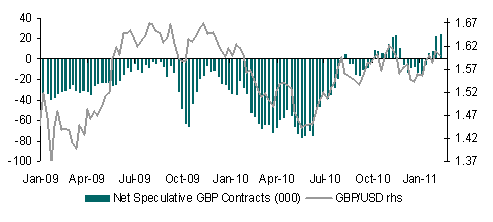
GBP performed even better than the EUR last week helped by an even more hawkish sounding than usual BoE Monetary Policy Committee (MPC) member Sentance and a letter from the BoE governor hinting at rate hikes. Even a relatively more slightly dovish Quarterly Inflation Report failed to halt GBP’s ascent. Further direction will come from the February MPC minutes in which we expect to see two dissenters, namely Sentence and Weale who likely voted for a rate hike. However, there is a risk that they may have been joined by at least one other, with speculation that MPC member Bean may have joined the dissenters. Such speculation alongside the jump in January UK retail sales at the end of last week will likely add to more upside potential for GBP, setting it up for another gain this week. Its upward momentum may however, be hampered by the large net long GBP positioning overhang.

FX Winners and Losers

There has been a sense of mean reversion in FX markets so far this year as some of last year’s winners have become losers. Namely NZD, CHF, JPY and AUD have all lost ground whilst EUR and GBP have gained ground. The odd one out is the SEK which has strengthened over 2010 and in 2011 versus USD. I expect this pattern to change and the likely winners over the next 3- months are NZD, AUD and CAD, with CHF and JPY the likely losers.

EUR held up reasonably well in the wake of slightly disappointing growth data, with eurozone GDP rising less than expected in Q4, and a smaller than expected gain in the February German ZEW investor confidence survey (economic sentiment component). My sense is that the net long EUR speculative position has already been pared back somewhat over recent days reducing the potential selling pressure on the currency in the near term.

Given that EUR/USD is one of the only major currency pairs being influenced by interest rate differentials, its direction will hinge more on policy expectations but in the near the announcement by the German Finance Minister this morning of a restructuring plan for WestLB may give the currency some support.

Perhaps one explanation for the stability of EUR/USD around the 1.3500 level is that US data was also disappointing yesterday. January retail sales rose less than forecast whilst revisions to back months suggest less momentum in Q4 consumer spending than previously envisaged. As with the eurozone data weather likely played a role in contributing to the outcome.

The net impact on currencies is that they are largely stuck within tight ranges. Further direction will come from the release of the Fed FOMC minutes for the January 26th meeting. The minutes may undermine the USD if a likely dovish slant continues to be expressed but given that the FOMC decision at that meeting to hold policy setting unchanged had no dissenters this should not come as a surprise.

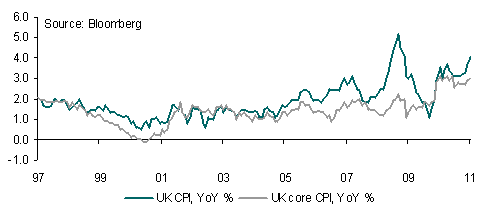
Whilst the battle between the USD and EUR ended in a stalemate GBP outperformed in the wake of the increase in UK January CPI inflation and in particular the letter from the BoE governor to the Chancellor keeping open the door to a rate hike. The Quarterly Inflation Report (QIR) today will be particularly important to determine whether the bounce in GBP is justified.

I remain hesitant to build on long GBP positions given the net long speculative overhang in the currency. The risks following yesterday’s jump in GBP are asymmetric, with a hawkish QIR likely to have less impact on the currency than the negative impact from a more dovish than expected report.

Econometer.org has been nominated in FXstreet.com’s Forex Best Awards 2011 in the “Best Fundamental Analysis” category. The survey is available at http://www.surveymonkey.com/s/fx_awards_2011

US Dollar Upside, Euro tensions

Following the famine that was last week this week will see a feast of data releases, which hopefully will give some clearer direction to currency markets. The key eurozone data focus for FX markets will be the German February ZEW survey and it should highlight that investor confidence is bouncing back smartly. This will be accompanied by data showing a slight acceleration in GDP in the eurozone in Q4 2010. Good news, but the reality is that the EUR is being driven more by peripheral bond tensions and relative yields.

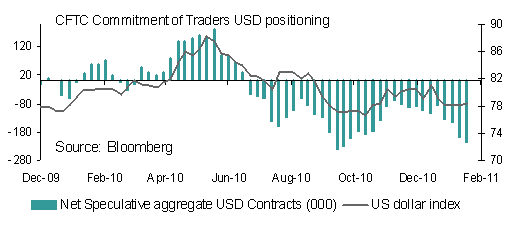
Although the EUR may get a brief lift from the news of the resignation of Egypt’s President Mubarak this will likely prove temporary. Given that tensions are beginning to creep higher EUR/USD may struggle to make any headway this week and will more likely slip below 1.3500 for a test of 1.3440 as sentiment sours. Even the usual sovereign interest may look a little more reluctant to provide support this week. The net long positioning overhang as reflected in the CFTC IMM data suggests some scope for a squaring in long positions, likely accelerating any downside pressure.

As usual data releases are failing to have a major impact on the JPY whilst interest rate / yield differentials suggest the JPY should be much weaker. One explanation for the stubbornly strong JPY is the strength of recent portfolio inflows to Japan, especially into its bond markets. This could reverse quickly and IMM positioning suggests that the potential for a shakeout of long positioning looms large, something that many Japanese margin traders are well positioned for according to TFX data. USD/JPY 84.51 will provide firm resistance to a move higher in the short-term.

GBP will be guided by the Bank of England Quarterly Inflation Report on Wednesday as well as the January CPI and retail sales data. The Report will reveal that inflation moderates over the medium term, even if short-term projections are shifted higher. Consequently, interest rate markets may even pare back overly hawkish expectations for UK rates, leaving GBP vulnerable. Nonetheless, markets maybe somewhat more sceptical or at least nervous in light of a likely increase in UK CPI, albeit mostly due to the increase in value added tax (VAT) at the turn of the year. Moreover, GBP may find some solace from a rebound in retail sales in January.

Overall, GBP/USD will take its cue from EUR/USD and the currency is vulnerable to a sustained drop below 1.6000 this week. The fact that GBP/USD IMM positioning is at its highest since September 2008 suggests a lot of scope for a sell-off. EUR/GBP looks like its consolidating in an even narrower range between 0.8400-0.8500.

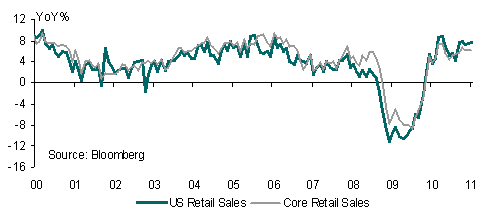
Another positive slate of US data releases and likely more pressure on US bond markets this week suggest that the USD will find further support, with the USD index likely to take a shot at the 79.00 level. Indeed a further improvement in both the Philly Fed and Empire manufacturing surveys is expected, providing more evidence of strengthening manufacturing momentum, will be borne out in the hard data, with a healthy gain in industrial output expected. Similarly a healthy reading for US retail sales will support the evidence that the US consumer is in full recovery mode.

The positive impact on the USD may be dampened however, by benign inflation readings this week, supporting the view that US policy rates will not be raised for a long time yet. This is likely to be echoed in the Fed FOMC minutes this week. Nonetheless, speculative positioning suggests plenty of scope for short USD covering, with the latest CFTC IMM report revealing the biggest net short position since October 2010.

Econometer.org has been nominated in FXstreet.com’s Forex Best Awards 2011 in the “Best Fundamental Analysis” category. The survey is available at http://www.surveymonkey.com/s/fx_awards_2011